By Philip Blenkinsop and Lili Bayer
BRUSSELS, Feb 13 (Reuters) - EU governments have long preached unity as the best response to U.S. and Chinese economic pressure, but are discovering they need urgently to boost Europe's competitiveness and that waiting for all 27 member states to agree may take too long.
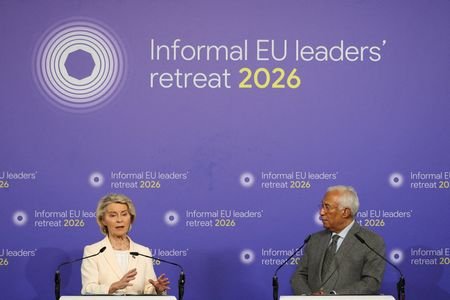
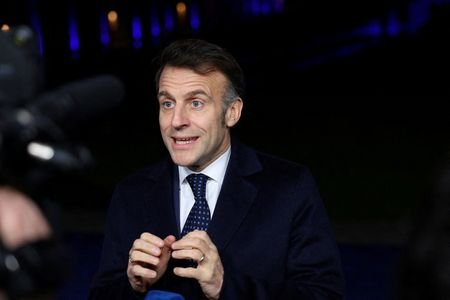
That was the clear message from an informal EU summit in Belgium on Thursday, where French President Emmanuel Macron and European Commission President Ursula von der Leyen gave the bloc until June to progress on a stalled union of financial markets.
The Capital Markets Union would allow the bloc to invest at scale at a level to match the United States, but vested interests in various countries and professional groups have held back any integration for more than a decade.
Now, unless there is sufficient progress by June, a smaller group of at least nine European Union members could press ahead in "enhanced cooperation" with the required steps and reforms, von der Leyen and Macron said.
"Often we move forward with the speed of the slowest and the enhanced cooperation avoids that," von der Leyen told reporters on Thursday. "The pressure and the sense of urgency is enormous, and that can move mountains."
The first movers could be the six leading economies who took part in talks last month hosted by Germany on a "Europe of two speeds" to break decision-making inertia and galvanise the EU economy. The other five countries were France, Italy, Spain, Poland and the Netherlands.
If EU leaders needed a reminder of threats to their economic model, data showed on Friday that the bloc's trade surplus shrank further in December as tariffs weighed on exports to the U.S. and rising Chinese imports crowded out domestic production.
MULTI-SPEED EU ALREADY EXISTS
Some of those not invited to the German-led group of six have expressed alarm.
"It is a good idea to threaten member states to agree on some files, but a very bad idea for the future of Europe," said one EU diplomat.
"Quite simply, it just flies in the face of the unity we like to parade in other areas," said another.
But a third diplomat said it was clear that plan A was to make progress with all 27 EU members and it was good to have a plan B.
"It's a hostile world out there. Prosperity is under threat if these bottlenecks continue," the third diplomat said, noting that Europe already operated at different speeds elsewhere.
Certain flagship EU projects, including the euro currency and the Schengen passport-free travel zone, allow groups of EU countries to move ahead, while others can join later.
The Schengen area, for example, does not include Cyprus or Ireland, but does include four non-EU countries. The European Public Prosecutor's Office has 24 EU participants and the Unitary Patent system 18.
As recently as December, EU leaders agreed to provide a 90 billion euro loan to Ukraine, but the Czech Republic, Hungary and Slovakia opted out.
Karel Lannoo, CEO of the Centre for European Policy Studies, said the EU should still try to advance as 27, not "become more concentric circles".
"You need to advance as Europe, and that's what we need to see also in the context of the threats from the United States and Russia," he said.
The European Policy Centre think-tank said a coalition of the willing was no silver bullet, noting that talks on creating the Capital Markets Union had been long held up by disagreements among big EU members, including France, Germany and Italy.
European Council President Antonio Costa, who chaired Thursday's meeting, said the topic of a coalition of the willing was not part of the official discussions, but diplomats said it was raised on the sidelines.
"Europe has never really suffered from a lack of plans or grand vision; the real obstacle has almost always been weak implementation and national interests taking precedence over European ones," ING Bank economists Carsten Brzeski and Bert Colijn said in a note to clients.
"Whether this time will be any different remains to be seen."
(Reporting by Philip Blenkinsop, Alex Chituc, Lili Bayer and Jan StrupzewskiEditing by Gareth Jones)