By Byron Kaye
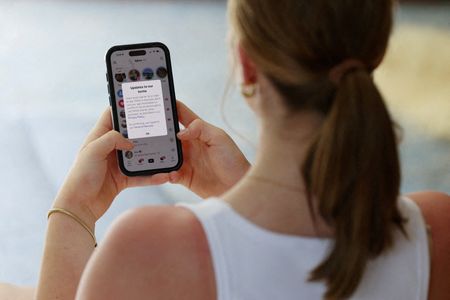
SYDNEY, April 3 (Reuters) - Since Australia banned children from using social media in December, lawmakers from Spain to Malaysia have expressed interest in following suit, while U.S. courts have found tech firms negligent toward young users.
This global spotlight on the first such ban on people under 16 using popular apps appears to have encouraged Prime Minister Anthony Albanese's government to ramp up enforcement this week of what it was touting as successful cooperation with industry two months ago, tech policy experts say.
In getting more aggressive with apps such as Instagram and TikTok, Albanese's centre-left government is pleased with the overseas interest - at least eight countries have said they want similar curbs - but keen to counter the news that many teens are still scrolling on their phones, experts say.
'WHOLE WORLD'S WATCHING'
"The whole world's watching Australia in this experiment, and therefore it looks like weak government to back down or pretend that the failures in reasonable efforts aren't happening," said Jeannie Paterson, co-founder of the Centre for Artificial Intelligence and Digital Ethics, who regularly advises government on tech policy.
A spokesperson for Communications Minister Anika Wells said she had not toughened her stance due to global attention, declining to comment further.
A month after the ban took effect, the government reported in mid-January that social media platforms had deactivated 4.7 million suspected underage accounts, prompting industry participants to expect a grace period of up to a year on enforcement of the ban.
The British and Canadian governments and some U.S. lawmakers have sounded out the Australian authorities on the social media ban - a policy overwhelmingly backed by parents but opposed by the multi-trillion-dollar industry that must comply with it.
Those signs of progress, however, have been undermined by a series of headlines about minors staying on social media.
On Tuesday the government said it was investigating Meta's Instagram and Facebook, TikTok, Alphabet's YouTube and Snapchat for possible breaches of the law, gathering evidence for possible legal action.
The eSafety regulator had previously said it would only take enforcement action in cases of systemic noncompliance.
In its first comprehensive compliance report, the regulator said nearly one-third of parents reported their under-16 child still had at least one social media account. Among those, two-thirds said the platform had not asked the child's age.
Angela Flannery, a former general counsel for the government's Communications Department who now advises the private sector, said, "The government is quite heartened generally by the number of other jurisdictions that are looking at imposing restrictions on the under-16s globally."
But given Tuesday's "disheartening" report on compliance, Flannery said, "They probably want to be seen to be taking action to keep encouraging other jurisdictions to enforce or to enact similar bans."
Meta and Snap said they were committed to complying with the ban, TikTok declined to comment and Alphabet did not respond to a request for comment on the government action.
META, GOOGLE LOSE IN U.S. COURTROOMS
The eSafety report said complaints about cyberbullying and image-based abuse - problems the government said the ban would fix - were unchanged, while parents reported being unable to notify platforms that their underage children still had accounts. Minors who failed an age test were being prompted to repeat the test until they passed, the regulator said.
The ban requires platforms to take "reasonable steps" to keep under-16s from having an account or face fines of up to A$49.5 million ($34 million).
Communications Minister Wells said the problem was not parents or kids failing to comply but Big Tech undermining the government's policy.
Also likely emboldening Australia to go after platforms, say people familiar with the ban's rollout, were a U.S. trial verdict last week ordering Meta to pay $375 million in penalties for safety lapses that allowed child exploitation on Facebook, Instagram and WhatsApp, and another decision finding Meta and Google negligent for designing social media platforms that are harmful to young people.
"The court cases in New Mexico and California have helped the court of public opinion," said Julian Sefton-Green, a professor of new media at Deakin University who is advising the commissioner's two-year study on the ban's impact.
"They're jury decisions, that social media is liable for the well-being of young people, so I think the government's going to take heart from that."
Rob Nicholls, a researcher of regulation at the University of Sydney, said the lawsuits may prompt platform redesigns that comply with the Australian ban by focusing on protecting minors.
"The effect of that design change will be to reduce access for under-16s," he said. "If you've got to do it to avoid litigation in the States, you may as well do the same thing around the world."
($1 = 1.4531 Australian dollars)
(Reporting by Byron Kaye in Sydney; Editing by William Mallard)