By Lucy Papachristou
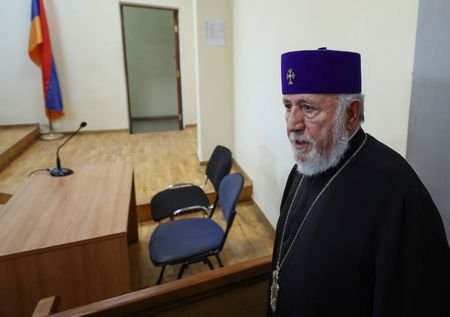
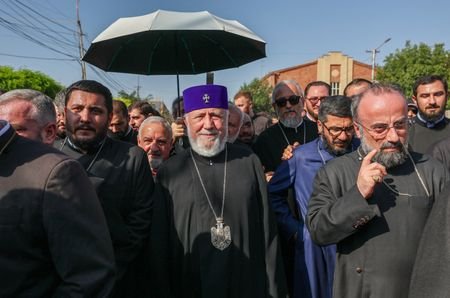
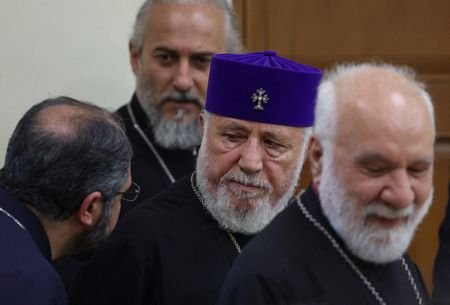
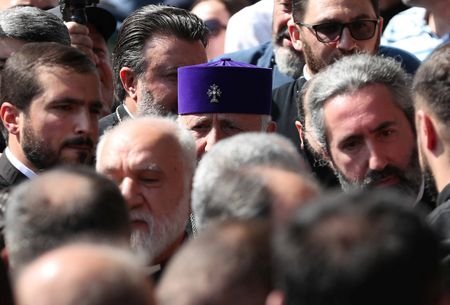
Aug 7 (Reuters) - Armenia on Friday began a trial of the head of its ancient Apostolic Church and six senior clerics for disobeying a state order, the latest move in a standoff with the government which accuses the church leader of links to foreign spies.
However, the trial's first session ended quickly after the judge recused himself from the case, Armenian media reported. There was no information on when the trial might resume.
Pro-Western Prime Minister Nikol Pashinyan has repeatedly called for the resignation of Catholicos Karekin II, who has led the Church since 1999 and has heavily criticised Pashinyan and his policies.
Re-elected in June, Pashinyan has accused the Apostolic Church, without presenting evidence, of acting as a proxy for foreign powers, namely Russia. Karekin and the church deny those accusations.
The trial had been due to hear charges against Karekin and the six clerics for allegedly failing to comply with a civil court order temporarily reinstating a bishop whom the Church had defrocked. They face up to two years in prison if convicted.
But the hearing came to a halt after the sole judge said he could not continue because he had originally been given his licence to be a lawyer by the counsel representing the church leader, the A1+ television channel and other outlets reported.
The case is the most significant legal challenge yet to the leadership of the Apostolic Church, a powerful institution in Armenia, a country that traces its adoption of Christianity to 301 AD.
It comes amid deepening tensions between church and state over Pashinyan's leadership and his handling of peace talks with Azerbaijan after a series of wars dating back to the 1980s.
TURNING AWAY FROM RUSSIA
Pashinyan has won strong backing from the European Union as he tries to steer Armenia closer to the West and away from Russia's orbit, a course that has angered Moscow which has banned a slew of Armenian imports.
Russia's Foreign Ministry said on Thursday that it doubted the Armenian leadership's desire for genuine cooperation with Moscow. Russia has a major military base in Armenia.
Opposition politicians, church leaders and civil society groups say the prosecution of the Catholicos is politically motivated, and part of a wider crackdown on government critics.
Anna Melikyan, a lawyer at Protection of Rights Without Borders, an Armenian non-profit group, said the case violated the constitutional independence of the Apostolic Church.
"This is a clear interference of the executive power in church affairs," she said.
"There are a lot of concerns about the independence of the judiciary in Armenia ... and with certain politically sensitive cases, including cases against the church or clergy, these concerns become very strong."
Pashinyan's office and the prosecutor's office did not respond to requests for comment.
SENIOR CLERGY CALL FOR PM'S RESIGNATION
The Apostolic Church counts millions of followers in Armenia, widely regarded as the world's first Christian nation, and around the world.
The trial stems from the case of Gevorg Saroyan, a bishop who was defrocked after the Church accused him of abusing his authority. Saroyan had publicly called for Karekin's resignation and aligned himself with Pashinyan.
Two years ago, another prominent cleric, Bagrat Galstanyan — who is now under house arrest awaiting trial — led street protests against Pashinyan over territorial concessions made to Azerbaijan. The Catholicos himself has echoed calls for the prime minister to step down.
"Pashinyan started viewing the Church as a political threat, as an institution that could support the opposition and different political parties to come to power," said Tigran Grigoryan, director of the Regional Centre for Democracy and Security think tank in Yerevan.
Grigoryan said the case against the clerics fit into a broader pattern of selective justice pursued by Pashinyan's government, which has seen leading opposition figures detained and some of their assets seized by the state.
(Reporting by Lucy Papachristou; Editing by Mark Trevelyan, Andrew Osborn, Ros Russell and Andrew Heavens)