(Refiles to fix second reference to Carroll, paragraph 8)
By Joey Roulette and Steve Gorman
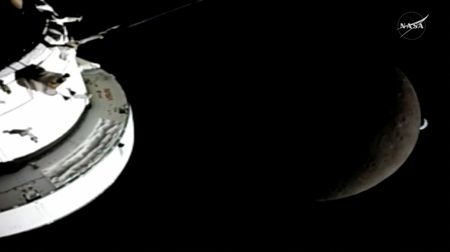
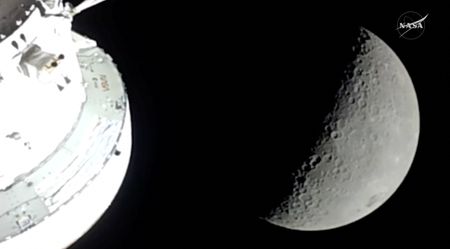
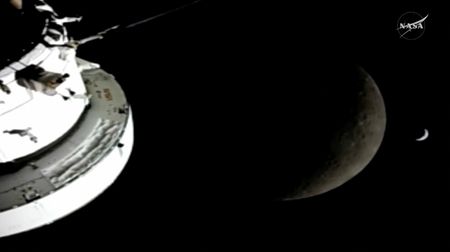
HOUSTON, April 6 (Reuters) - The four astronauts of NASA's Artemis II mission flew on Monday to the deepest point in space reached by any human, sailing along a path of lunar gravitational pull en route to a rare crewed flyby over the shadowed far side of the moon.
The Artemis II crew, riding in their Orion capsule since launching from Florida last week, began their sixth day of spaceflight as they awoke at around 10:50 a.m. ET to a recorded message from the late NASA astronaut Jim Lovell, who flew aboard the Cold War-era Apollo 8 and Apollo 13 moon missions.
"Welcome to my old neighborhood," said Lovell, who died last year at age 97. "It's a historic day, and I know how busy you'll be, but don't forget to enjoy the view... good luck and Godspeed."
The four Artemis astronauts set a new spaceflight record on Monday as they exceeded the maximum 248,000-mile distance from Earth reached in 1970 by Apollo 13 after a nearly catastrophic spacecraft malfunction cut short that mission, forcing Lovell and his two crewmates to use the moon's gravity to help return them safely to Earth.
Later on Monday, the Artemis crew of U.S. astronauts Reid Wiseman, Victor Glover and Christina Koch and Canadian astronaut Jeremy Hansen were due to reach their own farthest distance from Earth -- 252,755 miles, some 4,117 miles (6,626 km) beyond the record held by the Apollo 13 crew for 56 years.
NAMING CRATERS
Along the way, crew members spent some time assigning provisional new names to lunar features that previously lacked official designations.
In a radio message to mission control in Houston, Hansen suggested one crater be dubbed Integrity, after the name given to the crew's Orion capsule, and that another crater sometimes visible from Earth on the cusp between the far and near sides of the moon be named in honor of Wiseman's late wife, Carroll.
"A number of years ago we started this journey, our close knit astronaut family, and we lost a loved one," Hansen said of the mission commander's late spouse, his voice choking with emotion as he described the position of her lunar namesake. "It's a bright spot on the Moon, and we would like to call that Carroll."
If all goes according to plan, Orion will sail next around the moon's far side, witnessing it from roughly 4,000 miles above its darkened surface as it eclipses what will appear to be a basketball-sized Earth in the distant background.
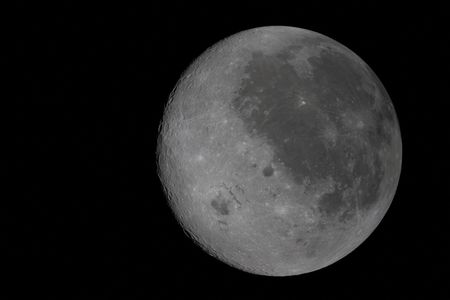
Because the moon rotates at the same speed as it revolves around the Earth, its far side always faces away from our planet, so that few human beings - only members of the Apollo crews who orbited the moon during their missions - have ever gazed directly on its surface.
The milestone would mark a climactic point in the nearly 10-day Artemis II mission, the first crewed test flight of NASA's Artemis program, successor to NASA's 1960s-1970s Apollo project, and the world's first voyage to send humans in the vicinity of the moon in more than half a century.
RARE DETAILED PHOTOS
The planned multibillion-dollar series of Artemis missions aims to return astronauts to the moon's surface by 2028, ahead of China, and establish a long-term U.S. presence there over the next decade, building a moon base that would serve as a proving ground for potential future missions to Mars.
The last time astronauts walked on the moon - a feat so far achieved only by the United States - was the final Apollo mission in 1972.
Monday's lunar flyby will plunge the crew into darkness and brief communications blackouts as the moon blocks them from NASA's Deep Space Network, a global array of massive radio communications antennas the agency has been using to talk to the crew.
During the six-hour flyby, the astronauts will use professional cameras to take detailed photos of the moon through Orion's window, showing a rare and scientifically valuable vantage point of sunlight filtering around its edges.
The crew will also have the chance to photograph a rare moment in which their home planet, dwarfed by their record-breaking distance in space, will set and rise with the lunar horizon as they swing around, presenting a celestial remix of the moonrise typically seen from Earth.
A team of dozens of lunar scientists positioned in the Science Evaluation Room at NASA's Johnson Space Center in Houston will be taking notes as the astronauts, who studied an array of lunar phenomena as part of mission training, describe their view in real time.
(Reporting by Joey Roulette; Editing by Don Durfee, Aurora Ellis and Bill Berkrot)