By Fabio Teixeira and Ricardo Brito
RIO DE JANEIRO, Sept 22 (Reuters) - Brazil has opened a new front against organized crime to keep candidates suspected of criminal ties off the ballot at October's general election in what experts say is an unprecedented effort in Latin American politics.
But, by targeting politicians who have not been convicted of any crime, the campaign is raising questions from some experts and targeted candidates over whether electoral authorities are stretching the limits of existing law and risking violations of due process.
"Interference in the election, in the people's democratic vote, whether political or judicial, leads to a dictatorship," said center-right congressional candidate Clebio Lopes Jacare, whose candidacy was barred over allegations that he is part of a criminal organization.
Brazil's courts have long played a decisive role in determining who can run for office, banning even the most consequential candidates because they had convictions, including President Luiz Inacio Lula da Silva, who was barred from the 2018 election, and rival ex-President Jair Bolsonaro, who is blocked from this year's race. Both claimed the cases against them were politically motivated.
But prosecutors are now advancing an interpretation of Brazil's law which they say allows them to protect the ballot from even suspected criminals, pitting growing concern over organized crime's influence in politics against democratic protections.
Brazilian legislation typically requires a conviction by an appellate court to bar candidates from running. Yet a Reuters review of 20 rulings barring candidates under the push against organized crime shows that none have been convicted at that level.
Criminal gangs' influence in politics is "a big and growing problem in Latin America," said Marcela Rios Tobar, regional director for Latin America and the Caribbean at the International Institute for Democracy and Electoral Assistance, a non-profit.
However, she stressed the need to balance those concerns with legal due process and avoid a situation where "accusations of wrongdoing are used as a political weapon."
GANGS EXPAND THEIR REACH
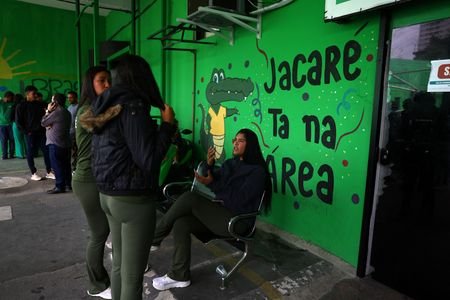
As Jacare's campaign team distributed leaflets in Nova Iguacu, a city of 800,000 people where he unsuccessfully ran for mayor, he stressed that authorities have yet to find him guilty of any crime.
Prosecutors should seek to bar candidates linked to organized crime, Jacare said. But "they need to have facts, proof. It can't just be based on guesswork."
But a 2024 ruling by Brazil's Superior Electoral Court, which oversees elections in the country, opened a precedent for authorities to challenge candidacies based on evidence rather than waiting for a criminal conviction.
The basis for the ruling is an article in Brazil's Constitution that says political parties cannot make use of paramilitary groups.
"Organized crime cannot find in the ballot box a path to institutionalize the power it conquered through weapons," said the head of the electoral court's office in the state of Rio de Janeiro, Claudio de Mello Tavares.
Nowhere is the criminal reach into politics in Brazil more evident than in the state of Rio de Janeiro, where the then head of the state assembly, Rodrigo Bacellar, was jailed last year accused of links to the Red Command, one of Brazil's biggest crime syndicates, which was designated as a terrorist group by the US.
Officials are also investigating whether campaigns used money from organized crime, and have moved a small share of voting locations in Rio because they were in areas dominated by gangs.
Having polling stations "where the voting machine will be transported in an armored vehicle," Tavares said, raises obvious safety concerns for voters.
NECESSARY MEASURE OR OVERREACH?
Among the candidates barred this year are two close relatives of Red Command leaders, a candidate charged in three murder cases, and a man convicted and given a 36-year sentence for illegal firearms possession who can still appeal.
But at least five people who prosecutors are seeking to keep off the ballot had no known links to armed groups. Jacare, the candidate from Rio, was charged with embezzlement and other crimes.
Prosecutors argued, in Jacare's case, that "the democratic process cannot be hijacked by organized crime, whether armed or not."
The challenge of separating necessary measures from overreach is not lost on candidates being barred now.
"If everyone facing any type of legal proceeding or investigation were barred from running for office, Lula wouldn't be president, and Flavio Bolsonaro wouldn't be a candidate," Ney Santos, a congressional candidate whose bid has been challenged by prosecutors citing alleged ties to the First Capital Command crime syndicate, said in a video posted on Instagram.
Sao Paulo's electoral courts ruled in Santos' favor, but prosecutors said they'll appeal. Santos did not reply to a request for comment.
Senator Flavio Bolsonaro, Lula's main competitor in this year's race, is being investigated for corruption, according to newly unsealed court files. He denies any wrongdoing.
Still, the courts' efforts against organized crime have found support among three legal experts consulted by Reuters. Electoral law professor Clever Vasconcelos said courts are responding to a real threat by adopting a broader interpretation of existing rules.
However, he added, Congress should amend the law to expand grounds for ineligibility to give efforts against organized crime a firmer legal basis.
Yet Brazil has faced challenges even when the law is clearer.
Lula was barred from the 2018 election under a law that bars convicted felons from running for office. But the conviction was later annulled, paving the way for his victory in the 2022 presidential race.
Efforts to bar malicious actors cannot come at the expense of due process, said Priscila Pamela Santos, president of the Institute for Defense of the Right to Defense, a Brazilian non-profit.
"One cannot resort to unconstitutional measures that, in an attempt to protect democracy, end up undermining it," she said.
Candidates barred by local courts can still appeal, and hope Brazil's highest electoral court does not confirm the 2024 precedent, said Rafael Soares, a law professor at Brazil's PUC-PR University.
"No one would be naive enough to imagine that there isn't already an infiltration of organized crime into the elections," he said. "The question we have now is the level of response and the legal limits we face."
(Reporting by Fabio Teixeira, Editing by Manuela Andreoni and Alistair Bell)