By Michael Martina and Saurabh Sharma
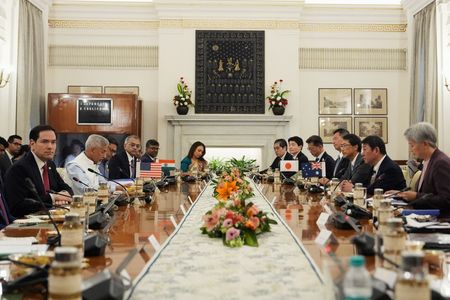
NEW DELHI, May 26 (Reuters) - At the beginning of the Quad meeting on Tuesday, Indian Foreign Minister S Jaishankar said Australia, India, Japan and the U.S. need to address "connectivity choke points" and resource concentration.
"We have to address issues like supply chain resilience, connectivity choke points, manufacturing and resource concentration and gaps in critical infrastructure," he said.
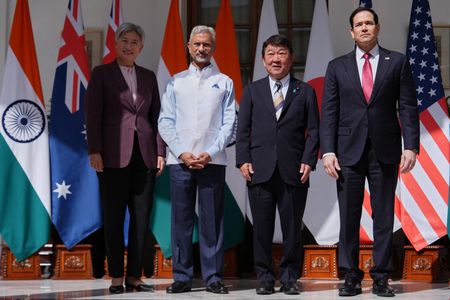
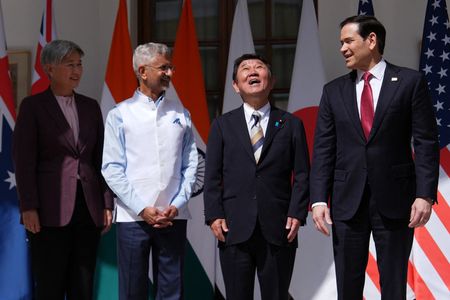
The meeting between the countries' top diplomats - Australia's Penny Wong, India's Jaishankar, Japan's Toshimitsu Motegi and U.S. Secretary of State Marco Rubio - is the third such gathering since September 2024.
The meeting is expected to last less than an hour and will be followed by statements from the four countries' diplomats.
The Quad meeting comes as the U.S. and Iran have circled around a possible deal to end their three-month conflict and reopen the Strait of Hormuz.
The countries share concerns about China's growing power and Rubio - who arrived in India on Saturday for a four-day visit aimed at shoring up relations with New Delhi - has stressed the importance of maintaining a "free and open Indo-Pacific."
"Our goal collectively over the last year has been to turn this from a forum in which we meet and talk about problems to one where we actually do something about it," Rubio said in his opening statement.
Rubio recently said the U.S. would like the Quad to take "concrete actions" on issues like maritime security and critical minerals, adding that diplomats would work toward a leaders' meeting later this year.
"I don't have a date on that yet, but hopefully this year we'll find a time for all four leaders to get together," Rubio said.
Tokyo is especially eager to diversify its supplies of critical minerals after Beijing stopped shipments of some materials used in aerospace, defence and chip-making industries to Japan following a diplomatic dispute.
The closure by Tehran of the crucial waterway has upended energy markets and disrupted the global economy, an issue that is likely to feature prominently in Quad discussions.
Previous Quad meetings have put forward initiatives to maintain "the free and open maritime order" in the Indo-Pacific by improving information gathering on what is happening in their waters.
Last week, a Japanese foreign ministry official said Japan expected the U.S.-Israeli war on Iran to be raised, along with tensions in the East China Sea and South China Sea, where China's heightened military presence in disputed waters has escalated tensions with Tokyo, the Philippines and other countries.
Beijing has criticized the Quad as a Cold War-style construct aimed at containing its development.
India, too, has territorial disputes with China, though Modi had signaled a willingness to improve ties with Beijing amid his tensions with Trump.
New Delhi has pressed for a Trump visit to India, a trip that would likely be tied to a Quad summit. Analysts have questioned whether a lack of leader-level engagement has downgraded the Quad's importance.
(Reporting by Michael Martina, Aftab Ahmed, Saurabh Sharma and Sakshi Dayal in New Delhi, and Tim Kelly in Tokyo; Editing by Thomas Derpinghaus)