By Xinghui Kok and Helen Clark
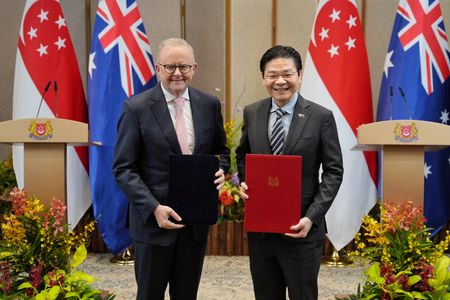
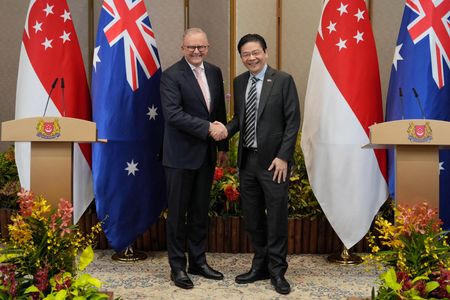
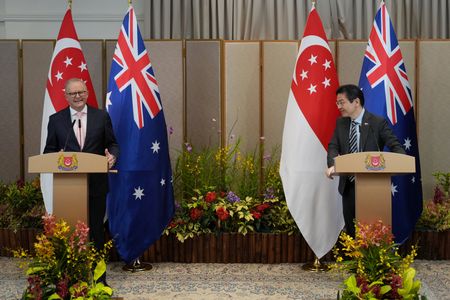
SINGAPORE/PERTH, April 10 (Reuters) - Australian Prime Minister Anthony Albanese held talks in Singapore on Friday with counterpart Lawrence Wong, in which they vowed closer cooperation to ensure energy security in the face of disruptions caused by the Middle East conflict.
Asia's oil trading hub of Singapore is the largest supplier of petrol and a major supplier of diesel and jet fuel to Australia, where tight domestic supplies of diesel are rattlingthe farming and mining sectors, its key users.
The leaders said they agreed to ensure the flow of essential supplies including diesel and LNG, making "maximum efforts" to boost their energy security.
"We reaffirmed our commitment to working together, particularly during crises, to support a resilient, rules-based multilateral trading system that underpins stability during periods of global disruption," they said in a joint statement.
SOME AUSTRALIAN PETROL STATIONS RUN DRY
Panic buying has caused several petrol stations to run dry across Australia, which has limited stockpiles and far-flung distribution networks.
Australia supplies about a third of Singapore's imports of liquefied natural gas, while getting about 26% of its refined fuel from the city-state, Albanese said.
"It's vitally important that we coordinate our response to the global fuel crisis and cooperate," he said during a joint news conference with Wong. "This is a win-win."
Singapore had no plans to curb exports despite the global energy shock, Wong added.
"We didn't have to do so even in the darkest days of COVID, and we will not do so during this energy crisis," he said. "It won't happen."
Friday's commitments would be reflected in a legally binding protocol to their existing free trade pact, said the leaders, who visited an LNG terminal and the Singapore Refining Co in the city state.
CLOSURE OF THE STRAIT OF HORMUZ
Australia is among the Asian countries worried about fuel supplies after Iran closed the Strait of Hormuz, through which about a fifth of the world's oil and gas transited before the Middle East conflict.
Ship traffic along the Strait remains at a near standstill despite a fragile peace deal between the U.S. and Iran.
Australia, which uses roughly a million barrels of oil a day and imported 84% of its petroleum product demand last year, has two refineries, down from eight in 2005.
Singapore is a major refining centre in Asia with three refineries that have combined capacity of about 1.2 million barrels per day, though refineries have cut output after crude supplies were disrupted by the closure of the Strait of Hormuz.
Statistics from insurer NRMA late in March showed Singapore accounted for 54.7% of Australia's petrol imports, or close to 6 billion litres. South Korea was second with 22.5%, and India third, with 11.5% or 1.25 billion litres.
Albanese and Foreign Minister Penny Wong have held talks with Asian counterparts on fuel supplies since early March.
Australia has said it has held talks with Brunei, China Indonesia, Japan, Malaysia and South Korea, among others.
(Reporting by Helen Clark in Perth and Xinghui Kok in Singapore; Additional reporting by Renju Jose in Sydney; Writing by Praveen Menon and Christine Chen; Editing by Jamie Freed and Clarence Fernandez)