By Parisa Hafezi
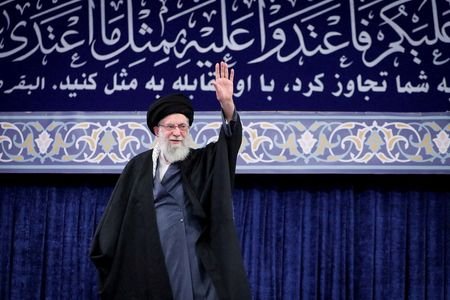
Feb 28 (Reuters) - Iran's Supreme Leader Ayatollah Ali Khamenei, 86, has been an inveterate foe of the West, crushing internal opposition while supporting proxy forces across the region in the hope of making his country respected and feared.
U.S. President Donald Trump on Saturday declared that Khamenei died in the conflict that had defined his rule of Iran, and a senior Israeli official told Reuters his body had been found following U.S.-Israeli airstrikes on Iran.
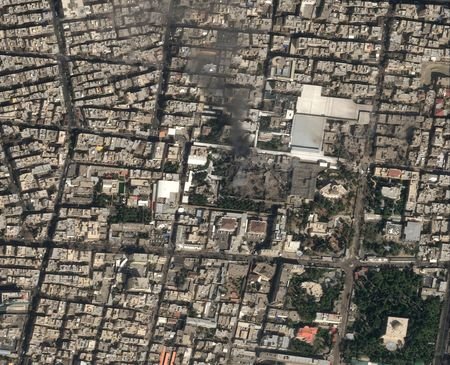
Iranian authorities had not confirmed his death but satellite images showed significant damage to the leader's Tehran compound, one of the first targets of the bombing campaign.
Khamenei's death would represent a massive blow to the Islamic Republic that he had led since 1989, a decade after rising to prominence in the theocratic revolution that toppled Iran's monarchy and rocked the Middle East.
MOUNTING CRISES OF KHAMENEI'S RULE
He survived foreign pressure before but, even before Saturday's attack, was facing the gravest crisis of his 36-year rule, attempting to spin out negotiations with the United States over Iran's nuclear programme.
Already this year, he had ordered the deadliest crackdown since the 1979 Islamic Revolution, saying those protesting nationwide, initially against soaring prices, "should be put in their place" before security forces opened fire on demonstrators chanting "Death to the dictator!".
And only last June, Khamenei had been forced into hiding during 12 days of airstrikes by Israel and then the U.S. that killed several close associates and Revolutionary Guard commanders and smashed prized nuclear and missile facilities.
That assault was among the many indirect results of the attack on Israel by the Iranian-backed Palestinian group Hamas on October 7, 2023, which not only triggered the war in Gaza but also spurred Israel to hammer Tehran's other regional proxies.
With Hezbollah weakened in Lebanon and Syria's Bashar al-Assad toppled, Khamenei's reach across the Middle East was stunted, while the U.S. demanded he abandon Iran's last major strategic lever - its ballistic missiles.
Khamenei refused to even discuss giving up missiles, which Iran saw as its only remaining deterrent to Israeli attack, a display of intransigence that may have helped invite the airstrikes that targeted him.
As the U.S. military massed air and naval forces in the region, Khamenei's calculations drew on a character moulded by revolution, years of turmoil and war with Iraq, decades of sparring with the U.S., and a ruthless accumulation of power.
While elected officials managed day-to-day affairs, no major policy - especially one concerning the United States - could proceed without his explicit approval; Khamenei's mastery of Iran's complex system of clerical rule combined with limited democracy ensured that no other group could challenge his decisions.
AS LEADER, KHAMENEI WAS ONCE FAR FROM SUPREME
Early in his rule, Khamenei was often dismissed as weak and an unlikely successor to the Islamic Republic's late founder, the charismatic Ayatollah Ruhollah Khomeini.
Not having achieved the religious rank of ayatollah when he was appointed Supreme Leader, Khamenei had difficulty wielding power through religious authority, as the theocratic system foresaw.
After struggling for a long time to emerge from the shadow of his mentor, it was by forging a formidable security apparatus devoted solely to him that he finally imposed himself.
Khamenei always distrusted the West, particularly the U.S., frequently accusing it of seeking to topple him.
In a typically pugnacious speech after January's protests, he blamed Trump for the unrest, saying: "We consider the U.S. president criminal for the casualties, damages and slander he inflicted on the Iranian nation."
Yet despite his ideological rigidity, he showed a willingness to bend when the survival of the Islamic Republic was at stake.
The concept of "heroic flexibility", first mentioned by Khamenei in 2013, permitted tactical compromises to advance his goals, mirroring Khomeini's choice in 1988 to embrace a ceasefire after eight years of war with Iraq.
Khamenei’s guarded endorsement of Iran's 2015 nuclear deal with six world powers was another such moment, as he calculated that sanctions relief was necessary to stabilise the economy and buttress his grip on power.
Trump quit the 2015 pact during his first term in 2018 and reimposed crippling sanctions on Iran. Tehran reacted by gradually violating all agreed curbs on its nuclear programme.
LOYAL SECURITY STRUCTURE KEY TO KHAMENEI'S POWER
At times of increasing pressure, Khamenei repeatedly turned to the Islamic Revolutionary Guard Corps (IRGC) and the Basij, a paramilitary force numbering hundreds of thousands of volunteers, to snuff out dissent.
It was they who crushed the protests that exploded after Mahmoud Ahmadinejad's re-election as president in 2009 amid allegations of vote fraud.
In 2022, Khamenei was just as ruthless in arresting, imprisoning or executing protesters enraged by the death in custody of the young Iranian-Kurdish woman Mahsa Amini.
And it was again the Guards and Basij who crushed the latest round of protests in January.
His power has also owed much to the parastatal financial empire known as Setad, under Khamenei's direct control. Worth tens of billions of dollars, it grew hugely during his rule, investing billions in the Revolutionary Guards.
Scholars outside Iran have painted a picture of a secretive ideologue fearful of betrayal - an anxiety fuelled by an assassination attempt in June 1981 with a bomb hidden in a tape recorder that paralysed his right arm.
Khamenei himself suffered severe torture, according to his official biography, in 1963, when at 24 he served the first of many terms in prison for political activities under the rule of the shah.
After the Revolution, as deputy defence minister, Khamenei became close to the Guards during the 1980-1988 war with Iraq, which claimed a million lives from both sides.
He won the presidency with Khomeini's support but was a surprise choice as successor when the supreme leader died, lacking both his popular appeal and his superior clerical credentials.
Karim Sadjadpour at the Carnegie Endowment for International Peace said that "accident of history" had transformed a "weak president to an initially weak supreme leader to one of the five most powerful Iranians of the last 100 years".
(Reporting by Parisa Hafezi; editing by Angus McDowall, Kevin Liffey and Cynthia Osterman)