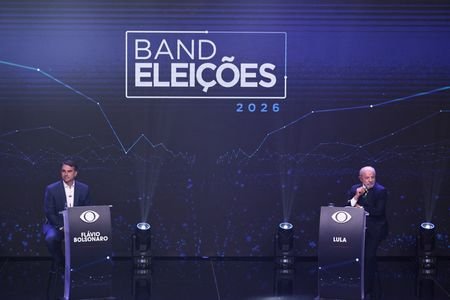
BRASILIA, Oct 21 (Reuters) - Brazilian presidential candidate Senator Flavio Bolsonaro imposed conditions on Wednesday to disclose his bank, tax and telephone records after a challenge from President Luiz Inacio Lula da Silva, his opponent in Sunday's election runoff.
The challenge has become a new battlefront in what polls portray as a strongly contested election, with the candidates seeking to convince voters of their transparency and integrity, and their rival's lack of it, in the last days of the campaign.
Lula's campaign submitted on Tuesday to Brazil's electoral court a document authorizing the release of personal data including his own bank, tax and telephone records, as well as those of his family members, if Flavio followed suit.
The challenge included legal entities in which the candidates are partners or directors.
In a response to the court, Bolsonaro's campaign authorized the release of the data requested by Lula, but only if the president expands his own pledges to include advisors, security staff and records from companies held by Lula's children.
Camilo Santana, a senator and representative of Lula's campaign, told journalists that Lula agreed with the new demands, and that the campaign would file an official response with the court on Thursday morning.
Bolsonaro, who narrowly leads Lula in polls, is under investigation over alleged corruption and money laundering related to an investment he allegedly sought from a banker, who is jailed and accused of fraud, to help finance a film about his father, ex-president Jair Bolsonaro.
The senator has acknowledged seeking funding but denies any wrongdoing. He is also under investigation in a separate probe over alleged money laundering.
Brazil's Supreme Court has authorized an investigation into Fabio Luis Lula da Silva, one of Lula's sons, over alleged influence peddling and corruption tied to Health Ministry dealings, as well as a separate pension-fraud probe.
Lula's son denies the allegations and the president has said his son would be treated like any other citizen.
(Reporting by Maria Carolina Marcello and Lisandra Paraguassu in Brasilia; additional reporting and writing by Andre Romani in Sao Paulo; Editing by Aurora Ellis)