
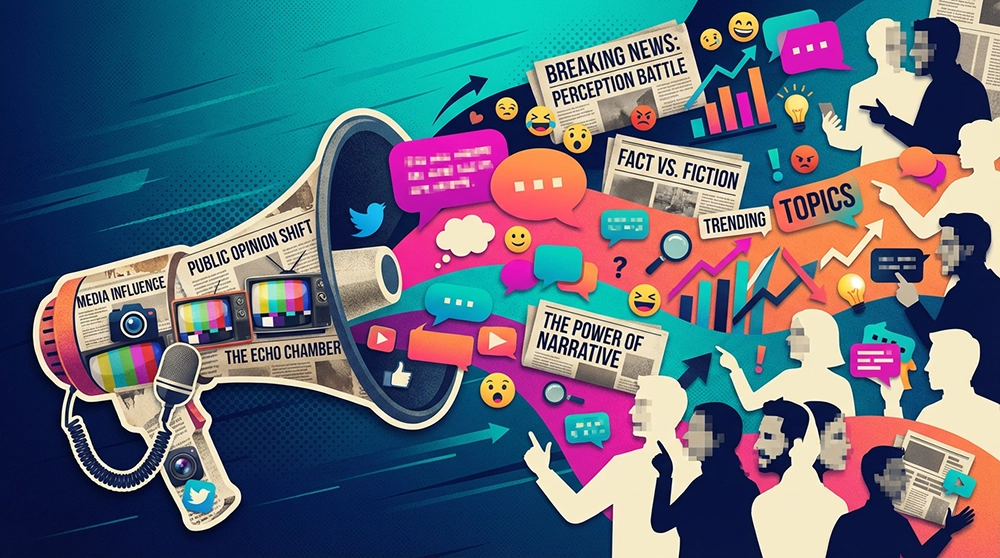
The role of media in shaping public perceptions and opinions, about political and social issues is an axiomatic truth. Still, vying perceptions exist of its use in mass information, education, enlightenment and as an open forum for rational social debates. This essay attempts to deconstruct the ways the media coverage of issues is perceived and traces the historical evolution of the current form of the media. It is essential to understand the background to decipher genesis of the inherent biases that become inextricably intertwined into the media and its coverage. The essay elucidates the manifestations of these biases such as the commercialisation of media, ideological leanings of journalists, close bonds of media with the centres of powers and the media dependence on a select cadre of experts. In the penultimate paragraph, the essay looks at the significance of technology and social media that has played a considerable role in imbuing rationality to the media coverage.
Evolution of public opinion: It would be prudent to trace the development of certain concepts, such as public, public opinion, public sphere and the media that emerged in the context of a term Public Sphere, coined by Jurgen Habermas in 1960s. Discerning this journey of the thought process of the public is fundamental to comprehend the notion that became a catalyst in bringing the egalitarian values of free speech in shaping the democratic societies of modern Europe. Public opinion has diverse meanings, but in general, is considered as the collective attitudes or beliefs of individuals in a community. Dewey (1927) described the word public in his essay as when important issues affect people negatively, they band together, so their voice is heard in the political process. Lippmann (1922) differed with this view. He interpreted the public opinion as a human tendency to view the world as “stereotypes”. Explaining the effects on minds and behaviours of people in his Hypodermic Needle Theory, he sees construct as an understanding of the world by using partial truths, which may not be the full picture of the facts; ‘the symbolism of public opinion usually bears, as we shall see, the marks of this balancing of interests’ (Dewey, 1927; Lippmann, 1922).
The Oxford Dictionary explains media as ‘the main ways that large numbers of people receive information and entertainment, that is television, radio, newspapers, and the Internet’. The insatiable thirst of knowing and telling a story has evoked the need and growth of the media. Starkman (2010) henceforth, writes that an army of journalists works round the clock in the journalistic machine, like a Hamster Wheel, to produce news. It was this enormous need to know that made Pheidippides run the twenty-six miles from the battle of Marathon, to announce the breaking news and became perhaps one of the first journalists in the world. (Grogan, 1981). The media world in the 1950s comprised of a few television broadcasts networks, radio channels, newspapers, and periodic magazines. The technology explosion enabled the development of internet-based platforms such as Twitter, Facebook, YouTube, Instagram, Google, and blogs known as social media. Often called, Mass Media, it is both applauded and criticised for not only translating but also building and affecting, on the behaviours of its consumers, the public and its opinion. Thomas Carlyle reports on the power of media, echoing Edmund Burke’s powerful words, resonated in the parliament: “there were three estates in parliament; but, in the Reporters’ Gallery yonder, there sat a Fourth Estate more important far than they all.” (Rose, 2015).
Athenian democracy, about 500 BC, had a political system of using anonymous public (demos) votes, on pottery shards (ostrakon) of up to 6000 Athenian citizens, to exile individuals, considered harmful to the city. Habermas in 1962, describing the idea of the public sphere, traced it from the Greek-city states as the sphere of the polis, which was common (koine) to the free citizens, and was strictly separated from the sphere of the Oikos (household). (Habermas, 1991: 3). He discusses the emergence of bourgeois mercantile class in the wake of the loosening grip of feudalism and monarchies in the post-industrial Europe that ultimately led to the French Revolution of 1789. The emerging French bourgeois middle class used the Gutenberg’s printing press, in communicating their opinion and dissent, at mass levels against the ruling monarchy, and utilised it as a print-mediated public sphere (ibid). This era coincided with the rise of global colonialism, as from the 15th century to the middle of the 20th century, the European colonial powers ended up controlling 84 per cent of the world, bringing back a bonanza of economic boom (Kennedy, 1989). The increased global European influence instigated a need for innovative ways of governance, taxation and credits, military inventions and increased mercantile activity. Maintaining and expanding the European imperialism required extensive network of human resource in maximising potentials of mercantile activity and in capitalising on the newfound global resources (Habermas, 1991). The much-needed mass dissemination of information was used by the mercantile class, in exchanging ideas and expanding trade and commerce activity (ibid). Major cities of France, England, Germany and Italy converted into the metropolis, increasing in population, enhancing interaction between people and bringing new ideas, cheap labour and economy of scale (ibid).
Press as an influencer: In the seventeen century the word le public meant “lectures, spectateurs and the critics of art and literature”, mainly referred to the court, it later included the nobility and a thin layer of bourgeois class (ibid). Mushrooming of coffee houses, salons and public houses in cities erupted, between 1680 to 1730. It served the social function of the court and the town and started to perform the role of the Public Sphere; a place for people to exchange ideas, share information, and voice opinions, and ultimately, becoming the incubators of ideas, cauldrons of political change and hatchery of literary thoughts. The process of free speech became increasingly common and widespread in Europe and played a crucial role in facilitating and sparking the bourgeois uprising against the ageing monarchy, eventually ending the feudal hegemony. It had become easy to print and distribute information, and newspaper business grew. At one stage, starting a newspaper was considered more of a ‘hobbyhorse’ of wealthy aristocrats, soon it became the business of the bourgeois entrepreneurs (ibid). Self-styled publishers started owning newspapers as well as the coffee shops and salons and did not have a shortage of loyal readership. Effect of the printing press and public sphere, and their distilled product, the public opinion expanded. Striding on it, the emerging bourgeois mercantile class became the deciding factor in the affairs of commerce as well as those of the state. With economy flourishing, the mercantile class needed information from afar for trade. It brought the interests of vying societal classes composed as one as they still needed one another for the expansion of imperialism, which entwined with the growing mercantile and capitalistic profits (ibid). The bourgeois mercantile class was the primary beneficiary in this tectonic change of fortunes. The relationship between people and the elite class of nobility and clergy changed from classical vertical to horizontal. Individuals with the same social status became people rather than subjects, and the public sphere became useful in bringing the welfare of people first, blurring the boundary between personal and the public sphere (ibid).
Influence of commercialisation: According to Habermas (1991), the Public Sphere was open to all citizens, without any restriction to participate, express and discuss general matters, not for any private or business use but the welfare of all. He considered it a central feature to free speech and modern democracy, stating ‘a sphere mediates between society and state, in which the public organises itself as the bearer of public opinion, accords with the principle of the public sphere’ (ibid).
Habermas (1991) discusses the influence of commercialisation of newspapers, and the impact it had on building opinions. He highlights newspapers playing pawns in the hands of the political parties with vested interests. And that a unique type of press emerges during a nation’s revolutionary phase when the small political parties use it, to spread their point of view and get more favoured news from the sympathetic press. The commercialising of newspapers affects the Public Sphere concept of free speech and public opinion, as certain newspapers receive privileges for their political alignment and use this clout to extend their plans. The newspapers often get into cahoots with the governments and attain a specific power, as is witnessed in England, France and the USA, ever since the emergence of the bourgeoise class (Habermas 1989: 234-235). He explains how the interested capitalists started becoming patrons of the newspapers by giving advertisements to boost their products sale, heralding the first wave of commercialising. The political groups found it useful in disseminating their views, and the governments and states also became involved to benefit from this new power, aptly called the Fourth State. The public sphere started as a movement to emancipate people from the tyrannical monopoly of the some and for captaining their right to express an opinion. But, within a short period, it came into the hands of a few people again, what Habermas called ‘Refeudalization’ (Habermas, 1991).
External influences: Media, with its immense power, has been instrumental in raising important civil, political and social issues that changed the course of human history. However, in the last few decades, public trust in the media has waned. Megan Brenan evidences it by quoting Gallup Survey of 2019, reporting American’s mistrust in mass media, with the figures in 1972 of 68% of the Americans trusting mass media, which declined to 41% in 2019 (Brenan, 2019). Miller et al. (2000, 2009) argue external influences that several social and political groups and lobbyists, including the public relation industry make media accounts and are involved in shaping specific issues for open discussions. But the audience is limited to certain information, enabling media to exclude a problem from the public, in starting appropriate dialogues. Herman and Chomsky (1994) describe that in less democratic countries, the authoritarian regimes use propaganda models via mass media and allow only their message to be transmitted to the public and silence or marginalise the opposing opinions. They identified five categories of the propaganda model namely the size & concentrated ownership, advertisement, the reliance on information provided by the government, “flak” disciplining of the media and anticommunism as a form of control.
Inherent factors: Apart from external influences, several inherent biases exist, in how media reports an issue such as personal, institutional, organisation and commercial influences. Nicolas Garnham brought the concept of Public Sphere into media debate and points towards the flaws related to the commercialisation of media. He shows escalating media focus on privatised domestic consumption, built around the television, describing it ‘information-rich vs information poor’ sectors and hints at the dangers of the replacement of ‘national’ cultural spheres with an international media market (Garnham, 1986: 38). The ownership of media plays a massive role, leaving little space for independent journalists, for gainful employment, if they disagree with the media owners and attempt to follow an autonomous line. Peter Oborne described his reasons for resigning from the Telegraph as “coverage of HSBC in Britain’s Daily Telegraph is a fraud on its readers. If major newspapers allow corporations to influence their content for fear of losing advertising revenue, democracy itself is in peril” (Oborne, 2015). In a survey of media ownership & plurality ‘The elephant in the room’, it was found that there were only three companies (News UK, DMGT and Trinity Mirror) that controlled nearly 70% of the national newspaper circulation in the UK. The report admitted, “we have a serious problem with the plurality in the UK”. Rupert Murdoch admission that he had “editorial control on major issues” is a validation of how owners influence media houses. (Media Reform Coalition, 2014).
Cultural biases: McLuhan, referring to a book’ Passage to India’ by EM Forster, highlights the inherent cultural bias. He emphasises that in recent times the traditional oral wisdom of certain cultures has gradually replaced by structured, visual and written knowledge of European thinking, ‘we have confused reason with literacy, and rationalism with a single technology’. (McLuhan, 1964: 16). At times, journalists become prisoners of their professed ideology. McLuhan mentions that Romans were the masters of their slaves, but due to the fact they lived with their slaves, they were affected by the mentality and psychology of slaves. Similarly, the journalists become captive to their personal biases and their opinions are coloured by these inherent biases (McLuhan 1964: 23).
The personal bias of journalists, at times, is blatantly apparent. For example, Douglas Kellner, the former editor of The New York Times, made a flagrant statement that the readers were open to the ‘judgment of the journalists’ and not what the metrics reflect. He went on to say, ‘We are not American Idol’. This statement indicates that some journalists feel that their opinion outshines any other and that they are the experts in whatever field they choose to give their opinion (Schlosberg, 2017: 52). Schlosberg (2017: 56) reports that the journalists are more inclined to conformity principles in newsgathering, which again fits the institutional agenda. The news, these days, are primarily digital and are easy prey to internal or external censorship. He cites the restriction on critical reporting of The Church of Scientology, wherein Google following a complaint under the copyright act in the USA blocked any critical links. Hansen, comments on this referring to a civil liberty lawyer “people will attempt to silence critics under the guise of copyright infringement.” (ibid).
Curran James (2002: 116-117) mentions that people look at the information according to their predispositions and form a unique understanding of the matter. He cited a study by Hastorf and Cantril (1954), where a film of a rough football match, between Dartmouth and Princeton, was shown to two groups of participants. The study showed a bias of the participants on the roughness of the offending team. Each group sided for the team they supported, regardless of the offending behaviour of the teams in the match. The theory of fundamental attributional error explains personal cognitive biases. It reflects a tendency in people to give more credence to constitutional factors when judging other’s actions while overemphasising situational factors when judging their own (Ross et al., 1975). Research of human behaviours reveals limitations of human reasoning, memory and judgment. Stocking, et al (1989) in essay Understanding errors, biases that can affect journalists highlight several biases that can affect journalists such as correspondence bias, hindsight bias, confirmation bias, sample bias, illusory correlation and eye witness fallacy (Stocking, et al, 1989). The journalists working for a left-leaning organisation, are likely to tilt towards the left ideology in their coverage of issues.
Dependence on sources: Similarly, the organisations determine the angle the journalists take in their reportage. Curran James (2002) reports that the organisations and journalists take tilt towards the left or right ideology, they have a propensity for, reflected in the way they report some news (Curran, 2002: 137). He indicates informal ties between the media and centres of power in society, and that the government officials minimise the gravest misuse of power regardless of its seriousness. He gives an example of the infamous case of the Abu Ghraib scandal, where American soldiers were seen sexually humiliating the inmates at the US-run detention centre in Iraq. The Abu Ghraib scandal was a symptom of systemic illness wherein the well-connected sources drive the framing of news to a level that only a handful of select voices remain to articulate in the media. There is no denying that “photos may have driven the Abu Ghraib story, but the White House communications staff ultimately wrote the captions” (Bennett et al., 2007; Curran, 2011: 36). Journalists often interact only with a few personalities who they tend to procure news from and offer free publicity, in return. This exchange of news often leads to a situation where the reporters refrain from taking a critical stand against conventional sources (Gandy 1982, Ericson et al., 1989).
Allan highlights the increasing influence on media as media houses ownership concentrates to a few powerful conglomerates. He refers to the growing concerns of political economists that the media appears in the grips of a small number of ‘white and male’ hands. He adds that corporate profits, rather the content, drive the media. Media appears to make certain news superficial, and there is a reduction in addressing controversial issues such as environment, feminism, anti-racist and labour and trade unions, whereas media appears silencing the competing opinions. It is for these reasons; the political economists are stressing the need for comprehensive overhauling and restructuring of media ownership and control as well as the state regulations (Allan, 1962: 19).
Paradigm shift by social media: Papacharissi (2015) presents a different viewpoint. She argues that bringing people’s emotions, shared on social media, does not lead to irrational coverage. The deliberations on the social media platform, undoubtedly, cast a shadow on media’s agenda-setting and therefore, strings of social media posts set the tone for political discourse. She stresses, the emotion and drama replace deliberation and logic on social media (Papacharisshi, 2015: 116-117). She argues that the emotions are an intrinsic part of the news and should not be brushed aside as mere irrational facets. She maintains that affective attunement observed through “discursive mediality” of Twitter is a public statement. The open displays of emotion on social media, such as Twitter reflect degree of the culture, mood, and feel of the contemporary social moments, which Papacharissi contends as “spaces that stimulate political interest, expression, and engagement work best when they invite impromptu, casual, and unforced forays into the political” (ibid). After every substantial incident, as witnessed in the civic mobilisation of the Egypt revolution, clear boundaries of diverging views appear. The active debates on social media along separate aspects ought to be overlooked, in entirety; however, they might appear to supersede logic and evidence (Papacharisshi, 2015: 130). On social media, the active exchange of ideas is not against logic but facilitates it through emotion, she says. Both logic and emotion can co-exist.
It is vital to acknowledge the significance of reporting truth by ‘witnessing it’ when debating rationality (or the lack of it) of media coverage. Nietzsche said, “there are no facts, only interpretations”. Arguably, versions of truth may exist but reporting bare facts in anecdotes, statistics & evidence in a collated form invariably leaves a little scope of irrationality by the media. After all, a witness is authorised to speak by having been present at an occurrence (Peters, 2001: 710). The above is particularly relevant in specific genres of media coverage, including news, sports and documentary (Peters, 2001: 707). For instance, reporting on the role of government during Covid-19 catastrophe, the media channels could not afford to overlook what was witnessed by the people. High fatalities, numbering over 26,000, by the end of April 2020, spoke volumes of the government’s missteps, regardless of whichever side the media took. Hence, The Times newspaper — believed to be the ruling party’s supporter – after a detailed investigation, slammed the Prime Minister Boris Johnson’s carelessness in handling the Covid-19 calamity, by skipping five Cobra meetings in the run-up to the crisis (Calvert; et al., 2020). Something witnessed, with substantive evidence, in the form of official data and video clips in the public domain, becomes almost impossible for the reporter (s) to ignore. In the era of technology, what is recorded on cameras and shared on the social media cannot be denied, and it leaves little or probably no scope for the press to create a false or irrational narrative. Facebook co-founder Mark Zuckerberg rightly said that technology merely enables or facilitates social activities (Van Dijck, 2013: 12).
Another example that supports the rationale of witnessing is the coverage of sports & music events, and political rallies usually shown on the TV. These events sometimes do broadcast live because of the high demand by the people who want to be involved in history (Peters, 2001: 719). There is no option of irrational coverage in such cases because it is presented as it is, without any subjectivity and shown directly to the audience. Reporters (and the media in general) only play the role of facilitators.
Conclusion: The essay notes that several factors, including personal, institutional and commercialisation, play a significant role in influencing the media and its editorial coverage of issues. Peter Oborne’s resignation letter from The Daily Telegraph clearly showed the impact of corporates on the content of mainstream newspapers. The interferences by political parties, state establishments, ideological leanings & personal biases of journalists inherently sway the media coverage. Besides, several social and political groups, including lobbyists, are openly seen to influence the media through public relations industry. Historically, the papers and mass media tools have also been exploited to bolster political agendas, and in propagating political ideas, some even triggering revolutions in the past.
A clutch of corporates controls the entire media practically, leaving little or no representation to the masses, thus defying the very essence of its name – “mass media”. It is no surprise then that the public’s trust in the integrity of media has considerably fallen as we saw in the Gallup survey. However, a glimmer of hope lurks as technology plays a significant role, ubiquitously, in undoing some of the harm caused to the balanced coverage. The rapid infusion of communication technologies in the media, politics and people’s lives is shaping multifaceted forces, in spreading what is said, how, when and by who, and it becomes the target of global criticality for validation or public scrutiny. With one tweet and appropriate emotive lexicon, the news becomes Edward Munch’s Scream and spreads as the shot heard around the world, from the battle of Concorde, reverberated in the entire planet. Since the public manages to get a glimpse into the actual events through live coverage or video/ audio evidence now, they are unlikely to be misled by irrational or biased coverage of events.
Also, seamless debate on the social media, however affective it might sound, reflects the opinions of masses notwithstanding the side of rationality the media decides to take. Deduced understanding and logic, and hence rationality of the subjective matter, is dependent upon the presented media coverage, to the pre-conditioned audience.
References:
Bennett, W.L., & Lawrence, R.G. Livingston, S. (2007). When the press fails: Political power and the news media from Iraq to Katrina. Chicago, IL: University of Chicago Press
Brenan, Megan (2019) in Gallup < https://news.gallup.com/poll/267047/americans-trust-mass-media-edges-down.aspx> (accessed on 2/5/2020).
Calvert, J., Arbuthnott, G., Leake, J. (2020) in The Times <https://www.thetimes.co.uk/article/coronavirus-38-days-when-britain-sleepwalked-into-disaster-hq3b9tlgh> (accessed on 25/4/2020)
Curran, J. (2002) Media and Power. London: Routledge (pp: 137)
Curran, J. (2011) Media and Democracy. London: Routledge.
Dewey, J. (1927). The public and its problems: an essay in political inquiry. New York: Holt.
Ericson, R. Baranek, P. and Chan, J. (1989) Negotating Control, Milton Keynes: Open University Press
Garnham, N. (1986). ‘Extended Review: Bourdieu’s Distinction: Distinction: A Social Critique of the Judgement of Taste’. The Sociological Review, 34 (2), 423-433 <https://doi.org/10.1111/j.1467-954X.1986.tb02709.x> (accessed on 24/4/2020)
Gandy, O. (1982) Beyond Agenda Setting, Norwood, NJ: Ablex
Grogan R. (1981) ‘Run, Pheidippides, Run! The story of the Battle of Marathon’ British journal of sports medicine, 15(3), 186–189. https://doi.org/10.1136/bjsm.15.3.186
Habermas, J. (1989) ‘The Public Sphere’ Jürgen Habermas on Society and Politics: A Reader, Steven Seidman, ed. Boston: Beacon Press, 1989, pp. 231-236.
Habermas, J. (1991) ‘The structural transformation of the public sphere’ < http://courses.ischool.berkeley.edu/i218/s15/Habermas_STBPS_I.Intro.pdf> (accessed on 24/4/20202)
Happer, C. & Philo, G. (2013), ‘The Role of the Media in the construction of public belief and social change’, Journal of Social and political psychology, Vol 1, No 1 <https://jspp.psychopen.eu/article/view/96/37> (accessed on 25/4/2020)
Herman, E., & Chomsky, N. (1994). Manufacturing consent: The political economy of the mass media. New York, NY: Vintage.
Kennedy, P. (1989) The Rise and Fall of the Great Powers. New York: Vintage (pp. 150)
McGuigan, J. (1998). National Government and the Cultural Public Sphere. Media International Australia Incorporating Culture and Policy, 87(1), 68–83 <https://doi.org/10.1177/1329878X9808700109> (accessed on 20/4/2020)
Media Reform Coalition (2014) <https://www.mediareform.org.uk/wp-content/uploads/2014/04/ElephantintheroomFinalfinal.pdf> (accessed on 24/4/2020)
Miller, D., & Dinan, W. (2000) ‘The rise of the PR industry in Britain 1979-1998’. European Journal of Communication, 15(1), 15-35. doi:10.1177/0267323100015001001
Miller, D., & Dinan, W. (2009) ‘Journalism, public relations and spin’. In K. Wahl-Jorgense & T. Hanitzsch (Eds.), Handbook of journalism studies (pp. 250-264), New York, NY: Routledge.
Lippmann, W. (1922) Public Opinion. San Diego: Harcourt. (pp.12)
Oborne, P. (2015) in Open Democracy <https://www.opendemocracy.net/en/opendemocracyuk/why-i-have-resigned-from-telegraph/> (accessed on 24/4/2020)
Papacharissi, Z. (2015) Affective Publics: Sentiment, Technology, and Politics. Oxford: Oxford University Press, pp. 115-136.
Peters, John Durham (2001) ‘Witnessing’. Media, Culture & Society. London: Sage Publications. Vol. 23 (6): pp. 707-723
Rose, D. (2015) in Journalism.co.uk <https://www.journalism.co.uk/news-commentary/why-the-mainstream-media-needs-more-plurality/s6/a564159/> (accessed on 24/4/20202).
Ross, L., Lepper, M.R., Hubbard, M. (1975) ‘Perseverance in self-perception and social perception: Biased attribution processes in the debriefing paradigm’ Journal of Personality and Social Psychology, 32, 880–892.
Schlosberg J, (2016) Media Ownership and Agenda Control: The Hidden Limits of the Information Age. London: Routledge.
Starkman, Dean (2010) ‘The Hamster Wheel’ in Columbia Journalism Review <https://archives.cjr.org/cover_story/the_hamster_wheel.php> (accessed on 25/4/2020).
Stocking, S.H., & Gross, P.H. (1989) ‘Understanding errors, bias that can affect journalists’ Sage Journals <https://journals.sagepub.com/doi/10.1177/107769588904400101> (accessed on 25/4/2020)
Van Dijck, J. (2013) The Culture of Connectivity: A Critical History of Social Media. Oxford: Oxford University Press, pp. 3-23.