By Lisandra Paraguassu, Ricardo Brito and Janaina Quinet
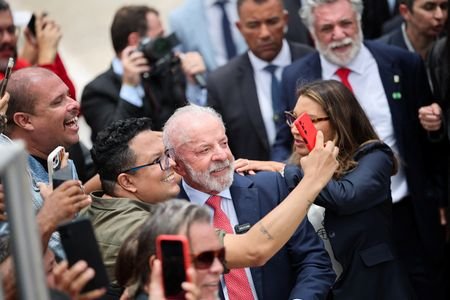
BRASILIA/RIO DE JANEIRO, Feb 15 (Reuters) - When Brazilian President Luiz Inacio Lula da Silva learned that a samba school in Rio de Janeiro would base its carnival parade this year on his journey from factory worker to president, he broke into tears and then smiled for pictures holding the school's flag.
But the tribute gradually became a political issue, prompting the president's allies and his own party to take several precautions before and during the parade on Sunday night to avoid what opposition parties and politicians claimed was an illegal form of early campaigning.
A flurry of lawsuits alleging that Lula could electorally benefit from the parade was filed, as the president hopes to be elected for his fourth non-consecutive term in October.
Courts have already rejected all but one of the lawsuits, including one that asked judges to stop the parade from taking place, but more will potentially be filed.
Still, Lula sought to remain discreet throughout the parade on Sunday. He did not speak publicly at any time, whether in interviews or speeches, so as not to be accused of asking for votes.
The president even got out to greet the parade participants and took photos kissing the flag of Academicos de Niteroi, the samba school that honored him, but did the same with three other schools that followed. He published all the pictures in a post on X, but did not mention the tribute.
As participants sang and danced to Lula and his mother's life stories in Rio, a planned appearance from the first lady Rosangela "Janja" da Silva - who was to appear in the school's last float - was canceled.
Amid the risk that her participation could be challenged in court, Janja opted to watch the parade from the box alongside Lula and was replaced by Brazilian singer Fafa de Belem.
During the weekend, Lula also attended two other traditional carnival events in the northeastern cities of Recife and Salvador before heading to Rio.
"It’s not campaigning," said Tiago Martins, a carnival parade designer at Academicos de Niteroi. "It’s a plot that tells the life story of a warrior of a man, who despite all obstacles got to the presidency."
Critics disagree, pointing, for example, to mentions of the number 13 in the song’s lyrics, the same one that Lula and his Workers Party use on the ballot box.
“This is the kind of thing you see in a Soviet republic, in North Korea, an ode to the great leader,” said lawmaker Marcel Van Hattem, a leader of the opposition Novo Party, which filed one of the lawsuits against Lula.
PARTY WITH RESTRAINT, MINISTERS ARE TOLD
The parade designed by Academicos de Niteroi describes the president’s childhood in the country’s impoverished Northeastern region and his mother’s journey to Sao Paulo with her children in search of a better life.
“I saw myself in my children’s eyes, frightened and empty. With my heart in pieces, I set out in search of love and of my dreams,” the lyrics say.
Artists at Academicos de Niteroi sought the president’s authorization to use his life's story last year, before going forward with their plan. After they received it, Lula welcomed Martins and other members of the samba school for a dinner at his Alvorada presidential residence in September.
As they sang the song they had written for the parade, Lula became emotional and cried, people who were in the meeting told Reuters. He later described it as a tribute to his mother, Dona Lindu, rather than to himself.
Lula's aides acknowledged the political sensitivity of the moment to Reuters. After the lawsuits multiplied, the president's team consulted legal advisers to clarify what restrictions apply during the pre‑campaign period.
Ministers attending the parade were instructed to remain seated in the audience, refrain from participating in the parade itself, avoid public funds for travel, and not make any election‑related gestures, statements, or live posts on social media.
Lula's Workers Party also issued recommendations for supporters not to wear accessories, clothing, or flags bearing the party's number, mentions to the 2026 election, or use slogans referring to the president's reelection campaign.
OPPOSITION SAYS THE TRIBUTE CROSSES LEGAL LINES
Opposition figures argue the precautions show the government knows the tribute crosses legal lines.
They complain that Academicos de Niteroi received hundreds of thousands of dollars of public funds to do the parade.
But government lawyers stressed that all of Rio's samba schools taking part in official parades received the same amount of resources and that funds are not tied to artistic choices.
All cases have been thrown out because judges either agreed with the government's arguments or pointed to procedural issues. One case is still pending before the federal accounting court, though a preliminary ruling also rejected blocking funds to the parade.
While Lula has attended Rio's carnival parade before as president, it is not common for presidents to do so.
One former president, Itamar Franco, famously got into trouble in the 1990s after being photographed next to a woman wearing no underwear at the parade.
For Martins, the carnival parade designer, the political clash has overshadowed what, for him, is a deeply personal artistic achievement.
“The samba says it: there are children of the poor becoming doctors, and me, a child of the poor, becoming a carnival designer,” he said. “We wanted to tell the story of a man who did a lot for the poor and for Brazil.”
(Reporting by Lisandra Paraguassu and Ricardo Brito in Brasilia, and Janaina Quinet in Rio de Janeiro; Writing by Manuela Andreoni and Fernando Cardoso, Editing by William Maclean and Nick Zieminski)