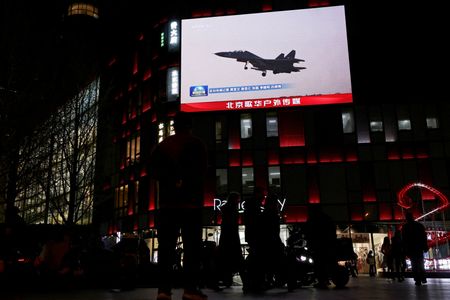
BEIJING/TAIPEI, April 29 (Reuters) - Taiwan's economy would gain see unprecedented opportunities if it unites with China, Beijing said on Wednesday, stepping up a campaign to persuade Taipei to accept its rule, which President Lai Ching-te's government has repeatedly rejected.
China, which views democratically governed Taiwan as its territory, has since late last year attempted to convince the island of the benefits of a "peaceful reunification," though Beijing has also refused to renounce the use of force.
At a weekly news briefing in Beijing, Chen Binhua, a spokesperson for China's Taiwan Affairs Office, said Taiwan's economy would be "reinvigorated with new vitality", drawing on the advantages of China's huge market and Taiwan's own strengths in science, technology, and talent.
"Peaceful reunification will inject greater certainty and growth potential into Taiwan's investment and business environment, representing an unprecedented opportunity and the greatest source of confidence for Taiwan's economic development," he added.
Taiwan is a major producer of the world's most advanced semiconductors, which are powering the global artificial intelligence megatrend and its economy is booming, growing 8.68% in 2025, its fastest rate in 15 years, and is expected to expand 11.3% in the first quarter.
"Rather than continuing to issue empty promises to Taiwan, the Chinese communists would be better served by first confronting the economic and social problems within mainland China itself," Taiwan's Mainland Affairs Council said in a statement, pointing to issues like high youth unemployment.
Lai says only Taiwan's people can decide their future and that Beijing has no right to claim the island.
Speaking to senior military officers in Taipei on Wednesday, Lai said that only by strengthening Taiwan's own defence capabilities can genuine peace be ensured.
"Unification packaged as peace will inevitably bring endless troubles to our nation," he said.
"At present, China is frequently conducting grey zone operations and military exercises in the waters surrounding the Taiwan Strait, while simultaneously employing a combination of military, legal, informational, and psychological means, in an attempt to alter the status quo in the Taiwan Strait and the broader region."
Taiwan says China uses "grey-zone" activity - irregular tactics to exhaust a foe without resorting to open combat - on a daily basis, including regularly sending warships and warplanes near the island.
China says its regular military activities around Taiwan are "entirely justified and reasonable".
China has offered Taiwan a Hong Kong-style "one country, two systems" form of autonomy, though no major political party in Taiwan supports that.
(Reporting by Beijing newsroom and Ben Blanchard; Editing by Raju Gopalakrishnan and Bernadette Baum)

