By Liz Lee and Joe Cash
BEIJING, March 19 (Reuters) - China called for an end to conflict in the Gulf and said the safety of waterways should not be disturbed on Thursday, adding that it was ready to work with Southeast Asia to address energy shortages as oil markets reel from supply shocks.
While the U.S.-Israeli war on Iran has allowed China to cast itself as the more reliable superpower, analysts say it is wary of global energy market uncertainty, not least because it needs the resources it has been stockpiling since the late 2000s to power the manufacturing sector underpinning its economy.
Assisting Southeast Asia's 700 million people would be welcome relief to the region's oil importers, after an order by Beijing earlier this month to ban Chinese exports of diesel, gasoline and jet fuel. China is also curbing exports of fertilisers, which rely on oil and gas refining byproducts, to protect its domestic market.
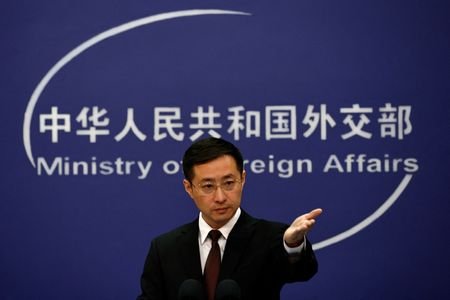
"The situation in the Middle East has disrupted global energy security," Lin Jian, spokesperson at the Chinese foreign ministry, told a regular news conference when asked if Southeast Asian nations had reached out to China for help.
"The countries involved should immediately cease military operations to prevent regional instability from having a greater impact on global economic development," Lin said, adding that the safety of waterways should not be "disturbed", without naming the Strait of Hormuz.
"China is willing to strengthen coordination and cooperation with Southeast Asian countries to jointly address energy security issues," Lin added.
In a phone call with his British counterpart later on Thursday, Chinese Foreign Minister Wang Yi said "as permanent members of the U.N. Security Council, China and the United Kingdom bear the responsibility of maintaining international peace and security."
The "still widening" war in the Middle East has had "direct impact on international energy, finance, trade and shipping, and harms the common interests of all countries," he said.
OPPORTUNITY FOR CHINESE RELATIONS
The crisis could create new openings in countries where China had struggled to gain a foothold, said Wang Jin, senior fellow at the Beijing Club for International Dialogue, a think tank under the purview of China's foreign ministry.
The Strait of Hormuz's closure also highlights the relative reliability of renewable energy, compared with reliance on Gulf fossil fuels, including nuclear power and other green energy sectors in which Beijing is a world leader, Wang said.
"China hopes to develop very positive, healthy, and very consistent relations - particularly energy relations - with everybody," Wang added.
Philippine Energy Secretary Sharon Garin met with the Chinese ambassador to the Philippines on Tuesday to discuss cooperation in energy, a departure from the two countries' arguing over maritime rights in the South China Sea.
(Reporting by Liz Lee and Joe Cash; Writing by Ryan Woo; Editing by Muralikumar Anantharaman, Alexander Smith and Nia Williams)