By Joe Cash
BEIJING, April 21 (Reuters) - China on Tuesday implied energy assistance for the Philippines could be tied to Manila holding military drills with the U.S. and other allies, as its top newspaper showed Beijing's readiness to leverage its reserves in diplomatic disputes.
In an editorial headlined "The Philippines should create conditions for deepening cooperation," the ruling Communist Party's official People's Daily accused the Philippines of hypocrisy for seeking the emergency supplies days before hosting annual drills involving more than 17,000 troops on a remote Philippine island near Taiwan.
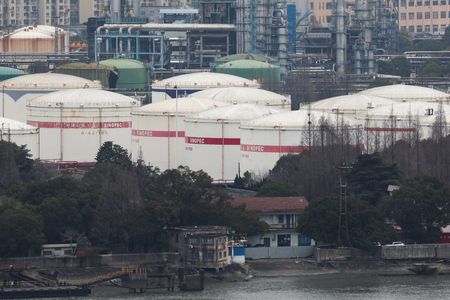
China has the world's largest strategic oil inventories.
"These blatantly contradictory words and deeds expose the opportunistic nature of Philippine politicians," the commentary said, published under the pen name "Zhong Sheng," meaning "Voice of China", and commonly used to convey top officials' views on foreign policy.
"How can (the Philippines) justify acting with complete disregard for the interests of its neighbours and yet expect them to come to its aid in a critical moment?", the commentary continued, calling on Manila to "create the right conditions" for improved two-way ties.
Tying energy relief to diplomatic disputes suggests Beijing could start to use supply assistance as leverage against nations that have displeased it, analysts say, as it has with critical minerals exports to Japan.
Relations between China and the Philippines have deteriorated over the two countries' competing claims in the South China Sea, particularly over Second Thomas Shoal where Manila grounded a warship in 1999 and conducts regular supply missions to sailors stationed on board. The shoal lies within the Philippines' 200-nautical-mile exclusive economic zone and about 1,300 km (808 miles) off mainland China.
China - the world's second-largest fertiliser exporter and a major fuel supplier in Asia - has reduced exports of refined fuels to neighbouring countries, following reports in March that it had ordered a ban on fuel exports to prioritise its domestic supply.
"I saw hints of an implied quid pro quo but not a direct conditionality of energy aid for political pre-conditions. What I saw more was the critique of the Philippines being ungrateful," said Eric Olander, co-founder of the China-Global South Project. "It wants to rely on China for economic 'emergency relief' while also stirring up trouble."
Chinese officials last month offered Taiwan what they described as energy stability in exchange for accepting Beijing’s rule.
CHINA'S COMPARATIVE ENERGY ADVANTAGE
People's Daily highlighted China's decision to honour fertiliser contracts with the Philippines despite the March export ban and pointed to Manila's parallel interest in starting talks on oil and gas supplies. But it went on to list a series of grievances, including the war games.
Running until May 8, the exercises known as "Balikatan" or "shoulder-to-shoulder", also include Australia, Canada, France and New Zealand. Maritime strike drills will take place on the island of Itbayat, the northernmost point of the Philippines about 155 km from democratically governed Taiwan, which China views as its own territory. Counter‑landing live‑fire drills will take place in Zambales province on the South China Sea, about 230 km from the hotly contested Scarborough Shoal, which China controls.
Ruby Osman, a senior policy adviser at the Tony Blair Institute, said the energy shocks had vindicated China's early‑2000s strategy of stockpiling and reinforced its ability to resist U.S. pressure, encouraging Beijing to act more confidently in situations involving its geopolitical rival.
But China's comparative energy advantage should not be confused with the overall health of the country's energy security, she warned. "China is still burning through strategic reserves they'd rather not have to, with limited say in the length and scale of the disruption."
Chinese President Xi Jinping publicly called for the reopening of the Strait of Hormuz for the first time during a Monday call with Saudi Arabia's Crown Prince Mohammed bin Salman, underlining the unease within the $19 trillion economy over the closure of the Strait of Hormuz, as export-led growth relies on open sea lanes.
(Reporting by Joe Cash; Editing by Kate Mayberry)

