By Ryan Woo and Yukun Zhang
BEIJING, March 31 (Reuters) - China is stepping up a years-long anti-corruption drive against securities regulatory officials as Beijing works to improve the image of its regulatory authorities and draw in global investors.
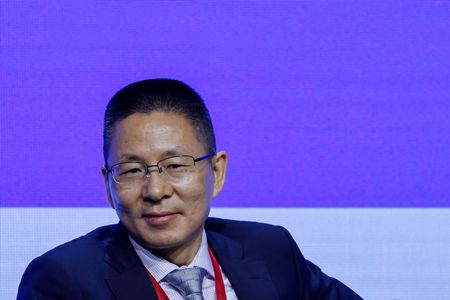
Prosecutors said on Tuesday that Wang Jianjun, previously vice chairman of the China Securities Regulatory Commission (CSRC), illegally took large amounts of money and property while helping to benefit others by abusing his position.
Wang held the role of CSRC vice chairman from 2021 until April 2025. CSRC backed the decision to investigate Wang, hailing the effort at the time as showing that China would not halt its graft fight.
Wang could not immediately be reached for comment.
The anti-corruption campaign later widened that same year when Wang's former boss, Yi Huiman, became an investigation target of China's highest anti-corruption agency. Yi helmed CSRC from January 2019 to February 2024.
Yi's immediate predecessor Liu Shiyu was also expelled from the government due to corruption charges.
As global capital trickles back to China this year, authorities are working on bolstering the long-term appeal of Chinese markets by cracking down on corruption, especially cases involving initial public offerings (IPOs), rooting out insider trading, and curbing large market swings that trigger regulatory concerns.
Corruption not only hinders the market's ability to serve the economy but also severely damages the authority and image of regulatory authorities, Li Chao, a CSRC vice chairman, said in unusually candid remarks at a news briefing one month after Yi's departure.
FORMER SUPERVISORS OF IPOS UNDER INVESTIGATION
A number of former CSRC officials who became targets of corruption probes were involved in reviewing IPOs, a procedure that has been undergoing a revamp in the past few years.
China, in 2023, expanded a registration-based IPO system to cover all corners of its stock market to speed up listings and corporate fundraising. The CSRC has also been carrying out further reforms to STAR Market and ChiNext, its two start-up and tech-focused boards, including introducing a pre-review IPO mechanism for qualified, high-quality innovative companies.
Toh Han Shih, Hong Kong-based consultant of Headland Intelligence, said there was an "inherent, systemic incentive for corruption" at CSRC due to its vetting power in areas such as IPOs.
"Many Chinese companies are lining up to apply for IPOs in the mainland Chinese stock market, so the temptation is for the bosses of these companies to bribe CSRC officials" to approve the applications, Toh said.
On Friday, China's anti-corruption agency said Guo Xudong, a former deputy head of CSRC's issuance supervision department, had abused her power in IPO reviews by adopting "preferential treatment" and accepting equity stakes.
Guo's wrongdoing also included illegally taking large sums of money and accepting job roles at places she used to regulate upon leaving public office, the watchdog said.
Other senior officials who held roles in the regulator's issuance review departments and were later probed included Wu Guofang, who accepted bribes under the guise of "investing" in companies planning to go public, and Li Xiaoqiang, another former deputy head of the issuance supervision department who "severely disrupted the order of capital market", according to the anti-corruption agency.
In 2025, the top prosecuting agency, the Supreme People's Procuratorate, took action against 29,000 individuals, including high-ranking officials, a figure that is more than a fifth higher than a year earlier.
(Reporting by Yukun Zhang, Ryan Woo and Liz Lee; Additional reporting by Samuel Shen in Shanghai; Editing by Christian Schmollinger, Clarence Fernandez and Saad Sayeed)