By Erikas Mwisi and Emma Farge
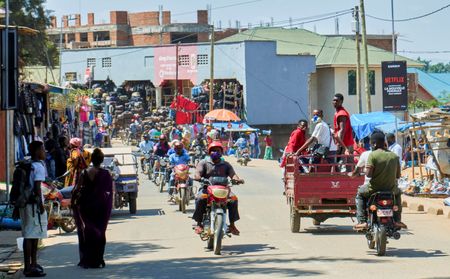
BUNIA, Democratic Republic of Congo, May 22 (Reuters) - The eastern Democratic Republic of Congo province most affected by the country's Ebola outbreak banned funeral wakes on Friday, a day after residents clashed with police while trying to recover the body of a victim.
The incident in Ituri province's Rwampara town recalled the hundreds of attacks on health facilities during eastern DRC's 2018-2020 outbreak and underscored the difficulty of imposing strict disease-control practices that conflict with local customs.
The World Health Organization has declared the outbreak of the rare Bundibugyo strain a public health emergency of international concern. The WHO says late detection, the absence of a vaccine or virus-specific therapeutics, widespread armed violence and high mobility among the population make Congo vulnerable.
Nearly 750 suspected cases and 177 suspected deaths have been recorded in eastern DRC, WHO Director-General Tedros Adhanom Ghebreyesus said on Friday. Two cases have also been confirmed in neighbouring Uganda.
"These numbers are changing as surveillance efforts and laboratory testing is improving, but violence and insecurity are impeding the response," Tedros said.
On Friday, the WHO raised its risk assessment for the outbreak in Congo to "very high" from "high," while maintaining its earlier assessment that there was a high risk at the regional level and low risk at the global level.
Dozens of armed groups operate in eastern DRC.
One of them, the Rwanda-backed M23, has been running large swathes of territory it seized last year, including cities where Ebola cases have been detected.
On Friday, an M23-appointed governor of North Kivu suspended public transport between Goma, the rebel headquarters, and Butembo, a major town to the north near Ituri province.
ITURI GOVERNMENT IMPOSES RESTRICTIVE MEASURES
In an official order on Friday, Ituri's provincial government said burials must now be conducted only by specialized teams and prohibited the transport of dead bodies by non-medical vehicles.
It also limited public gatherings to 50 people and suspended the local football league.
Ebola is an often-fatal virus that causes fever, body aches, vomiting and diarrhoea. It spreads through direct contact with bodily fluids.
Bodies of Ebola victims are highly infectious after death, and unsafe burials - in which family members handle the body without proper protective equipment - are a leading driver of transmission.
"So anyone who touches the body during carrying, washing, shrouding, moving is at extremely high risk of contracting the virus,” said Laura Archer, lead for clinical care and public health in emergencies for the International Federation of Red Cross and Red Crescent societies.
The first known case in the current outbreak died in Bunia, Ituri's capital, on April 24, and the virus spread when mourners touched him during a funeral in the nearby town of Mongbwalu.
During the 2018-2020 outbreak, the second-deadliest on record, with nearly 2,300 fatalities, health facilities were attacked by both civilians angry about the response and armed groups seeking to exploit the outbreak for political and economic gain.
The incident in Rwampara occurred after the family of footballer Eli Munongo Wangu refused a safe burial for him, disputing that the virus had killed him.
"We need to put a lot of efforts now on educating the population," WHO Regional Director for Africa, Mohamed Yakub Janabi, told Reuters on Friday. "There's a lot of misinformation on the ground, so that's another epidemic by itself."
Volunteers have started going door-to-door to combat misinformation about Ebola, the IFRC said on Friday.
RWANDA BANS ENTRY TO FOREIGNERS RECENTLY IN DRC
DRC's eastern neighbour Rwanda said on Friday it would deny entry to all foreign nationals who had travelled to or transited through DRC in the last 30 days and would require quarantines for Rwandan nationals or residents who had been in DRC during that period.
The WHO has urged countries to keep borders open, saying closures could encourage informal crossings and hamper aid delivery. The United States has also restricted travel from DRC, Uganda and South Sudan.
The U.S. government is "actively engaged" in efforts to find therapies for the Bundibugyo strain, the U.S. Centers for Disease Control and Prevention said.
Also on Friday, the United Nations' top humanitarian official, Tom Fletcher, said the U.N. was releasing around $60 million from an emergency fund for the response.
"We need to get ahead of this Ebola outbreak," Fletcher said on X. "These are tough operating environments for lifesaving work. We face conflict and high population movement."
(Reporting by Emma Farge and Erikas Mwisi; Writing by Aaron Ross and David Lewis; Editing by Alex Richardson and Rod Nickel)