By David Brunnstrom, Emma Farge and Olivia Le Poidevin
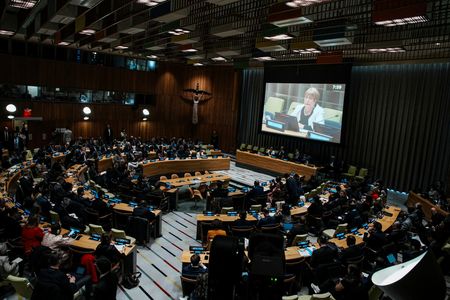
April 21 (Reuters) - The four candidates vying to become the next United Nations secretary-general face live hearings on Tuesday and Wednesday on their bids to lead the troubled global organization from next year.
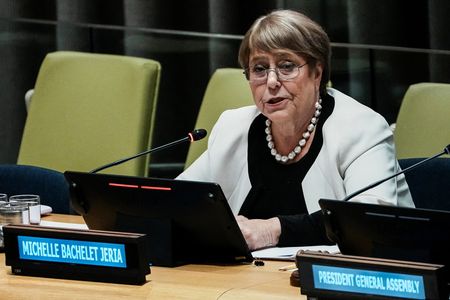
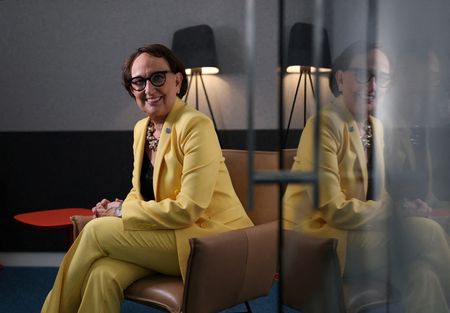
Chile's Michelle Bachelet, Argentina's Rafael Grossi, Costa Rica's Rebeca Grynspan and Senegal's Macky Sall are competing for a five-year term at the helm of the 193-member body, which can be extended for another five.
While they are the only declared candidates so far, others can join in the race in the coming months.
The next U.N. leader will face an enormous task to revitalize an organization in crisis, whose stature has significantly diminished in recent years.
Major powers, even as they increasingly flout long-held norms of international order, have pressed the U.N. to reform, slash costs, and prove its relevance.
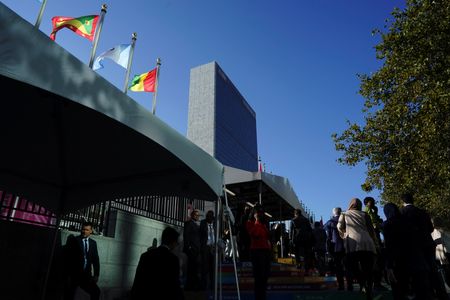
First up for three hours of grilling at U.N. headquarters in New York from member states and civil society representatives will be Bachelet and Grossi on Tuesday, followed by Grynspan and Sall on Wednesday.
There are currently far fewer candidates for the role than in 2016, when incumbent Antonio Guterres of Portugal was chosen from a field of 13 contenders, seven of them women.
The president of the U.N. General Assembly, Germany's Annalena Baerbock, described it as one of the toughest jobs in the world.
"But it is also one of the most important as the next Secretary-General will not only shape the future of this institution but in her or his role as the strongest defender of the U.N. Charter also that of the international rules-based order," she said.
No woman has been chosen in the U.N.'s 80-year history, despite growing calls to end this anomaly, and tradition has dictated that the role rotate between regions, with Latin America next in line.
Another unwritten rule is that a secretary-general never comes from among the five permanent members of the U.N. Security Council - Britain, China, France, Russia and the United States - to avoid over-concentration of power, though their backing is crucial in a lengthy and arcane selection process.
CRISIS REQUIRES 'PROACTIVE VISION'
"The need for a Secretary-General prepared to defend a clear, proactive vision for the U.N. on peacemaking and crisis management could not be more urgent," the International Crisis Group's Daniel Forti wrote recently.
"If candidates and member states miss this opportunity, there may be little left of the U.N. to defend."
Bachelet, 74, is a two-time president of Chile and a former U.N. High Commissioner for Human Rights.
In March, her own country withdrew its backing for her candidacy after a right-wing shift in leadership, but she has retained support from Brazil and Mexico.
Bachelet has faced criticism from U.S. conservatives for her pro-choice views and this month Washington's U.N. envoy appeared to torpedo her bid by saying he shared concerns about her suitability.
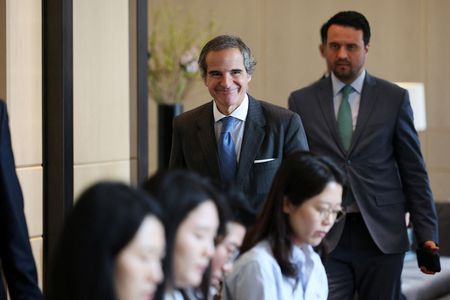
Grossi, a 65-year-old career diplomat and father of eight who speaks English, Spanish, French and Italian, has headed the U.N. nuclear watchdog for six years.
In his vision statement, Grossi declared that "even in times of division, multilateral institutions can deliver real, positive impact."
Grynspan, 70, a former vice president of Costa Rica who heads the U.N. Conference on Trade and Development, depicts herself as a reform‑minded multilateralist with a lifelong belief in U.N. commitments to peace, development and human rights, who has battled gender barriers.
"I am not waiting for special treatment. I want equal treatment," she told Reuters.
Sall, 64, Senegal's president for 12 years until 2024, is a geologist and son of a peanut seller.
Soft-spoken and more comfortable in French than English, he has championed African development and support for debt-burdened countries. "More than ever, a reinvented multilateralism remains the best way to respond to the challenges of a world in full transformation," he said on X.
(Reporting by David Brunnstrom in Washington and Emma Farge and Olivia Le Poidevin in Geneva; Editing by Don Durfee and Matthew Lewis)