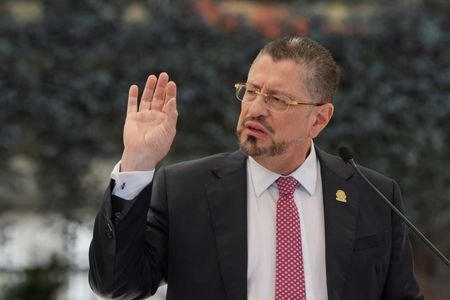
SAN JOSE, March 18 (Reuters) - Costa Rica's President Rodrigo Chaves said on Wednesday his administration did not recognize Cuba's government as legitimate and would close the Cuban embassy in its capital San Jose.
"Costa Rica does not recognize the legitimacy of Cuba's Communist regime, given the mistreatment, repression, and undignified conditions endured by the inhabitants of that beautiful island," Chaves said at an event attended by the U.S. ambassador.
"We must cleanse the hemisphere of Communists," Chaves added.
Neither Cuba's foreign ministry nor its embassy in Costa Rica immediately responded to requests for comment.
Cuba recently agreed to let Cuban Americans and others living abroad invest in and own businesses on the island, days after it began talks with Washington.
U.S. President Trump signaled this week he expected to have the "honor" of "taking Cuba in some form."
His administration has imposed an oil blockade on the Caribbean's largest island, contributing to widespread blackouts that have knocked out power across homes, hospitals and businesses.
The shortages have also battered transport, including Havana's trash collection system, and pushed some residents to turn to solar panels for power.
REGIONAL SHIFTS
Ecuador this month also closed its Cuban embassy, after declaring Cuban Ambassador Basilio Gutierrez and his diplomatic staff "persona non grata."
Ecuador's and Costa Rica's presidents were among a raft of right-wing-aligned Latin American presidents to attend an anti-crime summit Trump hosted in Florida this month, known as "Shield of the Americas."
Costa Rica's announcement comes as a slate of countries in Central America and the Caribbean announced they will end agreements to hire Cuban medics in their countries - an important source of foreign income for the Cuban government and a source of medical services in often under-served rural communities.
The U.S. had accused the program of exploiting its workers and threatened sanctions on officials from countries that take in Cuban workers.
Cuba has faced a longstanding U.S. economic embargo, which its government blames for its economic crisis that has pushed over 1 million people to leave the island.
Most countries globally oppose the embargo, but in October, Argentina and Paraguay joined a handful of countries in shifting their support to the United States in a U.N. vote.
(Reporting by Alvaro Murillo, Editing by Daina Beth Solomon, Rod Nickel)