By Soren Jeppesen and Louise Rasmussen
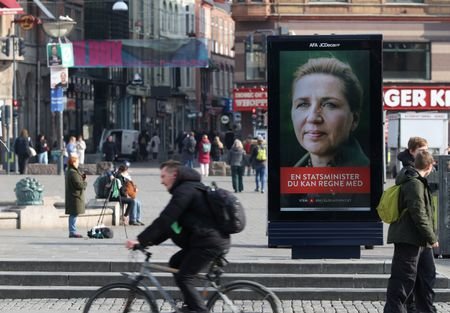
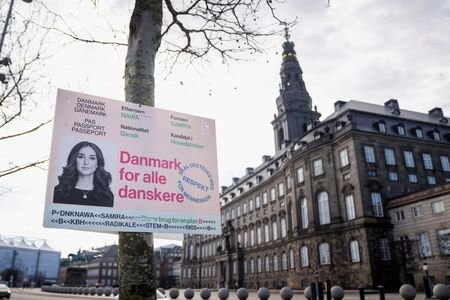
COPENHAGEN/NUUK, March 24 (Reuters) - Danish Prime Minister Mette Frederiksen emerged ahead but weakened in Tuesday's election, as the cost-of-living crisis appeared to obscure Denmark's support for her tough stance against U.S. President Donald Trump over Greenland.
In power since 2019, Frederiksen has benefited in recent months from her resistance to Trump's desires to control the Arctic island, but many Danes have grown weary of her focus on international affairs and accused her of neglecting domestic woes.
A poll from broadcaster DR and Epinion gave the left-wing bloc 83 seats against 78 for the right in the 179-seat assembly, the Folketing, while a TV2 and Megafon survey predicted 86 seats for the left and 75 for the right. The exit polls indicate the worst result for Frederiksen's Social Democrats since the start of the last century, with support collapsing to between 19.2% and 21%, a dramatic fall from the 27.5% they won in the last election.
Partial results are expected later in the evening.
If official results confirm the outcome, Frederiksen may struggle to form a cabinet. She will likely need support from across the political spectrum, similar to her outgoing cabinet, Denmark's first to bring left- and right-wing parties together in more than four decades.
Frederiksen, 48, had campaigned on a promise that her tough and tested leadership skills would help the Nordic nation of 6 million navigate a complex relationship with Washington and a European response to Russia's war against Ukraine.
In Brussels, she is widely respected for her clear line on Greenland and for her efforts to ramp up Denmark's defence spending in the wake of the Ukraine conflict. But her negotiating style is seen by some as abrasive and many Danes sought change.
"She is between a rock and a hard place because the (exit poll) numbers are bad for her," said Andreas Thyrring, a partner at Ulveman & Borsting public affairs advisory firm.
TOUGH TALKS AHEAD
Frederiksen called the vote months before an October deadline, in what analysts said was an effort to capitalise on an uptick in popularity when Trump's rhetoric about controlling Greenland, a semi-autonomous Danish territory, intensified in January and he refused to rule out military force.
But Greenland has since moved to a less heated diplomatic track and has been overtaken by domestic concerns, including a proposed wealth tax, debates on immigration and calls for restrictions on agricultural pesticides affecting the groundwater.
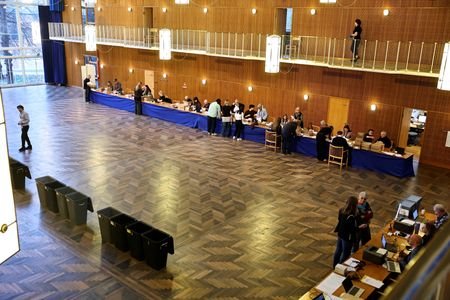
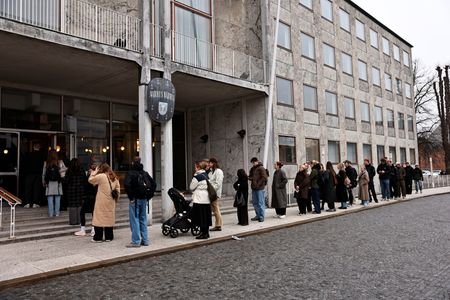
"The environment is the most important. And also to have a stable government. That's the two main things I'm voting for," said Kenneth Gall, a theatre producer casting his ballot at Copenhagen's City Hall.
In Greenland, the election is being closely watched, with many hoping it will be a chance for the territory to leverage Trump's attention to wrangle concessions from its former colonial power.
Many Greenlanders accuse Denmark of unfairly benefiting from their fishing industry, holding back economic independence and failing to protect the more than 17,000 Greenlanders living in Denmark from discrimination.
"This is perhaps the most important parliamentary election we've had ... we must secure greater equality in our union and stand together against outside forces, including the United States who has unfortunately shown a will or desire to own and control us," Greenland's Prime Minister Jens-Frederik Nielsen said as he cast his ballot.
Frederiksen may have to rely on deputies further to the right on the political spectrum or even on a handful of lawmakers from Greenland or the Faroe Islands, both semi-autonomous Danish territories.
This could give Foreign Minister Lars Lokke Rasmussen's non-aligned centrist Moderates the power to decide whether Frederiksen's left-wing bloc or its right-wing opponents form the next government.
(Reporting by Stine Jacobsen, Louise Rasmussen, Soren Jeppesen, Ilze Filks, Tom Little and Leonhard Foeger in Copenhagen, Tim Barsoe in Nuuk and Oliver Barth in Graested; Writing by Justyna Pawlak. Editing by Terje Solsvik, Alex Richardson, Rod Nickel)