By Stine Jacobsen and Oliver Barth
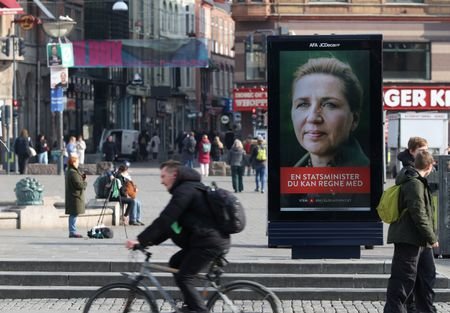
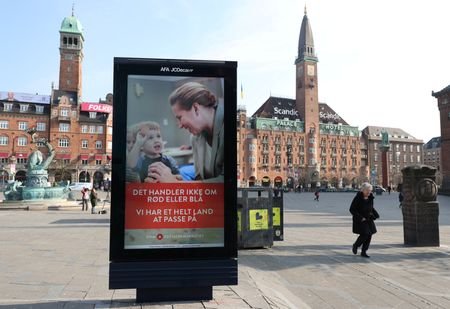
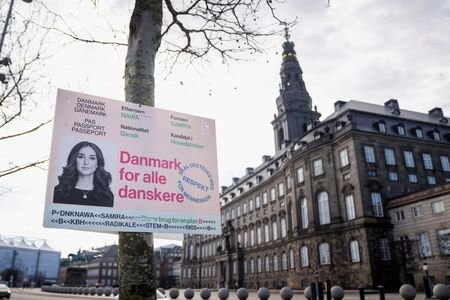
COPENHAGEN, March 24 (Reuters) - Danes voted on Tuesday in an election that could hand Prime Minister Mette Frederiksen a third term thanks to her staunch line against U.S. President Donald Trump over Greenland, even though cost-of-living worries have hurt her leftist credentials.
Opinion polls show her Social Democrats are headed for their weakest result since before World War Two - many Danes blame Frederiksen for not doing enough to protect their Nordic welfare model, while others point to growing weariness after nearly seven years of her leadership.
Frederiksen, 48, called the vote months before an October deadline, in what observers said was an effort to capitalise on an uptick in popularity when Trump's rhetoric about controlling Greenland, a semi-autonomous Danish territory, intensified in January and he refused to rule out military force.
But Greenland has since moved to a less heated diplomatic track and has been overtaken by domestic concerns, including a proposed wealth tax, debates on immigration and calls for restrictions on agricultural pesticides affecting the groundwater.
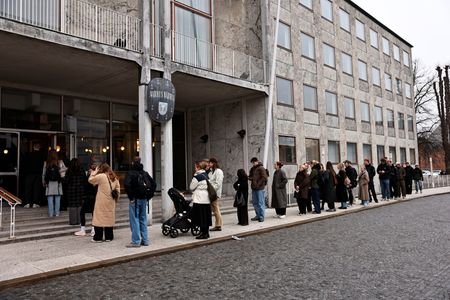
"The environment is the most important. And also to have a stable government. That's the two main thing I'm voting for," said Kenneth Gall, a theatre producer casting his ballot at Copenhagen's City Hall.
Polling stations close at 8 p.m. (1900 GMT), with exit polls due shortly after.
DENMARK PREPARES FOR A MORE UNCERTAIN WORLD
Frederiksen has campaigned on a promise that her tough and tested leadership skills will help the nation of 6 million navigate a complex relationship with Washington and a European response to Russia's war against Ukraine.
"I know that sometimes I express myself a bit bluntly," she said during a recent campaign event. "But given the times we live in, it is perhaps very good that there are some things that cannot be misunderstood: that Russia should not be allowed to win or that Greenland is not for sale."
Frederiksen, who has led Denmark since 2019, was the first premier to bridge the left-right divide in Denmark in more than 40 years, but her grand coalition is now projected to lose its parliamentary majority.
Foreign Minister Lars Lokke Rasmussen of the centrist Moderates Party, who may end up as a post-election kingmaker, said he was still hoping for a bipartisan government, even as the current coalition looked set to lose its grip on power.
"This is basically about Denmark preparing ourself for a world which is absolutely more uncertain than we were used to in the past," Rasmussen told reporters as he cast his ballot in the town of Graested, north of Copenhagen.
Rasmussen, himself a former two-times prime minister, reiterated that he was not seeking a third term as head of the government, but would like to lead talks to explore the formation of a coalition.
TESTING TIMES
"To a large degree, this election is about Mette Frederiksen," said political analyst Hans Engell, adding that, while some voters viewed her as the right person at a time of crisis, others saw her as too authoritarian.
Her Social Democrats, whose tough asylum reforms had alienated some on the left, have recovered in polls since the Greenland crisis, rising from a December low of 17% to around 21%.
But the left-leaning bloc is still expected to fall short of the 90 seats needed for a majority in Denmark's 179-seat Folketing, with projections pointing to around 85 seats.
With left-wing allies expected to hold firm and the right bloc fractured, however, she remains the favourite to form the next government as parties reposition themselves along more traditional left-right lines.
Key campaign issues include Frederiksen's proposal to reintroduce a wealth tax to fund investment in education and welfare, a move aimed at signalling a leftward shift.
In Denmark's parliamentary system a government need not command a majority - it simply must not have one against it.
The fractured right-leaning bloc is led by Defence Minister Troels Lund Poulsen of the Liberal Party, who hopes to win the backing of a wide range of parties, including hard-right anti-immigration groups and Rasmussen's Moderates.
In all, 12 parties are contesting the ballot. Additionally, four seats allocated to candidates from Greenland and the Faroe Islands may prove decisive.
Observers were particularly watching for results from Greenland, seeking signs on whether the governing coalition in Nuuk could be crumbling at a time when Denmark is in talks with U.S. and Greenlandic officials about future policy.
(Reporting by Stine Jacobsen, Louise Rasmussen, Soren Jeppesen, Ilze Filks, Tom Little and Leonhard Foeger in Copenhagen, and Oliver Barth in Graested; writing by Justyna Pawlak, editing by Terje Solsvik and Alex Richardson)