By Soren Jeppesen, Stine Jacobsen and Louise Rasmussen
COPENHAGEN, March 25 (Reuters) - Denmark's king asked Prime Minister Mette Frederiksen and her Social Democrats on Wednesday to explore the formation of a new government with two left-wing parties, kicking off what could be weeks of talks to build a working parliamentary majority.
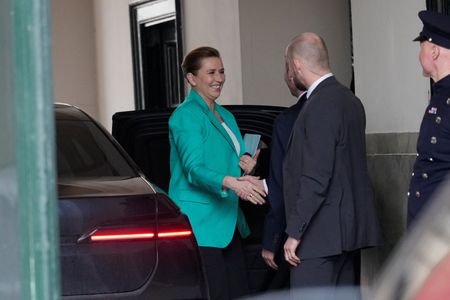
Frederiksen earlier handed in her centrist coalition government's resignation after a massive election defeat but she could still emerge as the leader of a new Danish government.
Analysts say Tuesday's election result marked a voter revolt over the outgoing government's broken economic promises and a sign that the electorate has grown tired of Frederiksen as a leader after seven years in power.
Her Social Democratic Party suffered its worst election result since 1903, winning just 38 seats in the 179-seat parliament - down from 50 - but it remains the largest party in parliament.
Voters' concerns over domestic issues such as the environment, the cost-of-living crisis and welfare outweighed any support Frederiksen garnered with her defiant stance towards U.S. President Donald Trump's repeated ambitions to acquire Denmark's semi-autonomous territory of Greenland, analysts said.
"This loss was larger than you could explain just by the cost of ruling," said Rune Stubager, a political scientist at Aarhus University.
POLARISED ELECTORATE SHIFTS TOWARDS MARGINS
Stubager attributed the defeat to polarising economic decisions, such as the controversial scrapping of a public holiday, tax cuts for high earners, and a last-minute proposal to introduce a wealth tax, which failed to resonate with voters.
King Frederik X tasked Frederiksen with exploring a coalition of her Social Democrats with the Green Left, which won 20 seats, and the Social Liberal Party, which secured 10 seats.
But while other left-wing parties may support this constellation, Frederiksen would also need support from the centrist Moderates party or right-wing parties to form a working majority for her policies in parliament.
If she fails to build a new coalition, the king would have to invite another person to explore options for forming a new government.
The election reflected a broader trend of voters moving away from centrist parties. Right-wing nationalist parties increased their share of the vote to 17%, from 14.4% in 2022, while the Green Left Party also gained ground.
The anti-immigration Danish People's Party also capitalised on concerns over inflation and living costs, promising to cut fuel taxes and staging campaign events offering discounted petrol to motorists, Stubager said.
While Frederiksen's tough immigration policies remained broadly in line with public sentiment, the domestic economic agenda carried more weight in this election, analysts said.
NEITHER BLOC HAS A MAJORITY
Despite their losses, the Social Democrats remain Denmark's biggest party with 21.9% support, meaning Frederiksen is widely seen as having a good shot at returning for a third term as prime minister.
"That is the paradox of the election, that the huge loser, Mette Frederiksen, the prime minister, she is the favourite to become the next prime minister as well," political analyst Noa Redington said.
In total, Frederiksen's left-wing bloc secured 84 seats in parliament, slightly ahead of the right-leaning bloc's 77 seats, leaving both sides short of the 90 seats required to form a majority government. The Moderates, led by Foreign Minister Lars Lokke Rasmussen, emerged as a potential kingmaker with 14 seats.
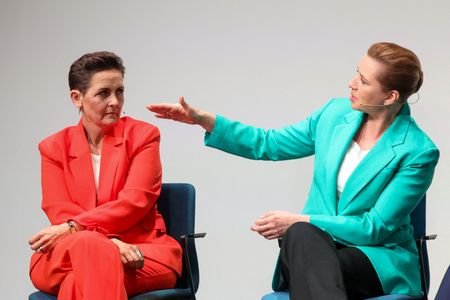
Frederiksen acknowledged the fractured electoral landscape during a Wednesday debate, saying the result excluded the possibility of forming a traditional right- or left-wing government.
"So what is left is that we need to cooperate. That is the message here," she said.
Since 2022, Frederiksen has led a grand coalition of the Social Democrats, the right-of-centre Liberal Party and the Moderates. The leader of the Liberal Party, Defence Minister Troels Lund Poulsen, has said he is no longer interested in coalition rule with Frederiksen.
(Reporting by Tom Little, Soren Jeppesen and Louise Breusch Rasmussen in Copenhagen and Anna Ringstrom in Stockholm, writing by Stine Jacobsen, editing by Alex Richardson and Gareth Jones)