By Andrew Gray and Lili Bayer
BRUSSELS, March 19 (Reuters) - European Union leaders failed to convince Hungarian Prime Minister Viktor Orban on Thursday to lift his blockade on a 90-billion-euro ($103 billion) EU loan to help Ukraine keep up its fight against Russia's invasion.
After a summit in Brussels, several leaders voiced deep frustration with Orban, who has cited a dispute over a war-damaged pipeline to justify blocking the implementation of the loan agreed back in December.
German Chancellor Friedrich Merz accused Orban - who maintains cordial ties with Russia and is running for re-election next month - of an act of "gross disloyalty" that damaged the EU's reputation and ability to act.
European Council President Antonio Costa, the chair of the summit, declared: "A deal is a deal, and all the leaders need to honour that word. And nobody can blackmail the European Council."
EU officials say that Kyiv could run short of money in weeks if it does not receive new funding and that Orban's U-turn has called into question the credibility of the European Council, the EU's highest decision-making body.
Orban, a frequent critic of Ukrainian President Volodymyr Zelenskiy, has been able to block the loan as one step in the implementation process requires unanimity among the bloc's 27 member states.
PIPELINE CARRYING RUSSIAN OIL AT HEART OF DISPUTE
At the heart of the hold-up is the Druzhba pipeline, which carries Russian oil through Ukraine to Hungary and Slovakia. It was damaged by a Russian attack in January, according to Ukrainian and EU officials.
Ukraine says the pipeline will take a further six weeks to repair. Hungary says the pipeline is already functional and accuses Ukraine of withholding the oil supply.
Some leaders voiced hope that Hungary will change its stance after next month's election or after the pipeline is repaired.
But Merz said EU leaders had asked the European Commission, the bloc's executive, to examine whether there were ways to implement the loan without relying on Orban.
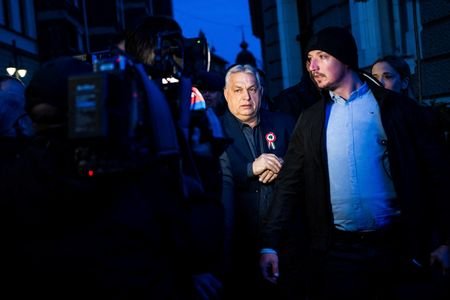
Orban said he had faced a "tough debate" at the summit but Hungary had stood its ground. "As long as Zelenskiy does not lift the oil blockade, they will not receive any money from Brussels," he posted on X.
Speaking to reporters after the summit, Orban said Hungary also wanted guarantees the oil supply would not be interrupted again.
That argument drew the ire of Costa, who said only Russia could ensure the pipeline would not be attacked in future.
"This is not responsibility of Ukraine. This is not responsibility of the European Union," he said. "And that's why it's completely unacceptable what Hungary is doing."
Slovak Prime Minister Robert Fico also criticised Ukraine over interrupted supplies through the pipeline. "Relations between the EU and Ukraine, as well as mutual Slovak-Ukrainian relations, are not and cannot be a one-way ticket," Fico said.
ZELENSKIY TELLS LEADERS LOAN IS 'CRITICAL' FOR UKRAINE
In a video address to the EU leaders which was posted on X, Zelenskiy said the loan was "critical" for Ukraine. "It is a resource to protect lives," he said.
Orban, a nationalist ally of U.S. President Donald Trump, has often clashed with Brussels and mainstream EU politicians but had not previously reneged on a deal agreed among EU leaders, diplomats say.
Many EU officials are particularly exasperated by Orban's veto as Hungary secured an opt-out from paying for the costs of the loan, along with the Czech Republic and Slovakia.
With Russia's war on Ukraine in its fifth year, Kyiv faces a ballooning budget deficit and has said there are no alternative financing options if the EU loan remains blocked.
Ukraine's government spends the bulk of its revenues on defence and depends on foreign financial aid to pay pensions, public sector wages, and other social spending.
If the loan is not approved soon, the government will have to start cutting expenditure and resort to printing money, political analysts said.
($1 = 0.8726 euros)
(Additional reporting by Andrew Gray, Bart Meijer, Miranda Murray, Essi Lehto, Gianluca Lo Nostro, Gergely Szakacs, Andreas Rinke, Olena Harmash, Julia Payne, Jason Hovet and Alexander Chituc; Writing by Andrew Gray and Ingrid Melander; Editing by Stephen Coates, Timothy Heritage and Gareth Jones)