By Saurabh Sharma, Sarita Chaganti Singh and Gopal Sharma
KATHMANDU, Sept 9 (Reuters) - Flood-hit Nepal will ask wealthier countries and global agencies for financial help this week, arguing they should contribute to the $5 billion needed for initial rebuilding as the disaster shows how climate change has hit poor countries that did little to cause it, officials said.
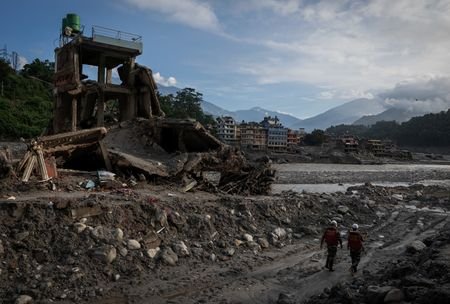
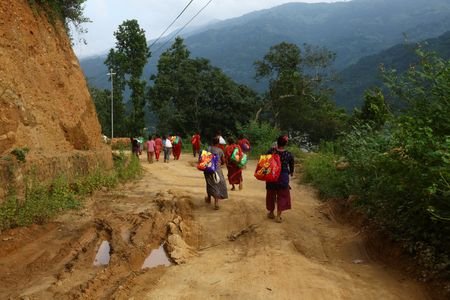
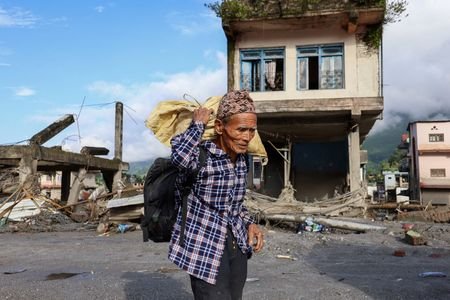
Since the collapse of a Himalayan glacier in late August caused devastation in the valleys below, at least 1,300 people have been confirmed dead and more than 5,300 are missing across Nepal and China's Tibet region.
The torrent also swept away more than 12 hydropower plants, cross-border trade routes, roads, bridges, houses and other infrastructure in Nepal, which bore the brunt of it.
Nepal's initial estimate for funds covers the first phase of recovery over the next five months and will be shared with the World Bank and Asian Development Bank, along with the embassies of countries and blocs including the United States, Britain, India, China, Japan and the European Union, Nepal's disaster management chief Dharam Raj Uprety told Reuters.
"It's not only a disaster induced by flood, it's massive. A disaster induced by climate change..." he said.
Reuters is reporting for the first time Nepal's plan to position its $5 billion rebuilding need as a climate justice issue in its outreach to donor countries and agencies this week.
'CLIMATE CHANGE IMPACT A SHARED RESPONSIBILITY'
Nepalese officials have publicly framed the disaster as an example of the disproportionate impact of climate change on poor countries.
Nepal expects global agencies and other partners to "recognise this kind of event and take accountability on that", though it is not for the country to dictate who should contribute how much, said Prakash Pokhrel, a geologist for the National Disaster Risk Reduction and Management Authority.
"We need not say what is causing climate change because you already know why climate change is happening and who is contributing the most to it," Pokhrel said.
"Countries like Nepal don't contribute significantly to climate change, but they are facing this level of disaster. So why should it not be a shared responsibility among the global community?"
China accounts for roughly a third of global emissions, with the United States and Nepal's other neighbour, India, also among the world's biggest emitters. Nepal has said in its submissions to the United Nations that its contribution to past and current greenhouse gas emissions is negligible.
China is willing to provide assistance within its capacity for Nepal's post-disaster reconstruction, foreign ministry spokesperson Guo Jiakun said on Thursday.
Guo said Beijing had immediately extended assistance to Nepal, while rescue and relief work was ongoing back home on its side of the border.
"We believe that under the leadership of the Nepalese government, the Nepalese people will be able to overcome the disaster and rebuild their homes at an early date," he said at a regular news briefing.
FUNDS TYPICALLY COME SLOWLY
But the experience of fellow South Asian country Pakistan shows that international funding linked to natural disasters tends to arrive slowly and may lag initial commitments.
Pakistan secured about $11 billion in pledges from international partners including the Islamic Development Bank and Saudi Arabia following devastating 2022 floods that displaced millions. But nearly 42% of the commitments -- about $4.6 billion - was allocated for oil imports by international partners rather than direct flood reconstruction.
By early 2024, the government estimated that only $3.4 billion had actually been disbursed. Oil funding accounted for $1.45 billion of the disbursed amount.
The Nepal government is finalising a report detailing the extent of the damage, losses and funding requirements for temporary shelters, schools and essential infrastructure, officials said.
The donor outreach will come ahead of Prime Minister Balendra Shah's address at the United Nations on September 24, where he is expected to seek greater international support for climate-vulnerable developing countries.
(Reporting by Saurabh Sharma, Sarita Chaganti Singh and Gopal Sharma; Additional reporting by Ariba Shahid, and Colleen Howe; Editing by Krishna N. Das and Toby Chopra)