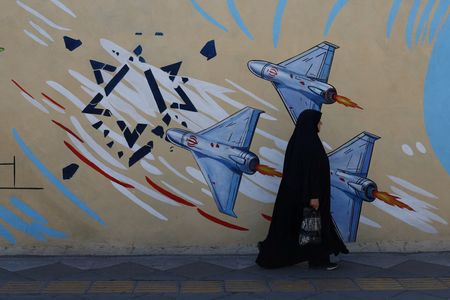
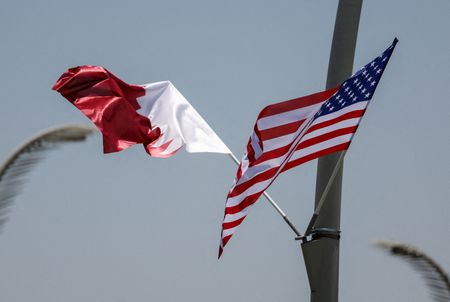
May 22 (Reuters) - A Qatari negotiating team arrived in Tehran on Friday in coordination with United States to try to help secure a deal to end the war with Iran and resolve outstanding issues, a source with knowledge of the matter told Reuters on Friday.
Doha, which has worked as a mediator in the Gaza war and other areas of international tension, had till now distanced itself from playing a mediation role in the Iran war after it came under attack from Iranian missiles and drones during the latest conflict.
"A Qatari negotiation team is in Tehran on Friday," the source said, adding that the team had travelled in coordination with the United States and was there to help "reach a final deal that would end the war and address outstanding issues with Iran."
The Qatari Ministry of Foreign Affairs did not immediately respond to a request for comment.
While Pakistan has served as the official mediator since fighting began, Qatar's re-engagement reflects its longstanding role as a U.S. ally in the region and trusted back-channel between Washington and Tehran.
A shaky ceasefire is in place in the war that began with U.S.-Israeli strikes on Iran on February 28, but there has been no major breakthrough, with a U.S. blockade of Iranian ports and Tehran's effective closure of the Strait of Hormuz complicating negotiations.
A senior Iranian source told Reuters on Thursday that no deal had been reached but gaps have been narrowed, with Iran's uranium enrichment and its control over the strait among the remaining sticking points.
Secretary of State Marco Rubio noted some progress on Thursday: “There's some good signs," he said. "I don't want to be overly optimistic ... So, let's see what happens over the next few days."
Asked on Friday about the Qatari team in Iran, Rubio told reporters on the sidelines of a gathering of NATO foreign ministers in Sweden that Pakistan was the primary interlocutor in the Iran talks and they had done an "admirable job".
He added: "Obviously other countries have interests, because especially Gulf countries that are, you know, in the middle of all this - they have their own situation going. And we talk to all of them. I would just say that the primary country we've been working with on all of this, is Pakistan, and that remains the case."
Doha's re-engagement comes despite Iran having pounded Qatar with hundreds of missiles and drones, targeting civilian infrastructure and its vital liquefied natural gas (LNG) production facility at Ras Laffan. That attack wiped out roughly 17 percent of Qatar's LNG export capacity. The country had already halted LNG production on March 2 following Iranian strikes.
Before the war, about 20% of global LNG trade transited the Strait of Hormuz, primarily from Qatar — Iran's effective closure of the strait has cut off virtually all of its LNG export capacity.
Qatar is a designated major non-NATO ally of the United States and hosts Al Udeid Air Base, the largest U.S. military installation in the Middle East.
(Reporting by Dubai Newsroom; Additional reporting by Doina Chiacu, Editing by Toby Chopra, Editing by William Maclean)