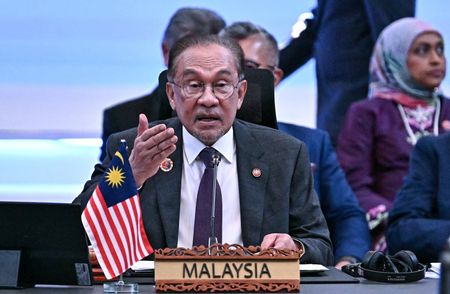
KUALA LUMPUR, May 29 (Reuters) - Malaysia's Prime Minister Anwar Ibrahim has said he would consider calling for snap polls if tensions within his ruling alliance got worse.
The next general election is not due until February 2028, but Anwar may seek the consent of the country's king to dissolve parliament earlier. Government lawmakers told Reuters in March an election could be held as soon as July.
Here's why the Southeast Asian nation could see early polls:
SYNCHRONISING STATE AND FEDERAL POLLS
Malaysia is a federal system and most state polls are usually held alongside the federal election every five years.
But political instability since 2020 has led to some state governments collapsing before the end of their terms, breaking the election cycle.
Three states are due to hold polls within the next year - Johor and Malacca on the Malaysian peninsular, and Sarawak on Borneo island.
The Election Commission said in February an early general election would allow the state polls to be held concurrently, reducing costs, media reported.
CRACKS IN THE RULING COALITION
Anwar took office in November 2022, forming a "unity government" consisting of his Pakatan Harapan bloc, former rival Barisan Nasional (BN), and a handful of other parties after a general election ended in an unprecedented hung parliament.
The administration has been praised for restoring stability, after a period of political infighting since 2020 that saw three prime ministers in as many years.
The ruling coalition, however, has been tested by internal divisions, with some allies concerned over corruption allegations and a rollback in democratic freedoms.
Anwar has also faced pressure from BN's once-dominant United Malays National Organisation (UMNO) over a royal pardon for former prime minister and UMNO leader Najib Razak, who has been in prison since 2022 for his role in the multibillion-dollar 1MDB scandal.
Johor BN said this month it would contest the upcoming state election independently without Pakatan's support, in a sign of the growing tensions.
RISING ENERGY COSTS
Malaysia has enjoyed steady economic growth and a jump in investment during Anwar's tenure, but public discontent has grown over rising living costs.
The government provides support and subsidies for fuel and other basic needs. But its energy subsidy bill has ballooned to around 7 billion ringgit ($1.77 billion) a month as a result of the U.S.-Israeli war on Iran, straining its finances.
Anwar may be pushed to seek a fresh mandate ahead of any move to trim subsidies or raise fuel prices, which would be deeply unpopular, analysts have said.
FRAGMENTED OPPOSITION
An early election could also benefit Anwar's coalition, with the country's opposition in disarray.
The opposition is currently led by PAS, the country's Islamist party. PAS took over leadership of the bloc this month after its key partner Bersatu, headed by former prime minister Muhyiddin Yassin, fractured due to internal rifts that saw more than a dozen party leaders sacked.
Anwar may also be challenged by two of his former cabinet ministers, Rafizi Ramli and Nik Nazmi Nik Ahmad, who left the ruling coalition earlier this month to lead a smaller party.
While they say thousands have joined, including defectors from Anwar's bloc, it remains unclear if they will have sufficient support to be a major electoral force.
($1 = 3.9640 ringgit)
(Reporting by Rozanna Latiff; Editing by Kate Mayberry)