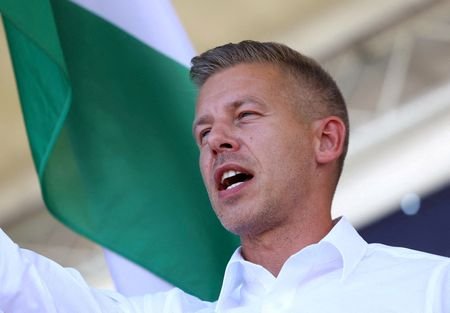
Feb 10 (Reuters) - Hungary's main opposition Tisza Party has published its manifesto for an April 12 election, when its leader Peter Magyar aims to end nationalist Prime Minister Viktor Orban's 16-year rule.
The centre-right party presents the biggest challenge to Orban's rule since his Fidesz party swept to victory in 2010, opinion polls suggest, although the outcome of the ballot remains highly uncertain.
Following are key points from Tisza's plan:
ECONOMIC POLICY
* Seek the release of billions of euros worth of EU funding currently suspended over Orban's rule-of-law reforms to help kick-start Hungary's stagnating economy.
* Use those released funds to invest in healthcare, transport, education and support for businesses.
* Clamp down on corruption and cut back on what it calls unjustified public investments, saying this could save trillions of forints.
* It expects stronger growth and investor confidence to curb the financing costs of the EU's largest debt pile outside the euro zone by up to 1 trillion forints ($3.15 billion) over the longer term.
* It aims to cut the budget deficit from 5% or more of gross domestic product this year to below 3% and to meet euro entry criteria by 2030. However, joining the euro would not be possible without a parliamentary super-majority.
* Raise healthcare spending by at least 500 billion forints each year until it reaches 7% of GDP by 2030.
* Impose a 1% tax on wealth exceeding 1 billion forints that it says will raise hundreds of billions of forints.
* Limit state intervention in the economy and markets and create a predictable and transparent business environment.
* Support small businesses with EU-funded grants and tax benefits while cutting bureaucracy and energy costs.
* Suspend new permits for workers from outside the EU from June.
* Cut subsidies for manufacturing and polluting technologies and review the operation of large battery manufacturers in Hungary to ensure they comply with environmental standards.
FOREIGN POLICY
* Lift defence spending to NATO's target of 5% of GDP by 2035.
* Tisza would not send troops to Ukraine and does not plan to revive conscription.
* It does not support the fast-track entry of Ukraine into the EU and would put the issue of Ukraine's EU membership to a binding referendum.
* Halt Hungary's withdrawal from the International Criminal Court.
* Seek a bilateral strategic partnership with the U.S. focusing on energy diversification, security and transparent economic cooperation.
* Strengthen Hungary's European and Western orientation.
* It would not accept the relocation of migrants from western Europe and opposes EU migration quotas and its migration pact.
RULE OF LAW
* Join the European Public Prosecutors' Office.
* Strengthen the independence of public media and the judiciary.
* Greater transparency in public procurement, tougher conflict-of-interest rules.
* Two-term limit for prime ministers.
ENERGY
* Eliminate dependence on Russian energy by 2035.
* Full-scale review of a Russian-built nuclear power plant.
* Double the share of renewables in Hungary's energy mix by 2040.
* Launch a 1 trillion forint energy efficiency programme for households and companies.
* Maintain and extend Orban's policy of household energy price subsidies.
SOCIAL POLICY
* Employment taxes will not increase.
* Cut income tax for 2.2 million workers earning below the median wage. The current 15% rate would stay in place for higher earners.
* Cut the tax on the minimum wage to 9% from 15%.
* Maintain and extend the current system of family benefits.
* A so-called 13th and 14th month of pension payment launched by Orban would remain in place.
($1 = 317.23 forints)
(Compiled by Gergely SzakacsEditing by Gareth Jones)