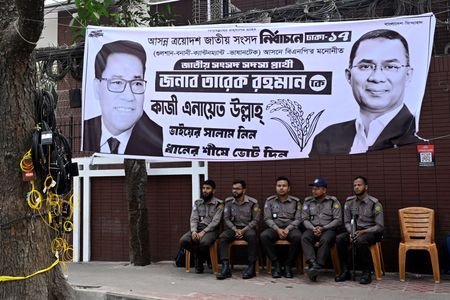
Feb 13 (Reuters) - The Bangladesh National Party (BNP) won a decisive two-thirds majority on Friday in general elections, a result expected to bring stability to the nation after months of tumult following the ouster of former Prime Minister Sheikh Hasina in a Gen Z-led uprising.
The party, led by Tarique Rahman, will return to power after 20 years. Rahman, the son of BNP founder and former president Ziaur Rahman, is widely expected to be sworn in as prime minister.
Here are some of the key promises made by the BNP in its election manifesto, which has the motto 'Bangladesh before all':
REFORMS
* To implement all points of the July Charter that seeks to create new constitutional bodies, introduce a bicameral parliament, along with broader changes in line with political parties' commitments
TRADE
* To undertake initiatives to restart closed industries and diversify the export sector
* To undertake measures so that legally operating foreign businesses can repatriate their stipulated profits to home countries within 30 days
EMPLOYMENT
* To create nearly 1 million new jobs in the information and communication technology sector
* To ensure fair, price-index-based wages in line with inflation and a review system to be launched every two years
* To develop technical and language skills among the youth and ensure merit-based government recruitment
ECONOMY
* To introduce international payment systems, establish regional e-commerce hubs and boost 'Make in Bangladesh'
* To launch a 'Family Card' for low-income families with monthly provisions to buy essential commodities
HEALTH
* To increase public spending on health to 5% of GDP gradually
* To recruit 100,000 health workers across the country and expand preventive healthcare programmes
SOCIAL
* To launch a mid-day meal program for students and a new, skills and values-based education policy for schools
* To build better sports infrastructure and training facilities
* To set up training-based welfare programs for religious leaders of all faiths at places of worship
(Compiled by Tanvi Mehta; Editing by Raju Gopalakrishnan)