By Michel Rose and Andrea Shalal
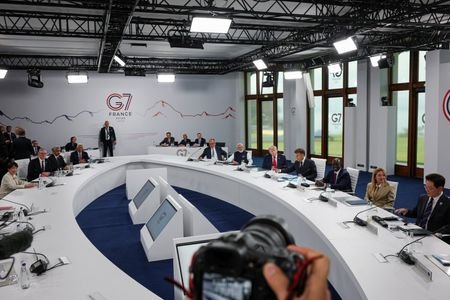
EVIAN-LES-BAINS, France/WASHINGTON, June 16 (Reuters) - G7 leaders on Tuesday pledged to step up efforts to address high debt burdens among developing countries, including middle-income countries not currently eligible for a debt relief initiative launched by the broader Group of 20 large economies during the COVID-19 pandemic.
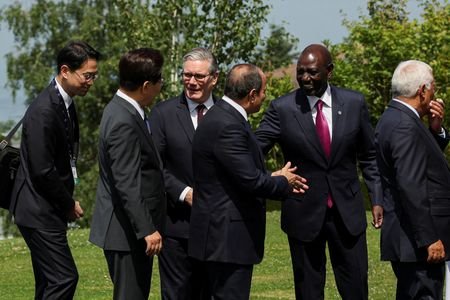
In a joint declaration issued after a session that included guest countries Kenya, Egypt, India, Brazil and South Korea, the G7 leaders affirmed their commitment to international cooperation on development while urging reforms and a greater emphasis on private investment.
They said traditional development policies had produced results, but had only "limited impact in reducing financial dependency on external assistance." Public resources, curtailed sharply by the U.S. and other advanced economies in recent years, would continue to play a key role, but were insufficient to meet global development needs, the leaders meeting in the French lakeside resort of Evian-les-Bains said.
"We will enhance efforts to address escalating global debt vulnerabilities that threaten economic stability and constrain fiscal space for essential public service interventions," the statement, backed by South Korea and Kenya, said.
The leaders also underscored the importance of progress toward a common approach to debt restructurings for vulnerable middle-income countries not eligible for the G20 Common Framework, set up during COVID to aid the poorest countries.
"Essentially what they're calling for is pre-emptive debt restructuring — dealing with debt before it becomes a crisis," said Eric LeCompte, executive director of Jubilee USA Network, a development group, welcoming the leaders' statement. He said the focus on private sector investment was important, given the decline of public development funding.
OECD data showed official development assistance dropped by 23.1% in real terms in 2025 to $174.3 billion, led by a nearly 57% drop in aid by the U.S. and smaller declines from Germany, France, Britain and Japan.
Kevin Gallagher, director of Boston University's Global Development Policy Center, noted that it was the G7's first official acknowledgement of debt concerns among poorer countries that were not eligible for the Common Framework. He expressed surprise, however, that the declaration did not address the urgent, immediate needs of developing countries caused by the war in the Middle East.
"Countries outside of the G7, especially in Asia and Africa, that are net energy importers need immediate liquidity finance, immediate fiscal support for imports and fuel/fertilizer subsidies, and longer-run low-cost development finance to shift away from such vulnerable positions in the world economy," he said.
Development group Oxfam International criticised the G7 statement, and called on its leaders to increase their aid to the 0.7% of gross national income previously promised.
“The G7 has made the biggest collective cut in life-saving aid in its history, a move that is already causing millions of people to die," said Joern Kalinski, the group's senior adviser on G7. “Repurposing life-saving aid to provide multiple financial incentives for private investors rather than building public schools and hospitals is the wrong thing to do, and will make a bad situation far worse."
(Reporting by Michel Rose, Richard Lough and Dominique Vidalon; Additional reporting by Andrea Shalal in Washington; Writing by Makini Brice; Editing by Alison Williams and Sanjeev Miglani)