
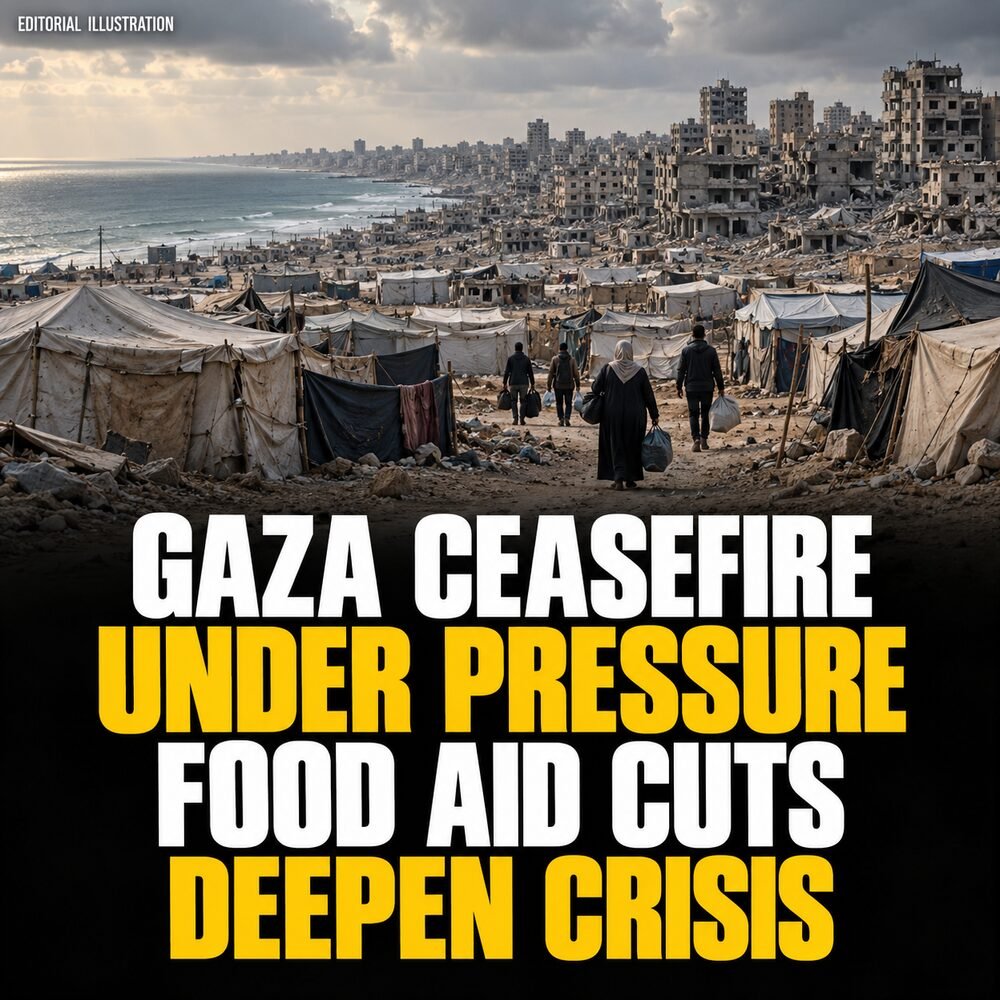
Fresh deaths, shrinking food assistance and inadequate shelter are placing further pressure on Palestinians as Gaza approaches another winter.
Gaza’s humanitarian crisis remains severe despite the ceasefire announced in October 2025, with continued violence and funding shortages threatening families already living through displacement and widespread destruction.
The agreement has reduced large-scale fighting, but it has not ended Israeli strikes or delivered a permanent peace, according to reporting by Sky News. Sky News
At least four Palestinians, including a married couple and a 17-year-old, were killed by Israeli strikes and gunfire on Tuesday, 20 October, health officials told Reuters. The Israeli military identified the man killed in the airstrike as a senior Hamas security official. It did not immediately comment on the two reported shooting incidents. Reuters
The latest deaths come as humanitarian agencies warn that assistance is being reduced at a particularly vulnerable moment.
On 19 October, the United Nations World Food Programme announced that funding shortages had forced it to cut food assistance in Gaza by approximately one-third. Its monthly programme is now reaching around 1.1 million people, down from 1.6 million, leaving approximately half a million people without that support.
The agency said food rations had been halved and the value of cash assistance reduced for 75,000 families. Its daily provision of hot meals has fallen from 250,000 to 150,000, with some families in areas that are difficult to reach receiving meals every other day.
WFP is seeking US$450 million to maintain critical operations across Gaza and the West Bank between October 2026 and March 2027. It warned that recent improvements in food security remain fragile and could be reversed by further funding reductions. World Food Programme
Winter preparations present another urgent challenge. In its situation report dated 15 October and published on 19 October, the UN Office for the Coordination of Humanitarian Affairs estimated that approximately 950,000 displaced people were living in sites assessed as facing medium or high flood risks.
Available shelter supplies could partially support only 18 per cent of the 294,250 families requiring assistance for the rainy season, the report said.
OCHA also warned that shortages of fuel, medicines, spare parts and other essential supplies were threatening health care and water services. Damaged buildings, deteriorating tents and limited relocation options continued to complicate efforts to protect displaced families. Occupied Palestinian Territory
Children remain particularly exposed. UNICEF said on 16 October that approximately 800,000 children were still displaced, with many living in tents or unsafe, damaged buildings. The agency reported that more than 340 children had been killed since the ceasefire was announced.
Although humanitarian assistance has helped restore some learning opportunities and essential services, UNICEF said recovery remains far from sufficient. It called for sustained funding, protection for children and the entry of equipment and materials needed to repair essential infrastructure.
The agency urged all parties to uphold the ceasefire, stressing that children need safety, adequate shelter, education and access to care to begin rebuilding their lives. unicef.org
Sources and references
- Reuters — Israeli fire kills four people in Gaza, medics say, 20 October 2026.
- Sky News — UN cuts food aid to half a million Gazans over funding shortages, 19 October 2026.
- World Food Programme — Funding cuts force WFP to reduce assistance in Gaza, 19 October 2026.
- UN OCHA — Humanitarian Situation Report, 15 October 2026, published 19 October 2026.
- UNICEF — Childhood defined by struggle for survival in the Gaza Strip, 16 October 2026.