By Andreas Rinke
STUTTGART, Germany, Feb 21 (Reuters) - Germany's ruling conservatives on Saturday passed a motion to ban social media use for under 14s and introduce more stringent digital verification checks for teenagers, building momentum for such limits in Germany and elsewhere in Europe.
At a party conference in the city of Stuttgart, Chancellor Friedrich Merz's Christian Democratic Union also called for fines for online platforms that failed to enforce such limits, and European Union-wide harmonisation of age standards.
A growing number of countries, including Spain, Greece, France and Britain, are looking at similar social media bans or restrictions on accessing platforms like TikTok or Instagram.
It follows the example of Australia, which last year became the first country to force platforms to cut off access for children.
European nations are more broadly ratcheting up pressure on social media companies, risking a backlash from the United States. President Donald Trump has threatened tariffs and sanctions if EU countries impose new tech taxes or online regulations that hit U.S. firms.
"We call on the federal government to introduce a legal age limit of 14 for the use of social networks and to address the special need for protection in the digital sphere up to the age of 16," said the motion that passed on Saturday.
Merz's coalition partners the Social Democrats have also backed social media curbs for children. Pressure from both parties in the coalition makes it increasingly likely that the federal government will push for restrictions.
However, under Germany's federal system, media regulation is a state‑level responsibility and states must negotiate with each other to agree consistent nationwide rules.
SCHOOLCHILDREN IN BONN DISCUSS THE BAN
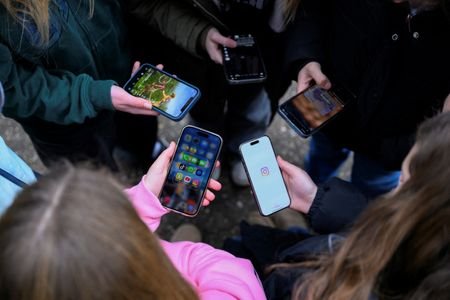
The ban could affect children like those at the Cardinal Frings Gymnasium in the city of Bonn, several of whom a day earlier were scrolling on their phones in the school grounds.
"I think it's fair, but I think it should be up to the parents to decide whether to forbid it, not the state," said 13-year-old Moritz, who says he only watches YouTube.
"For children under 12 it should be forbidden, but from age 12 onwards I think children can already distinguish between what is fake news and what is not."
His classmate Emma, 13, almost exclusively uses Snapchat, but has a time limit on her phone.
A ban would be "kind of unusual, because you get used to sending your snap in the morning before school, or what my friends do, like just scrolling through Instagram or TikTok for a bit," she said.
Ella, 12, scrolls through social media several times a day.
"So I have TikTok and Instagram myself, but I understand that it's all addictive, and the more you scroll, the more you want to see."
Teacher Till Franke said that for many of the children, "it would be a shock at first, because of this daily use of social media".
But eventually, the students would get used to it, he said, "because they would find other niches where they could communicate with each other".
(Andreas Rinke, Stephane Nitschke and Petra Wischgoll; Writing by Matthias Williams; Editing by Jan Harvey)