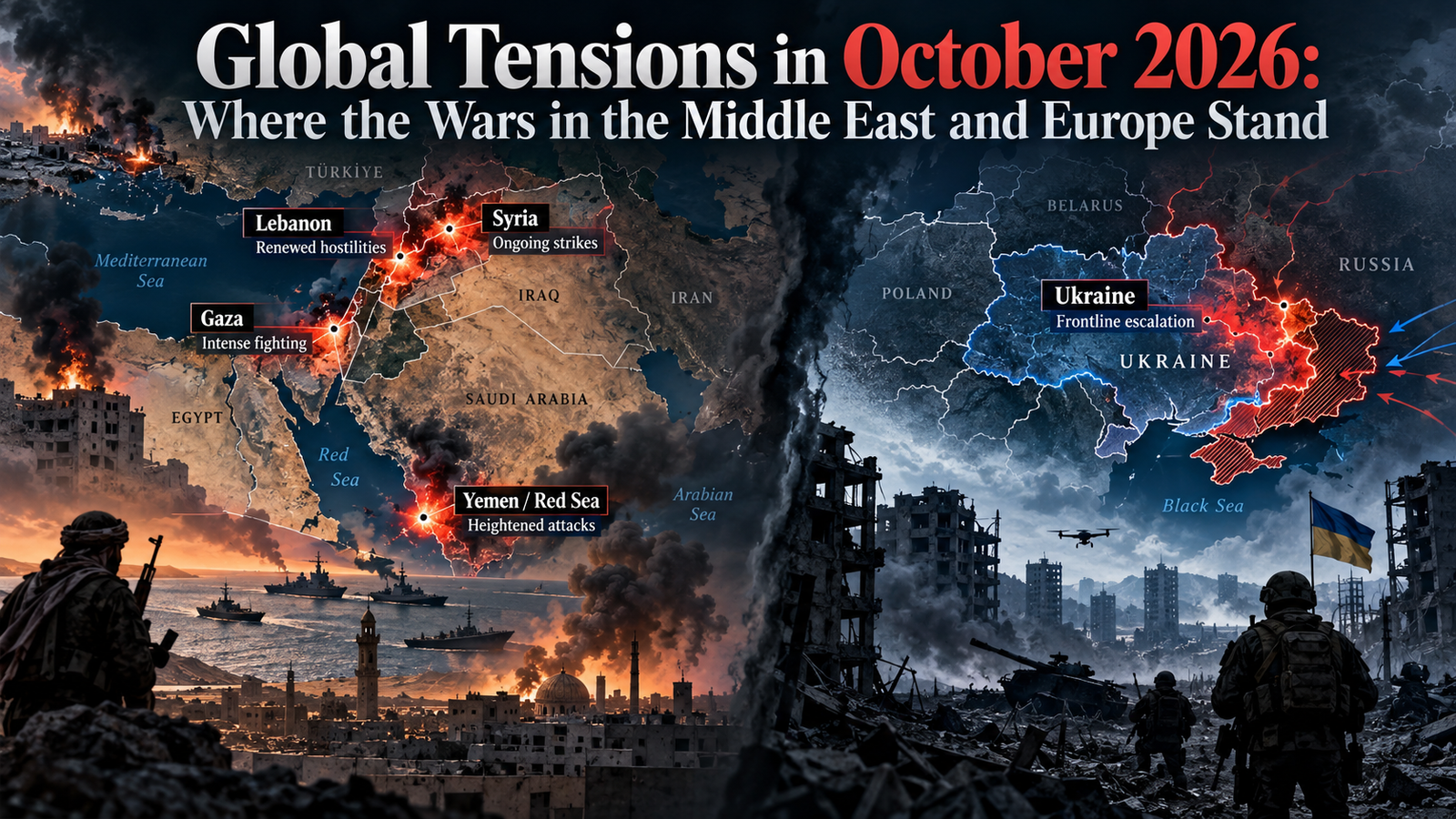
From a closed Strait of Hormuz to Russian submarines near Arctic undersea cables, several conflicts are now running at once across the Middle East and Europe, and they are feeding into each other. This guide explains where each one stands, how they connect and what they mean for oil prices, shipping and travel.
Key points
- Iran war: More than seven months after US-Israeli strikes began on 28 February 2026, the Strait of Hormuz is still largely closed, and peace talks are stuck.
- Yemen: The war has restarted. The Houthis claim strikes on Saudi Aramco, and Yemen's Saudi-backed government has launched a major offensive.
- Russia–Ukraine: The war is in its fifth year. Russia is hitting bridges and cities, and the US has proposed new three-way talks in the UAE.
- Europe's hidden front: NATO says it tracked and drove off Russian submarines practising attacks on undersea cables near Norway's Svalbard islands.
The four fronts at a glance
| Conflict | Main sides | Status now | Why it matters globally |
|---|---|---|---|
| Iran war / Strait of Hormuz | US and Israel vs Iran | Strait largely closed; talks through mediators stalled | About a fifth of the world's oil and gas normally passes through Hormuz |
| Yemen war | Houthis vs Yemeni government and Saudi-led coalition | Truce collapsed in July 2026; new offensive under way | Threatens Saudi oil sites and Red Sea shipping |
| Russia–Ukraine | Russia vs Ukraine | Heavy strikes on cities; Russian gains slowing | Europe's biggest security threat; affects energy and grain |
| Hybrid attacks on Europe | Russia vs NATO countries (Russia denies involvement) | Cable surveillance and suspected sabotage | Undersea cables carry internet, data and energy links |
1. The Iran war and the Strait of Hormuz
The war began on 28 February 2026 with US and Israeli strikes on Iran. Since then, traffic through the Strait of Hormuz has dropped by around 95%, according to Al Jazeera. In normal times, about one-fifth of the world's oil and natural gas passes through the strait.
Where talks stand: Iran says the strait will stay closed until its conditions are met. Parliament Speaker Mohammad Bagher Ghalibaf has said it will not reopen until Iran's "seven conditions" are accepted, based on what Tehran calls the "Islamabad memorandum". President Trump rejected Iran's proposal to reopen the strait, and Washington wants to focus on Iran's nuclear programme first. Foreign Minister Abbas Araghchi says Iran is "serious about finding diplomatic solutions", but the two sides remain far apart.
What it means for you: Oil prices have stayed high, and Brent crude went above US$100 a barrel at points in September. That feeds into fuel prices, airfares and shipping costs around the world, with Asia especially exposed because so much of its oil comes through Hormuz.
2. Yemen: Houthis vs Saudi Arabia
Yemen's war began in 2014, when the Houthis took the capital, Sanaa. A truce held from 2022, but it collapsed in July 2026.
- Houthi advances: In mid-September, the Iran-aligned Houthis captured the Red Sea port of Mocha and islands in the Bab al-Mandeb strait, another key shipping route.
- Strikes on Saudi Arabia: On 3 October, the Houthis claimed a missile and drone strike on an Aramco facility in Riyadh. The Saudi-led coalition called the claims "misleading".
- Counter-offensive: On 4 October, Yemen's Saudi-backed government announced a major offensive. The coalition says it carried out 97 strikes on Houthi positions around Taiz and Tor al-Baha.
The link to Iran: The Houthis are aligned with Iran. With both Hormuz and Bab al-Mandeb under pressure, the two main sea routes out of the Gulf region are disrupted at the same time.
3. Russia–Ukraine: the war in its fifth year
Russia has stepped up strikes on Ukrainian cities and infrastructure. It hit two bridges in Kyiv within 48 hours in early October, and a strike on a ship in Odesa killed one person. President Volodymyr Zelenskyy says Ukrainian intelligence has uncovered a Russian "new doctrine" aimed at pushing people to leave Kyiv and other cities.
On the battlefield, Russian gains are near record lows, and Ukraine says its counter-offensive has retaken about 140 square kilometres in the Donbas region.
Peace talks: The US has proposed three-way talks in the UAE in the coming weeks, but no date has been confirmed. Zelenskyy has warned against believing Russia would stop if it were given control of the Donbas.
4. Europe's hidden front: undersea cables and hybrid attacks
Beyond Ukraine, European governments say they face a rising campaign of "hybrid" attacks, meaning actions below open war, such as sabotage, drones and cyberattacks.
In September 2026, NATO allies revealed that the UK, Norway and the US had tracked three Russian submarines near Norway's Svalbard islands in the Arctic. The allies say the submarines were practising how to disable undersea data cables. Norway's Defence Minister Tore Sandvik said the message to Russia was clear: "they cannot operate covertly". Moscow did not comment and has consistently denied carrying out sabotage in NATO countries.
Why it matters: Undersea cables carry most of the world's internet and financial data. Damage to them can slow internet access, disrupt banking and cut power links between countries.
How the conflicts connect
- Energy: Hormuz and the Red Sea crises push up oil and gas prices, which also shapes how much money Russia makes from its energy exports.
- Shipping: Ships avoiding Hormuz and the Red Sea take longer routes, which raises costs and causes delays worldwide.
- Western attention and weapons: The US and Europe are split between the Middle East and Ukraine, which affects how much support each front gets.
What to watch next
- Whether US–Iran talks through mediators produce a deal to reopen Hormuz.
- Whether the Yemeni government offensive pushes the Houthis back from the Red Sea coast.
- Whether the proposed Russia–Ukraine–US talks in the UAE actually happen.
- Any new incidents involving undersea cables or drones over European airports.
FAQ
When did the Iran war start?
On 28 February 2026, with US and Israeli strikes on Iran.
Is the Strait of Hormuz open?
No. As of early October 2026 it remains largely closed, with traffic down about 95%. Iran says it will not reopen until its conditions are met.
Why are the Houthis attacking Saudi Arabia?
Yemen's 2022 truce collapsed in July 2026, and fighting between the Iran-aligned Houthis and the Saudi-backed Yemeni government has restarted. The Houthis have claimed strikes on Saudi energy sites as part of that war.
Are there Russia–Ukraine peace talks?
The US has proposed three-way talks in the UAE, but no date or venue has been confirmed.
What is a hybrid attack?
An attack that stops short of open war, such as sabotaging cables or pipelines, cyberattacks, drone flights over airports or spreading disinformation, often in a way that is hard to trace back to a country.
Sources:
- Al Jazeera: Iran says Hormuz to remain closed
- Al Jazeera: Houthis claim strike on Aramco site
- CNN: Yemen offensive against Houthis
- Al Jazeera: Russia's 'new doctrine', Kyiv bridges hit
- Euronews: NATO thwarts Russian undersea cable sabotage
- CFR: Conflict with Iran
- Trading Economics: Brent crude