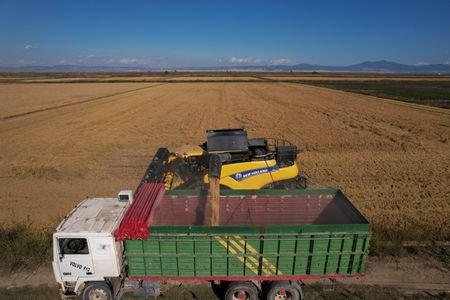
CHALASTRA, Greece, Jan 16 (Reuters) - Rice growers in northern Greece had braced for a tough 2026 season as competition from non-EU exporters heated up but many of them now worry that a controversial free trade deal between the European Union and South America's biggest Mercosur economies might put them out of business for good.
Greece, Europe's third largest producer of paddy rice behind Italy and Spain, is exporting most of its 240,000-ton annual production, mainly to Europe and Turkey. But its rice producers have felt the pinch of rising production costs and droughts in recent years and joined nationwide protests with other farmers who have blockaded Greek roads for weeks over delayed EU aid.
"We cannot sell because they are bringing a lot of rice from Asian countries and we're already having trouble," said Menelaos Koukourdis, who grows rice across 450 acres of land in a fertile river plain outside the northern city of Thessaloniki, Greece's main rice-growing region.
Koukourdis now sells at 25 cents per kilo, half the price from a year ago. "Now that they will also bring rice from Mercosur, from South America, we'll have to abandon everything," he said.
Under the EU-Mercosur trade pact - which was approved by Greece and other EU states last week and is due to be signed on Saturday - Europe will import 60,000 tons of duty-free rice from South America's Mercosur, comprising Brazil, Argentina, Paraguay and Uruguay, over five years.
The European Commission says the quantities are equal to a fraction of the annual consumption in Europe which relies on rice imports for about half of its needs.
Greece also defended the deal, saying it will give many of its products, including the trademark "feta" cheese and mastic, access to a population of 270 million and will come with safeguards in the event of import spikes.
Feeling the pressure, many rice growers have abandoned their fields and machinery to look for other jobs, said Christos Gatzaras, a 52-year-old farmer and head of the Chalastra cooperative's rice producers near Thessaloniki.
For Koukourdis, who has lowered prices despite higher production costs to be able to compete with cheaper imported rice, switching crops will not be easy.
"We have no room to sow anything else in these fields, in this area. Rice used to be a monoculture," he said.
(Reporting by Alexandros Avramidis; Writing by Angeliki Koutantou, editing by Ed Osmond)