By Ahmed Elimam and Patricia Zengerle
DUBAI/WASHINGTON, June 3 (Reuters) - Gulf hostilities flared again on Wednesday as Iranian attacks on Kuwait damaged its airport and injured dozens while the U.S. military carried out strikes near the Strait of Hormuz, with diplomacy to halt the war showing little sign of progress.
The attacks are the latest to test a shaky ceasefire, sending oil prices up more than 2%, as the strait remains largely closed more than three months after the U.S. and Israel launched strikes on Iran.
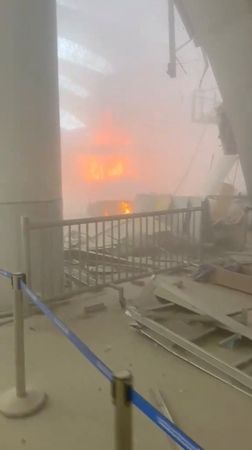
Flights at Kuwait International Airport were suspended after an Iranian drone and missile attack damaged airport facilities and diplomatic missions, killing one person and injuring more than 60 others, according to Kuwaiti authorities and state media.
The civil aviation authority said Kuwait Airways was resuming flights from Terminal 4, after evaluating damage and taking safety measures.
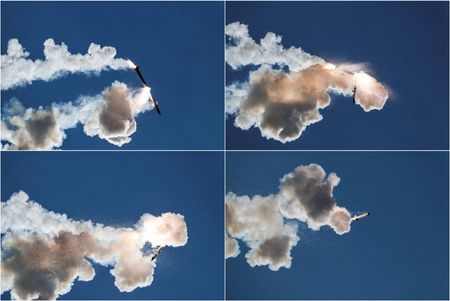
Bahrain's army said it had intercepted three missiles and several drones, as Iran said it had attacked the headquarters of the U.S. Fifth Fleet in the country, as well as an airbase and helicopters in another, unspecified, regional state.
The U.S. military said two Iranian missiles aimed at Kuwait fell short or broke up in flight, while several ballistic missiles failed to strike their targets in the region.
CEASEFIRE STRAINED BY FLARE-UPS
Since the conflict began on February 28, Iran has repeatedly attacked targets in the Gulf region home to U.S. military bases, hitting civilian and military targets.
Hostilities have occasionally flared up since a ceasefire was agreed in early April, as the U.S. has pushed to reopen the Strait of Hormuz, a route that handled roughly a fifth of global oil and liquefied natural gas shipments before the war.
Last week, Iran and the U.S. signalled progress towards a tentative initial agreement to halt the war and reopen the strait, but the two sides have yet to sign off on the deal, which would leave more complex negotiations for later.
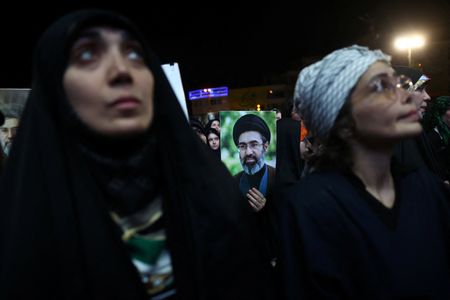
Mohsen Rezaei, military adviser to Iran's Supreme Leader Ayatollah Mojtaba Khamenei, said on Tuesday Iran would not allow the U.S. to "overreach" either in negotiations or ceasefire arrangements.
In a post on X, he warned that any aggression would be met with a barrage of missiles and drones.
Anwar Gargash, diplomatic adviser to the UAE president, said repeated attacks on Kuwait and Bahrain required a firm, unified and cohesive Gulf response. "The aggression does not target one country alone, but all of us," he wrote on X.
In further signs of escalation, the U.S. military said it had downed drones targeting civilian ships in regional waters and U.S. forces in Kuwait, and had carried out strikes on Qeshm Island near the Strait of Hormuz after attempted attacks by Iran.
Iranian media said that the Revolutionary Guards' navy targeted a vessel it identified as the Panaya with missiles, in response to what it said was a U.S. attack on an Iranian tanker near Hormuz.
UNCERTAINTY OVER COURSE OF TALKS
Since mid-March, U.S. President Donald Trump has repeatedly said he is close to a deal to end the fighting and pave the way for negotiations on thorny issues including the future of Iran's nuclear program.
As part of any deal, Tehran is seeking a halt to fighting in Lebanon, access to billions of dollars in oil revenues, waivers on crude exports, a lifting of a U.S. blockade on its ports and continued leverage over the strait.
Trump, who is under pressure to bring down U.S. fuel prices while not making concessions to Iran, has said his top priority is to stop Iran from acquiring nuclear weapons. Iran says its atomic program is for peaceful purposes.
Trump has said negotiations are continuing, though Iran's semi-official Tasnim news agency said on Wednesday that Iran had not responded to the U.S. in recent days and that exchanges of texts through intermediaries were suspended until Iran's conditions on Lebanon are met.
In a podcast interview released on Wednesday, Trump said Iran had agreed to not have a nuclear weapon and that Khamenei was involved in negotiations. "They've already agreed they're not going to have a nuclear weapon," he said.
ISRAEL KEEPS UP STRIKES ON LEBANON
The war has killed thousands, mainly in Iran and Lebanon, while causing global economic pain by severely disrupting energy supplies and other shipping.
It also sparked the latest round of conflict between Israel and Iran-backed Lebanese militant group Hezbollah, with Israel pursuing its deepest incursion into Lebanon in 25 years.
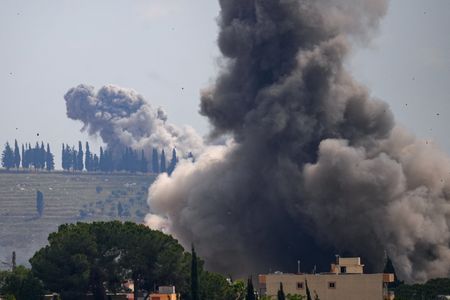
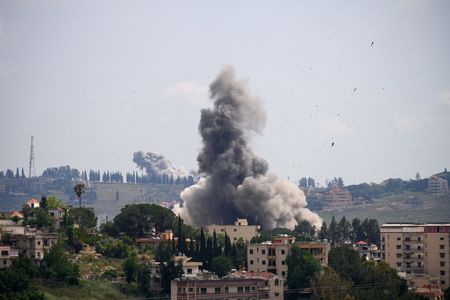
On Wednesday, Israeli drone strikes killed at least six people in southern Lebanon and targeted a car just south of Beirut, Lebanese security sources said, while Israel said it intercepted a hostile aircraft likely fired by Hezbollah.
There was no immediate response from the Israeli military to Reuters questions about the drone strikes, but the attack on the car appeared to mark the closest attack to Beirut since Trump asked Israel not to hit the Lebanese capital, under a U.S.-mediated partial ceasefire announced on Monday.
In his podcast comments, Trump acknowledged having a harsh exchange with Israeli Prime Minister Benjamin Netanyahu. "I was a little bit perturbed at his constantly fighting with Lebanon," he said.
(Additional reporting by Jana Choukier in Dubai, Ahmed Tolba in Cairo, Christian Martinez in Los Angeles and Ryan Jones in Toronto; Writing by Clarence Fernandez and Aidan Lewis; Editing by Lincoln Feast and Ros Russell)