By Pilar Olivares and Aline Massuca
RIO DE JANEIRO, May 29 (Reuters) - Before every match at this year's World Cup, viewers across the globe will watch as cameras linger on a familiar ritual: players gathered in tight circles, knocking the ball around in rapid‑fire rondos as they prepare for the spectacle ahead.
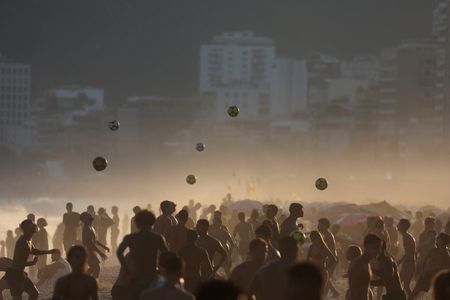
But in Rio de Janeiro, that circle is not just a warm‑up. It is often the game itself.
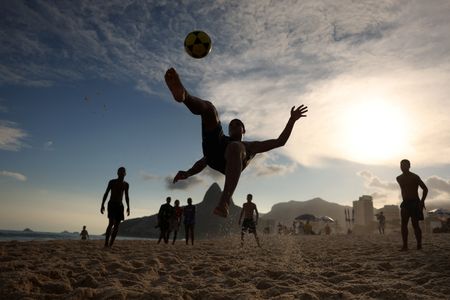
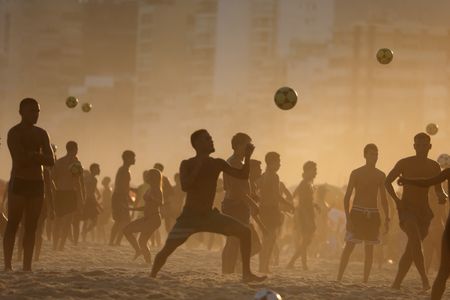
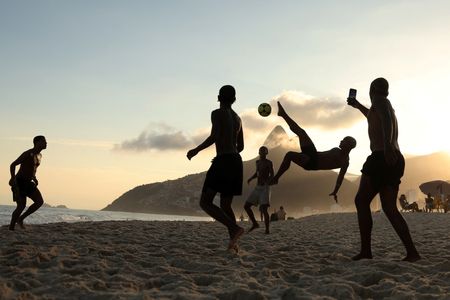
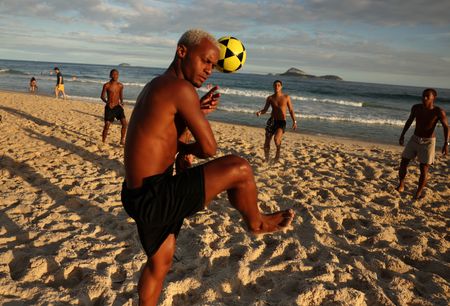
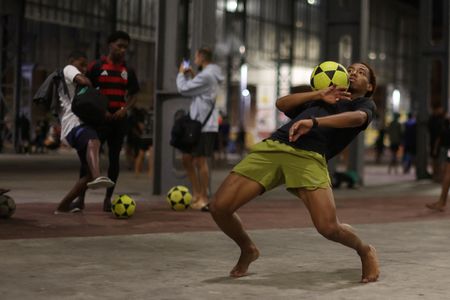
For decades, locals have gathered on beaches and neighborhood courts to play a version of the exercise known as "altinha", where keeping the ball in the air with anything but arms and hands is both a collective challenge and a chance for each player to show off their skills.
"The feeling is wonderful," said Patrick Emanuel, a 21-year-old at a court near the Engenhao soccer stadium where hundreds of people gather every Monday night to play altinha. "When we are playing ... we get distracted, cut off from all problems."
Altinha is said to have spread on the beaches of Rio in the 1960s when beach soccer was booming in Rio and players would do rondo drills before matches, said Cecilia Lang, the director of "Bola Pro Alto," an award-winning documentary about the game.
By the 1980s, she said the drill had become its own game, which became a showcase for skillful tricks between players in careful sync.
The goal is for the ball to flow so naturally and beautifully between players that they achieve a state of harmony in which "the mind is no longer there," Lang added.
"I've always seen it as a beachside spectacle," she said. "No one is going to take the ball from you. So that moment when the ball comes to you, that's the magic."
The game has gained such popularity globally that some of its proponents, including Senator Romario Faria, a renowned former soccer player, want to turn it into an Olympic sport.
"When that happens, I'll apply to represent Brazil again in the Olympics," said Romario, who won the World Cup with Brazil in 1994.
For now, altinha enthusiasts have organized championships in which the difficulty of tricks and the time the ball is kept in the air contribute to a final score.
Artur Marques, who can often be found playing altinha on Rio's beaches or at the Engenhao court, has already made it his job. Originally, he said he wanted to be a soccer player. But when that failed to pan out, he saw an opportunity in altinha.
"I started recording videos for the internet and realized I had found my place there," he said. "Now I live off it, it’s my only income."
(Reporting by Pilar Olivares and Aline Massuca in Rio de JaneiroWriting by Manuela AndreoniEditing by Brad Haynes and Lincoln Feast)