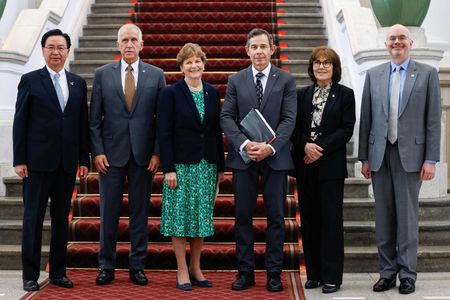
TAIPEI, March 30 (Reuters) - U.S. lawmakers visiting Taipei urged Taiwan's parliament on Monday to approve a stalled $40 billion defence budget, warning that delays could weaken the island's ability to deter Chinese military pressure despite U.S. security and arms support.
The U.S. is democratically governed Taiwan's most important international supporter and arms supplier, despite the lack of formal diplomatic ties. China claims Taiwan as its own territory, while the island rejects this.
President Lai Ching-te's proposed $40 billion in extra defence spending is currently stalled in the opposition-controlled parliament.
U.S. Republican Senator John Curtis arrived in Taipei on Monday with three other lawmakers, as Beijing ramps up military and political pressure on the democratic island to accept its sovereignty.
"We're here to enforce that message and demonstrate to the people here in Taiwan that we are together a very important part of the safety and the unity around this world," Curtis said at a media briefing in the presidential office after meeting Lai.
THE SPECIAL BUDGET 'IS IMPORTANT,' CURTIS SAYS
"I'd like to personally endorse the special defence budget and tell you back in Washington, D.C., that my colleagues are watching, that this is important," he said. "We want to make sure that as we invest in this part of the world, that you are also investing and that we're in this together."
Taiwan's opposition-dominated parliament is still debating Lai's defence spending proposal, though it has already cleared four U.S. arms deals worth about $9 billion.
The United States has strongly supported Lai's efforts to boost Taiwan's armaments as part of a push by President Donald Trump's administration to get allies to spend more on defence.
CONCERN OVER CHINA PRESSURE
"We are concerned by the increased pressure from Beijing, including military activity around Taiwan that raises the risk of miscalculation," Democrat Jeanne Shaheen, Ranking Member of the Senate Foreign Relations Committee, told the same briefing.
The United States should abide by the One-China principle and stop any form of official exchanges between the U.S. and Taiwan, said Mao Ning, spokesperson at the Chinese foreign ministry, at a separate, regular news conference on Monday.
The U.S. should take concrete actions to safeguard China-U.S. relations, and stability in the Taiwan Strait, she said.
China has been ramping up political and military pressure against Taiwan, including holding war games, most recently in December after Washington approved an $11 billion arms sale for the island.
The United States is currently preparing a second arms sale package for Taiwan worth some $14 billion, sources have previously told Reuters.
(Reporting by Yimou Lee, Fabian Hamacher and Ben Blanchard; Additional reporting by Liz Lee in BeijingEditing by Bernadette Baum)