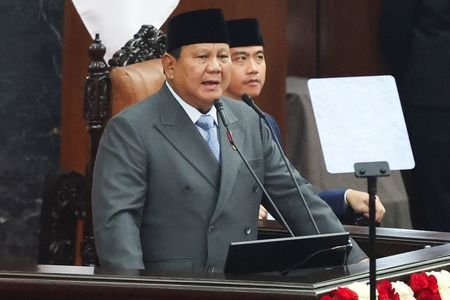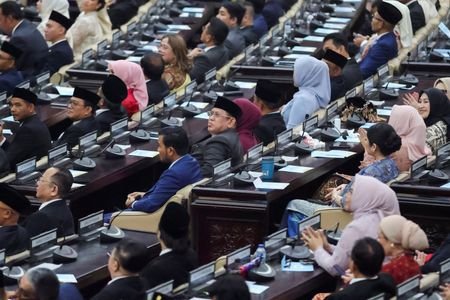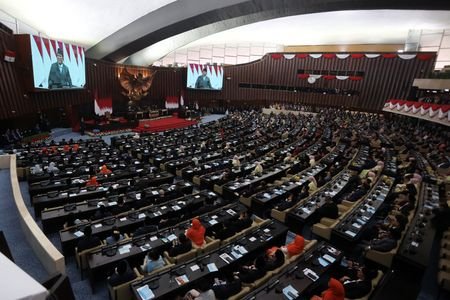
JAKARTA, Aug 14 (Reuters) - Indonesian President Prabowo Subianto said on Friday his country faced problems but his administration had started to resolve some of those and he believed economic growth of 6% could be achieved this year.
In remarks during his Independence Day speech at a time of falling approval ratings and growing investor scepticism over his ambitious policies and plans to control commodities exports, Prabowo acknowledged Indonesia had encountered issues, but said those were on the way to being addressed.
"I cannot yet say that all the nation’s problems have been resolved, or that every promise I made has been fulfilled. Not yet," he told parliament.
The former special forces commander took office in October 2024 after a sweeping election victory built on promises to root out corruption, lift economic growth from 5% to 8% and give free meals to tens of millions of children.
But his administration has struggled this year with a depreciating rupiah and a poorly performing stock market, as well as concerns over government overspending and central bank independence, while his flagship free meals programme has been hit by budget cuts and allegations of mismanagement.
However, he said investment in Indonesia would continue to grow, helping to create jobs, and gross domestic product growth could reach 6% by the end of the year.
The president's address centred on his administration's broader policies, before another speech scheduled later in the day on next year's budget.
INVESTORS AWAIT POLICY CLARITY
Investors are closely monitoring Prabowo's 2027 budget proposal, policy direction and clarity on his plan to centralise exports of key commodities.
Prabowo said that amid global supply chain disruption, Indonesia should be able to stand on its own feet due to his self-sufficiency drive and cannot be reliant on supply from outside, in the event global conditions worsen.
He has made food self-sufficiency a key priority of his administration, framing lower reliance on imports as essential to Indonesia's food security.
He said on Friday the country has so far reached self-sufficiency in eight food commodities and that food supply is secure even amid threats of El Nino dry weather pattern.
He also highlighted tighter control over other key sectors, including a crackdown on illegal tin mining, reorganisation and revenue improvement of its many state companies.
The last time Prabowo addressed parliament, in May, he dropped a bombshell for international markets, announcing plans to centralise exports of all critical natural resources under a new state-run entity, Danantara Sumberdaya Indonesia.
Many in his administration have since suggested that entity will only have a supervisory role rather than taking control, as was suggested in the original announcement.
But its precise role remains unclear and investors will be hoping the president will provide more clarity, Yose Rizal Damuri, executive director of the Center for Strategic and International Studies think tank, said.
Commodities traders will also be listening closely for any more details on Danantara Sumberdaya Indonesia's role, a palm oil analyst at a global agriculture trading house said.
(Reporting by Jakarta bureau; Writing by Gibran Peshimam, Fransiska Nangoy; Editing by Martin Petty)