By Jim Urquhart , Steve Gorman and Renee Hickman
MIDDLETOWN, Iowa, Nov 25 (Reuters) - Residents of an Iowa farm town that is also home to a US Army munitions depot braced for the planned detonation on Wednesday of an aging stockpile of lead-based explosives, a move that is meant to avoid the riskier prospect of the chemical drums blowing up themselves.
After days of public rancor and legal wrangling over its waste disposal plan, the Army was set to detonate nearly 5 tons (4,500 kg) of degraded and highly unstable lead azide stored in 68 deteriorating plastic barrels.
The operation was scheduled to begin at 9 a.m. Central time (1500 GMT).
Public safety concerns have focused on the plume of toxic lead dust that the explosions are likely to spew over homes, crops and livestock beyond the detonation site at the Iowa Army Ammunition Plant in Middletown, Iowa, about 150 miles southwest of Des Moines, the state capital.
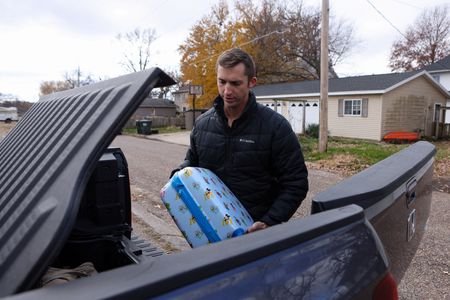
Federal, state and local officials spent Tuesday alerting residents closest to the plant of evacuation plans and bolstering an array of measures designed to curb the fallout, while seeking to reassure the public the operation was well under control.
They also churned out maps forecasting the distance and direction that the plume of toxic emissions was expected to take, based on changing weather conditions, and collected hundreds of air, soil and water samples for comparison with sampling to be done after the fact.
"Our No. 1 priority here in Iowa today is the health and safety of the citizens of this region," acting Army Secretary Adam Telle said at a news conference. "We don't believe that the public should be in a panic. We are very calm about this."
'CONTROLLED, MITIGATED DETONATION'
Experts from the Army, the US Environmental Protection Agency, the Bureau of Alcohol, Tobacco, Firearms and Explosives and others stressed their consensus that a "controlled, mitigated detonation" of the stockpile was the safest option for disposing of it.
Otherwise, they said, the increasingly volatile material - growing more unstable with the arrival of colder weather - was certain to eventually explode on its own, posing far greater risks to the surrounding region.
Experts likewise concluded that any attempt to chemically neutralize or relocate the storage drums would likely trigger an uncontrolled blast.
At Tuesday's press conference, officials said they had constructed a range of containment structures and equipment they hoped would keep the lead particulates belched from the detonation site to a minimum.
Those measures included a series of earthen berms built around the two subsurface concrete bunkers containing the lead azide, along with two towering walls stacked with tanks of water that will be released onto the blast zone. Engineers also installed a misting apparatus to dampen the surrounding terrain and a system to flood the blast site with aqueous foam designed to capture dust from the blast.
LEAD AZIDE OBSOLETE
Lead azide is an explosive chemical that has long been used as the chief detonating material in military ordnance. After the material was deemed largely obsolete years ago, the Army brought unused stockpiles from bases around the country to the Iowa plant in 2009.
During an inspection in March, officials discovered a dangerous crystallization of the storage drums and material in them, a sign that it had become dangerously unstable, spurring deliberations over the safest way to dispose of it.
The last major disposal of lead azide was an open-air detonation of 7,000 pounds of the chemical in Colorado in 1977, said Army Colonel Aaron Teller, a munitions specialist.
Teller said that detonation occurred with "zero mitigation" and that 75% of the lead particulate remained at the incident site.
"We believe we can reduce that last 25% with the mitigation strategy that we have in place," he said.
Lead exposure can cause a range of health problems, particularly in children, in whom it can interfere with cognitive development. Once it settles in the environment, it does not break down, he said.
The Federal Emergency Management Agency said residents within 5 miles (8 km) of the blast may be evacuated, while those within 5 to 20 miles were advised to stay indoors with windows closed to avoid lead dust exposure.
Army projections released on Tuesday showed that lead dust could settle on surfaces as far as 40 miles southwest of the blast site, extending through southeastern Iowa into northern Missouri. Airborne particles could travel nearly 100 miles within eight hours, according to projections.
The Army said it would release updated projection maps hourly beginning six hours before the scheduled explosion.
Some residents said changing guidance over the timing of the blast and the likely path of the lead plume had left them confused and frustrated.
Farmers and ranchers worried about protecting their crops and herds. US and Iowa agriculture officials estimated that 350 farms could be impacted by lead fallout, based on the anticipated direction of the plume.
(Reporting by Jim Urquhart in Middletown, Iowa; Additional reporting by Renee Hickman in Chicago; Writing and additional reporting by Gorman in Los Angeles; Editing by Thomas Derpinghaus)