By Gram Slattery, Maayan Lubell and Alexander Cornwell
WASHINGTON/JERUSALEM/TEL AVIV, March 23 (Reuters) - Iran denied on Monday that it had engaged in negotiations with the United States, after President Donald Trump postponed a threat to bomb Iran's power grid because of what he described as productive talks with unidentified Iranian officials.
A European official said that while there had been no direct negotiations between the two nations, Egypt, Pakistan and Gulf states were relaying messages. A Pakistani official and a second source told Reuters that direct talks on ending the war could be held in Islamabad as soon as this week.
Trump wrote on his Truth Social platform that the U.S. and Iran had held "very good and productive" conversations about a "complete and total resolution of hostilities in the Middle East".
As a result, he said, he was postponing for five days a plan to hit Iran's energy grid. His announcement sent share prices higher and oil prices sharply lower to below $100 a barrel, a sudden reversal to a market swoon caused by his weekend threats and Iran's vows to respond. [O/R]
Trump later told reporters his special envoy Steve Witkoff and son-in-law Jared Kushner, who had been negotiating with Iran before the war, had held discussions with a top Iranian official into the evening on Sunday and would continue on Monday.
"We have had very, very strong talks. We'll see where they lead. We have major points of agreement, I would say, almost all points of agreement," he told reporters before departing Florida for Memphis.
In Memphis, he said Washington had been negotiating with Iran "for a long time, and this time they mean business," adding: "I think it could very well end up being a good deal for everybody."
He did not identify the Iranian official in touch with Witkoff and Kushner, but said: "We're dealing with the man who I believe is the most respected and the leader."
An Israeli official and two other sources familiar with the matter said the interlocutor on the Iranian side was Iran's powerful parliament speaker Mohammad Baqer Qalibaf.
'FAKENEWS', SAYS IRAN PARLIAMENT SPEAKER
Qalibaf said on X that there had been no such talks with the United States, and ridiculed the suggestion as an attempt to rig financial markets.
"No negotiations have been held with the U.S., and fakenews is used to manipulate the financial and oil markets and escape the quagmire in which the US and Israel are trapped," he wrote.
"Iranian people demand complete and remorseful punishment of the aggressors. All Iranian officials stand firmly behind their supreme leader and people until this goal is achieved."
Iran's elite Revolutionary Guards (IRGC) said they were launching fresh attacks on U.S. targets, and described Trump's words as "psychological operations" that were "worn out" and having no impact on Tehran's fight.
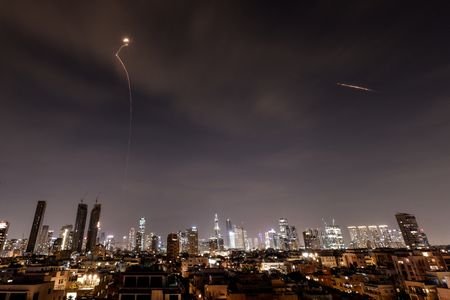
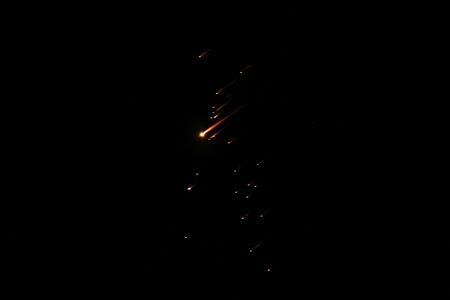
The IRGC said late on Monday it targeted several Israeli cities, including Dimona and Tel Aviv and a number of U.S. bases. It said it was "negotiating" with the "aggressors through impact-focused operations."
Israel's military said it had detected missiles launched from Iran on Monday night for the first time since Trump's earlier comments, and at least one interception blast was heard from Jerusalem.
Israeli Prime Minister Benjamin Netanyahu said in a video statement that he spoke with Trump on Monday and that Israel would press on with attacks in Lebanon and Iran.
But Netanyahu said Trump believed there was a possibility of "leveraging the mighty achievements obtained by the IDF (Israel Defence Forces) and the U.S. military, in order to realize the goals of the war in a deal - a deal that will preserve our vital interests."
Although there was no immediate confirmation that talks had taken place as described by Trump, Iran's foreign ministry described initiatives to reduce tensions.
It said Iran's Foreign Minister Abbas Araqchi reviewed developments related to the Strait of Hormuz with his Omani counterpart and agreed to continue consultations between the two countries.
Iran has effectively closed the key Strait of Hormuz, through which about a fifth of global oil and liquefied natural gas flows. Trump has demanded Iran open the strait, but Tehran says it will not do so until the United States and Israel call off their attacks.
The Pakistani official said U.S. Vice President JD Vance, as well as Witkoff and Kushner, were expected to meet Iranian officials in Islamabad this week, following a call between Trump and Pakistan's army chief Asim Munir.
The White House confirmed Trump's call with Munir. When asked about a possible visit by Witkoff and Kushner to Islamabad, White House spokesperson Karoline Leavitt said:
"These are sensitive diplomatic discussions and the U.S. will not negotiate through the press. This is a fluid situation, and speculation about meetings should not be deemed as final until they are formally announced by the White House."
The Pakistani prime minister's office and foreign ministry did not immediately respond to requests for comment.
Iranian media reported that Iran's President Masoud Pezeshkian and Pakistani Prime Minister Shehbaz Sharif discussed the impact of the war on regional and global security.
Pezeshkian was quoted as saying that Iran was committed "to preserving stability and security and countering foreign interference in regional affairs" and wanted to strengthen cooperation with the countries of the region.
Iran had responded to Trump's threats to strike its power plants by saying it would hammer the infrastructure of U.S. allies in the Middle East, raising the prospect that an extreme disruption to global energy supplies could last longer than previously expected.
More than 2,000 people have been killed in the war the U.S. and Israel launched on February 28.
(Reporting by Phil Stewart, Idrees Ali, Gram Slattery and Humeyra Pamuk in Washington, Maayan Lubell in Jerusalem and Alexander Cornwell in Tel Aviv, Ariba Shahid in Karachi and Saad Sayeed in Bangkok; Additional reporting by Reuters bureaus; Writing by Michael Perry, Sharon Singleton, Peter Graff and David Brunnstrom; Editing by Kevin Liffey, Aidan Lewis and Cynthia Osterman)