By Parisa Hafezi
DUBAI, April 3 (Reuters) - After more than a month of being stalked by targeted assassinations, Iran's leadership has adopted a new tactic to show it is still in control - with senior officials walking openly in the streets among small crowds who have gathered in support of the Islamic Republic.
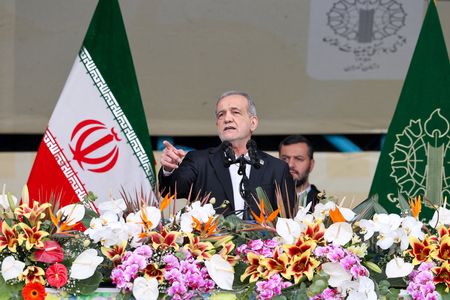
In recent days, Iran's president and foreign minister have separately mixed with groups of several hundred people in central Tehran. On Tuesday, state television aired footage of the two posing for selfies, talking to members of the public and shaking hands with supporters who had gathered in public areas.
According to insiders and analysts, the appearances are part of a calculated effort by Iran's theocratic leadership to project resilience and authority — not only over the vital Strait of Hormuz but also over the population — despite a sustained U.S.-Israeli campaign aimed at "obliterating" it.
One insider close to the hardline establishment said such public outings are intended to show that the Islamic Republic is "unshaken by strikes and that it remains in control and vigilant" as the war grinds on.
The U.S.-Israeli war on Iran began on February 28 with the killing of veteran Supreme Leader Ayatollah Ali Khamenei and several senior military commanders in waves of strikes that have since continued to target top officials.
Iran's new Supreme Leader, Mojtaba Khamenei, has not been seen in public since taking over on March 8 from his father. Foreign Minister Abbas Araqchi, meanwhile, was removed from Israel's hit list amid mediation efforts last month, including by Pakistan, to bring Tehran and Washington together for talks to end the war.
Talks aimed at ending the war have since appeared to have petered out, as Tehran brands U.S. peace proposals "unrealistic". Against that backdrop, recent public appearances by President Masoud Pezeshkian and Araqchi appear designed to project defiance, if not a convincing display of public support.
A senior Iranian source said officials' public presence demonstrates that "the establishment is not intimidated by Israel's targeted killing of top Iranian figures".
Asked whether Iran's foreign minister or president were on any sort of kill list, an Israeli military spokesperson, Nadav Shoshani, said on Friday he would not "speak about specific personnel."
NIGHTLY RALLIES TO SHOW RESILIENCE
Despite widespread destruction, Tehran appears emboldened by surviving weeks of intense U.S.-Israeli attacks, firing on Gulf countries hosting U.S. troops and demonstrating its ability to effectively block the Strait of Hormuz.
On Wednesday, U.S. President Donald Trump vowed more aggressive strikes on Iran, without offering a timeline for ending hostilities. Tehran responded by warning the United States and Israel that "more crushing, broader and more destructive" attacks were in store.
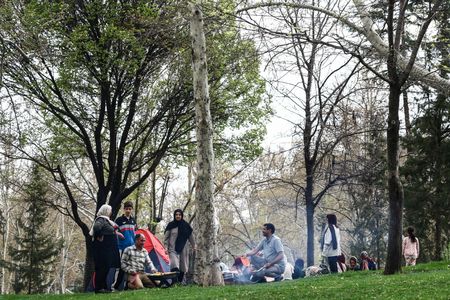
Encouraged by clerical rulers, supporters of the Islamic Republic take to the streets each night, filling public squares to show loyalty even as bombs rain down across the country.
Analysts say the establishment is also seeking to raise the "political and reputational" cost of the strikes at a time when civilian casualties are deeply disturbing for Iranians.
Omid Memarian, a senior Iran analyst at DAWN, a Washington-based think tank, said the decision to send officials into gatherings reflects a layered strategy, including an effort to sustain the morale of core supporters at a moment of acute pressure.
"The system relies heavily on this base; if its supporters withdraw from public space, its ability to project control and authority weakens significantly," Memarian said.
Speaking to state television, some in the crowds voice unwavering loyalty to Iran's leadership; others oppose the bombing of their country regardless of politics; and some have a stake in the system, including government employees, students and others whose livelihoods are tied to it.
Hadi Ghaemi, head of the New York-based Center for Human Rights in Iran, said the establishment is using such loyal crowds as human shields to raise the cost of any assassination attempts.
"By being in the middle of large crowds they have protections that would make Israeli-American attacks against them very bloody and generate sympathy worldwide," he said.
POTENTIAL PROTESTERS STAY OFF STREETS AT NIGHT
The Islamic Republic emerged from a 1979 revolution backed by millions of Iranians. But decades of rule marked by corruption, repression and mismanagement have thinned that support, alienating many ordinary people.
While there has been little sign so far of anti-government protests that erupted in January and abated after a deadly crackdown, the establishment has adopted harsh measures - such as arrests, executions and large-scale deployment of security forces - to prevent any sparks of dissent.
Rights groups have warned about "rushed executions" during wartime after Iran hanged at least seven political prisoners during the war.
"Many potential protesters are frightened by the continuing presence of armed men and violent crowds in the streets and largely stay at home once darkness falls," Ghaemi said.
(Writing by Parisa HafeziEditing by Ros Russell)