By Parisa Hafezi, Rami Ayyub and Maya Gebeily
DUBAI/JERUSALEM/BEIRUT, March 18 (Reuters) - Iran's huge Pars gas field was hit on Wednesday in the first reported strikes on Iranian energy infrastructure in the Gulf during the U.S.-Israeli war, a major escalation that prompted Tehran to warn its neighbours that their energy installations would be targeted "in the coming hours".
Pars is the Iranian sector of the world's largest natural gas deposit, which Iran shares with Qatar across the Gulf. Iran's Fars news agency reported that gas tanks and parts of a refinery had been hit, workers had been evacuated to a safe location and emergency crews were trying to put out a fire.
The attack was widely reported in Israeli media to have been carried out by Israel with U.S. consent. The Israeli military did not immediately respond to requests for comment.
Qatar, a close U.S. ally which hosts the largest U.S. airbase in the region, called it an Israeli attack without mentioning any U.S. role. The Qatari foreign ministry spokesperson called it a "dangerous and irresponsible" escalation that put global energy security at risk.
Iran's Revolutionary Guards told Saudi Arabia, the UAE and Qatar to evacuate several energy facilities.
"These centres have become direct and legitimate targets and will be targeted in the coming hours. Therefore, all citizens, residents, and employees are requested to immediately leave these areas and move to a safe distance without any delay," Iranian state media cited authorities as saying.
During three weeks of war, the U.S. and Israel had previously held back from targeting Iran's energy production facilities in the Gulf, a move that could invite retaliation against other producers and make it harder for global markets to recover from what has already been the biggest ever interruption to energy supplies.
Iran's warning was directed at Saudi Arabia's Samref Refinery and Jubail Petrochemical Complex, the UAE's Al Hosn Gas Field, and Qatar's Mesaieed Petrochemical Complex, Mesaieed Holding Company and Ras Laffan Refinery.
'EVERYONE IS IN THE CROSSHAIRS'
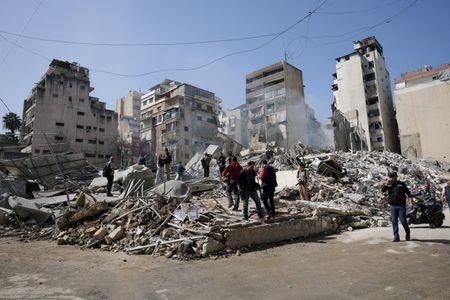
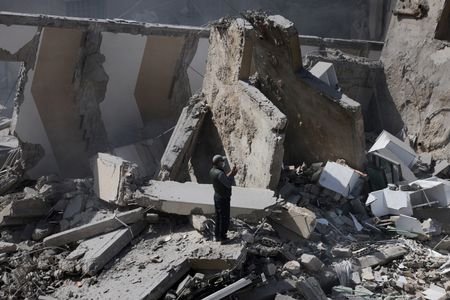
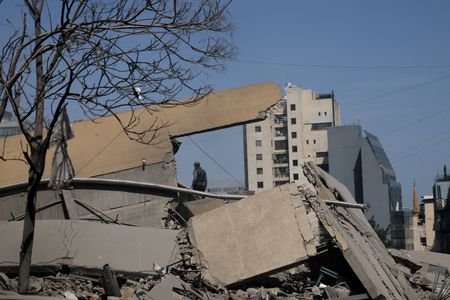
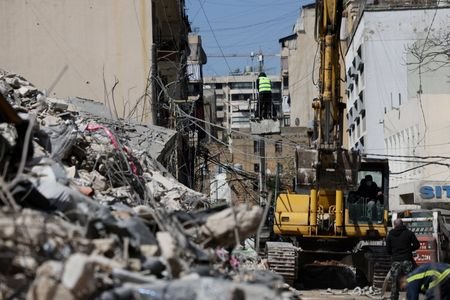
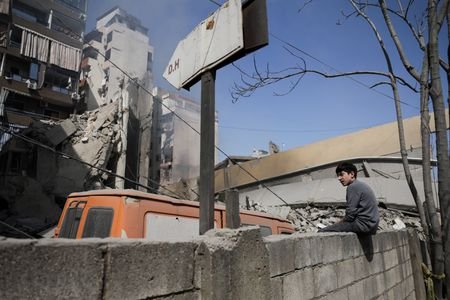
The Israeli military also hit central Beirut, destroying apartment buildings in some of the most intense airstrikes on the Lebanese capital for decades, on Israel's other front in the war it launched with the U.S. against Iran.
Israel said on Wednesday it had killed Iran's intelligence minister and his death was later confirmed by Iranian President Masoud Pezeshkian in a post on X. It was the second strike on a top leadership figure in two days.
"No one in Iran has immunity and everyone is in the crosshairs," said Defence Minister Israel Katz, who announced that Israel had killed Iran's Intelligence Minister Esmail Khatib a day after killing security chief Ali Larijani.
Katz said he and Prime Minister Benjamin Netanyahu had authorised the Israeli military "to target any senior Iranian official for whom an intelligence and operational opportunity arises, without the need for additional approval".
It appeared to be the first time Israel has publicly stated that it would let the military target enemy officials without seeking special permission from political leaders for missions.
In Tehran, thousands of people appeared in the streets for a funeral for Larijani and other slain figures. The crowd waved Iranian flags and carried portraits of the dead as a eulogist sang: "Martyrs are leading the way, they've become more alive, burning with love."
Iran retaliated for the killing of Larijani by firing missiles at Israel, which Israeli authorities said killed two people near Tel Aviv. Tehran said it fired overnight on Tel Aviv, Haifa and Beersheba in Israel, and at U.S. bases in Bahrain, Iraq, Jordan, Kuwait, Saudi Arabia and the UAE.
ENERGY PRICES SURGE
The unprecedented disruption to global energy supplies has raised the political stakes for U.S. President Donald Trump. Diesel prices in the United States rose above $5 a gallon for the first time since the 2022 inflation surge that eroded support for his predecessor Joe Biden.
Israel has stepped up strikes on Lebanon and a ground assault in the south in pursuit of the Iran-backed Hezbollah group, which has fired across the border in solidarity with Tehran.
In central Beirut's Bachoura district, Israel warned residents early on Wednesday to leave a building it said was used by Hezbollah, which it then completely flattened.
Abu Khalil, who lives in the area, said he had helped people flee nearby homes after the Israeli warning. "It's just an operation to hurt, to terrify people, to terrify children," he told Reuters, insisting there were no military targets nearby.
No similar warnings were given for strikes that hit apartment buildings in two other central districts, killing at least 10 people, according to Lebanese authorities.
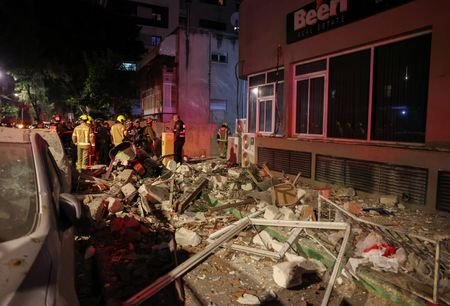
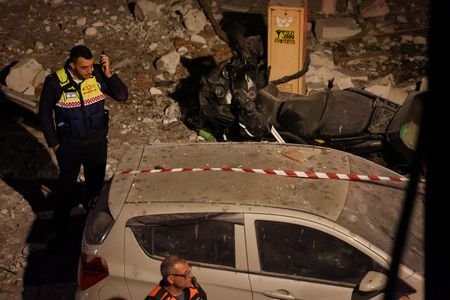
Inside Israel, the ambulance service reported that a 44-year-old man and two children, aged 13 and 12, in Petah Tikva, east of Tel Aviv, were hospitalised with blast injuries following an Iranian missile attack. In a separate incident, an Iranian missile tore a crater into the pavement and set cars ablaze in a residential area of Holon, just south of Tel Aviv.
"There was an alarm, we went into the shelter, we heard a crazy boom," resident Leah Palteal told Reuters.
U.S.-based Iran human rights group HRANA said on Monday that an estimated 3,000-plus people had been killed in Iran since the U.S.-Israeli attacks began on February 28. Authorities in Lebanon say 900 people have been killed there and 800,000 forced to flee their homes.
Iranian attacks have killed people in Iraq and across the Gulf states. Fourteen have been killed in Israel.
(Reporting by Reuters bureaux, Writing by Peter Graff; Editing by Ros Russell and Gareth Jones)