By Ahmed Rasheed, Yomna Ehab and Muayad Hameed
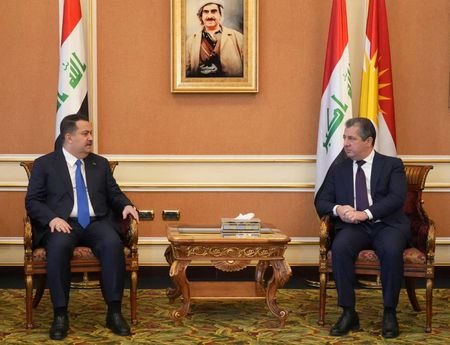
BAGHDAD, March 17 (Reuters) - Crude exports from Iraq's Kirkuk fields to Turkey's Ceyhan port have resumed via pipeline, North Oil Company said, after Baghdad and the Kurdistan Regional Government agreed on Tuesday to restart flows.
The KRG confirmed the agreement, saying in a statement the two sides would form a joint committee to prepare to resume oil exports and that revenue would be returned to the federal treasury.
The North Oil Company added that Kirkuk crude exports would resume with an initial capacity of 250,000 barrels per day.
The two sides agreed to take the necessary security measures to protect oilfields and ensure the continuity of export operations, the KRG said.
Iraq has begun pumping crude from Kirkuk to Ceyhan at an initial rate of 170,000 barrels per day, with plans to ramp up gradually to 250,000 bpd, Basim Mohammed, the Iraqi deputy oil minister for upstream affairs, said in a televised statement.
International oil prices, which have risen by roughly 30% to over $100 a barrel since the U.S.-Israeli war on Iran began causing a severe disruption of oil flows, fell 1.46%, to $101.91 on Wednesday.
KRG PREMIER SAYS EXPORTS SHOULD FLOW AS SOON AS POSSIBLE
KRG Prime Minister Masrour Barzani said in a post on X the region would allow crude exports through the Kurdistan pipeline as soon as possible given "the exceptional circumstances the country is confronting".
"Discussions with Baghdad will continue to urgently lift restrictions on imports and trade to the region, and to provide the necessary guarantees to oil and gas companies to ensure they can resume production in a safe environment," he added.
Barzani later said on X that during a phone call with U.S. envoy Tom Barrack, he had told the KRG team to provide all necessary facilities to resume oil exports.
Iraq's Kurdish authorities said on Sunday that Baghdad had failed to address security and economic challenges facing the oil sector.
Iraq's oil ministry had earlier said the KRG had refused to let it use a pipeline as an alternative route for crude flows disrupted by the Iran conflict and that authorities had put in place arbitrary conditions.
PRODUCTION PLUNGE BECAUSE OF IRAN CONFLICT
Oil production from Iraq's southern oilfields, where most of its crude is produced and exported, had fallen by 70% to just 1.3 million barrels per day, sources told Reuters on March 8, as the Iran conflict effectively shut the Strait of Hormuz through which some 20% of global oil passes.
The drop in production and exports is set to strain Iraq's already fragile finances as the state relies on crude sales for nearly all public spending and more than 90% of its income.
Under pressure to mitigate the losses, Iraq's state oil company SOMO signed contracts with international carriers and buyers to export crude oil via Turkey, Jordan and Syria, SOMO said in a statement on Wednesday.
Iraq's oil ministry sent a letter in early March to the KRG seeking permission to pump at least 100,000 bpd of crude from Kirkuk oilfields through the Kurdistan pipeline network to Turkey's Ceyhan energy hub, two oil officials told Reuters last week.
Kurdish officials say tensions with Baghdad have risen after the federal government implemented a new electronic customs system earlier this year, allowing it to monitor imports and revenue, a step the KRG sees as undermining its autonomy and control over trade.
On Tuesday, the Iraqi presidency had urged both the Iraqi federal government and the KRG to cooperate to resume crude oil exports, a presidency statement said.
Iraq's parliament also called on the federal government to find outlets for Iraqi crude to avoid the current security conditions causing economic damage, the state news agency reported.
(Reporting by Ahmed Rasheed and Muayad Hameed in Baghdad, Yomna Ehab and Muhammed Al Gebaly in Cairo; Additional Reporting by Enas Alashray in Cairo; Writing by Yomna Ehab; Editing by Alistair Bell, Rod Nickel, Bill Berkrot, Barbara Lewis and Deepa Babington)