By Maayan Lubell, Laila Bassam and Maya Gebeily
JERUSALEM/BEIRUT, April 15 (Reuters) - Israel's security cabinet will convene on Wednesday to discuss a possible Lebanon ceasefire, a senior Israeli official said, more than five weeks into a war with Hezbollah that spiralled out of the U.S.-Israeli conflict with Iran.
Israeli Prime Minister Benjamin Netanyahu's security cabinet will meet at 8 p.m. (1700 GMT), the official said.
Senior Hezbollah official Ibrahim al-Moussawi told Reuters that diplomatic efforts by Iran and other regional states could produce a ceasefire soon, saying Tehran had used its blockade of the Strait of Hormuz as leverage.
Two other senior Lebanese officials said they had been briefed that efforts were underway for a ceasefire. One of them said the U.S. had been pressuring Israel to work towards a ceasefire in Lebanon, including during rare talks between Israeli and Lebanese government envoys in Washington on Tuesday.
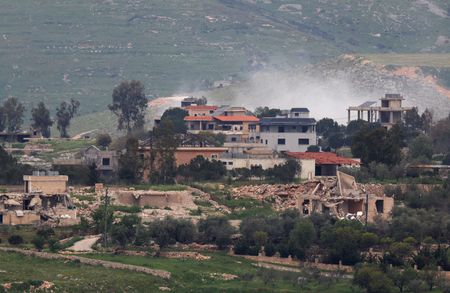
Israel's offensive in Lebanon began on March 2 after the Iran-backed Hezbollah opened fire at Israel in support of Tehran. It has killed more than 2,000 people and forced 1.2 million from their homes, according to Lebanese authorities.
U.S. President Donald Trump earlier said the war with Iran could end soon, telling the world to watch out for an "amazing two days", while U.S. forces imposing a blockade turned back vessels leaving Iranian ports.
On Tuesday, the United States hosted the first direct talks between Israel and Lebanon in decades. Israel had ruled out discussion of a ceasefire with Lebanon during those talks.
Trump has urged Israel to scale back attacks in Lebanon, apparently to avoid undermining the ceasefire with Iran.
Iran has said Israel's campaign against Hezbollah in Lebanon must be included in any agreement to end the wider war in the Middle East. Washington has pushed back, saying there is no link between the two sets of talks.
The two Lebanese officials did not have details on when any ceasefire would begin or how long it would last. They said the duration would likely be linked to how long a truce between the United States and Iran holds.
(Reporting by Jana Choukeir and Tala Ramadan in Dubai; Writing by Tom Perry; Editing by Sharon Singleton, Janane Venkatraman, Alison Williams and Hugh Lawson)