By Fatos Bytyci and Daria Sito-Sucic
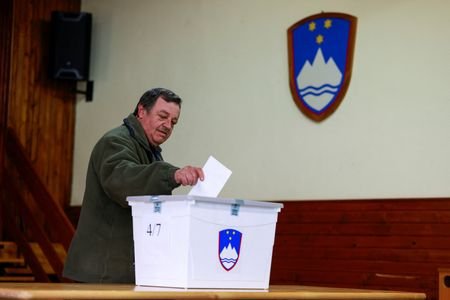
LJUBLJANA, March 22 (Reuters) - Right-leaning Slovenian Democratic Party (SDS) and liberal Freedom Movement (GS) were tied in Slovenia's parliamentary vote on Sunday, according to preliminary results of the state election commission based on the most votes counted.
Neither party — even with its existing coalition partners — looked likely to secure the 46 seats needed for a majority in the 90‑seat parliament, making smaller parties that cross the 4% threshold potential kingmakers.
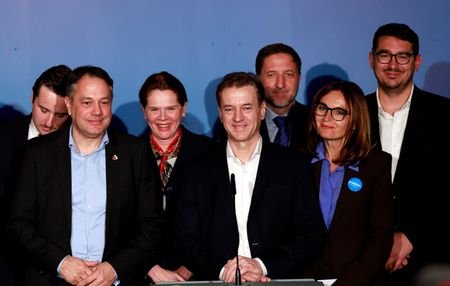
Based on 99.45% of ballots counted, GS won 29 seats, trailed tightly by SDS with 28 seats. Along with the supporting parties, the GS led by incumbent Prime Minister Robert Golob would have 40 MPs while SDS, led by populist ex-prime minister Janez Jansa, would have 43 seats.
"We all placed our trust in one party, regardless of what we believe," Golob told his supporters after preliminary results showed the GS lead. "We all deserve a future and I am here right now to say that with this mandate we will do everything to make that future better for all our citizens."
Jansa, who was running for the fourth term as the premier, accused the election commission of messing with counting, saying that his monitoring team has noticed the discrepancy of 50,000 votes for SDS.
"I call upon those responsible at the national election commission, those who manage the computer program, to understand that I will recount every vote from all the polling stations if we organize ourselves accordingly," he told a local television.
Political analyst Aljaz Pengov Bitenc doubts that a stable government can be formed but thinks that Golob is in a better position than Jansa to negotiate with parties from a wider spectrum.
"I expect a very long coalition negotiation because hammering out the priorities will be a difficult task ahead and will require a huge amount of political patience, wisdom and experience," he said.
DECIDING SLOVENIA'S FUTURE PATH
Both camps have said the elections would determine a future path for Slovenia. Under Golob, the country has pursued a liberal, pro-European democracy focused on social reforms, while Jansa wants to introduce tax breaks for businesses and cut funding for NGOs, welfare and media.
Golob aligned Slovenian foreign policy with European countries that supported an independent Palestinian state while Jansa, an ally of Hungarian nationalist Prime Minister Viktor Orban and supporter of U.S. President Donald Trump, would shift the country's international alignment.
The election campaign heated up this month when covert videos were published on an anonymous website purportedly exposing government corruption.
A report this week alleged that Jansa met with officials from Israeli private spy firm Black Cube, which LinkedIn alleged in 2023 was behind a hidden camera campaign that targeted activists and journalists in the lead-up to Hungary's 2022 vote.
(Reporting by Branko Filipovic, Fatos Bytyci, Gasper Lubej and Daria Sito-Sucic; Editing by Kirsten Donovan, Alexander Smith, Hugh Lawson and Diane Craft)