By Luis Jaime Acosta, Julia Symmes Cobb and Nelson Bocanegra
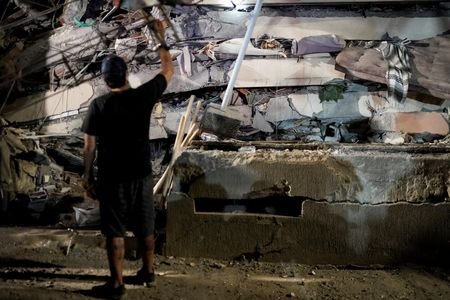
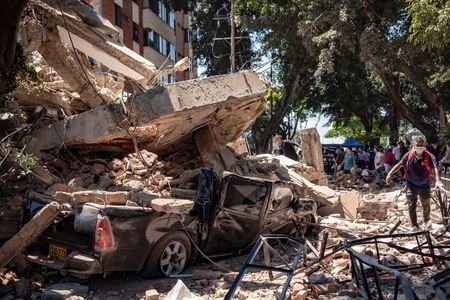
BOGOTA, Aug 10 (Reuters) - More than 100 people were killed after a powerful earthquake struck western Colombia on Monday, toppling buildings, damaging hospitals and infrastructure and trapping people beneath the rubble in the country's strongest earthquake this century.
The quake struck just days after Abelardo De La Espriella was sworn in as president, thrusting the new administration into its first major crisis, with memories still fresh of devastating twin earthquakes in neighboring Venezuela in June.
"The national government has all of its capabilities deployed to protect lives, assist affected communities and deliver aid wherever it is needed," he said in a national address around 1 p.m. local time, upon declaring a national state of emergency and giving a death toll of 111. "The first priority is rescuing the people trapped under the rubble."
De La Espriella visited Quibdo, the capital of coastal Choco province, where he promised rent subsidies for those who have lost homes, and then traveled to Cali, western Colombia's largest city.
Though he had been expected to give an updated national death toll on Monday evening, De La Espriella offered only figures for Valle del Cauca province, where Cali is located, saying 35 people had died there, while 700 had been injured. Some local media have cited a national total of 132 deaths, though the origin of the figure is unclear.
The U.S. Geological Survey said the 7.4-magnitude quake struck at a depth of 107 km (66 miles). Colombia's Geological Service said it was the strongest earthquake recorded in the country in the 21st century.
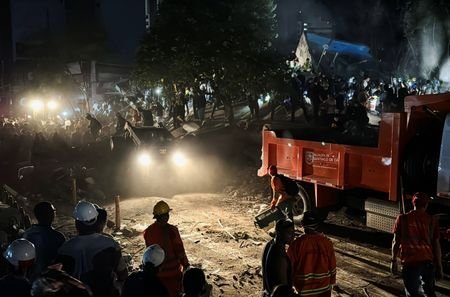
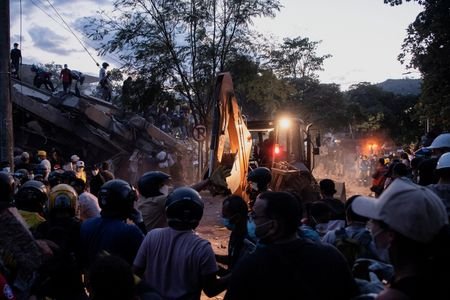
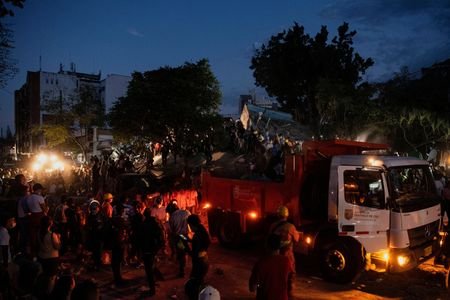
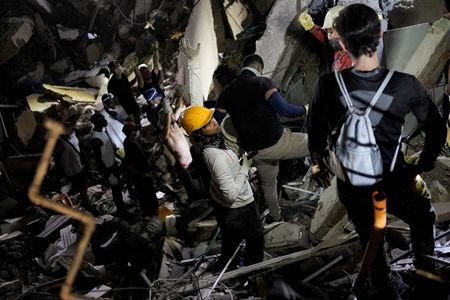
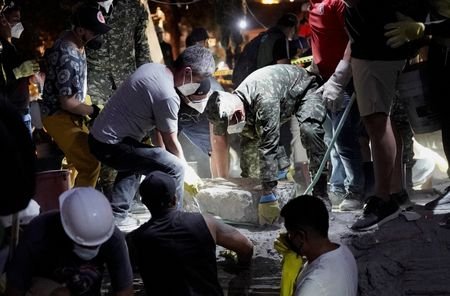
As night fell, rescue workers and volunteers with headlamps hurried to find people still trapped under rubble.
Authorities in Cali, Armenia and Manizales announced curfews, with Cali's mayor saying threats of looting had forced him to deploy police and military personnel to the streets. De La Espriella promised 1,000 additional security personnel for the city.
Cali authorities said the Petronio Alvarez festival, an annual celebration of Pacific music which was due to start on Wednesday, has been postponed.
Video broadcast by Caracol Television showed a group of people pulling a small baby covered in dust from under a pile of rubble. Caracol reported the six-month-old girl and her mother were rescued from under a five-story building in Cali.
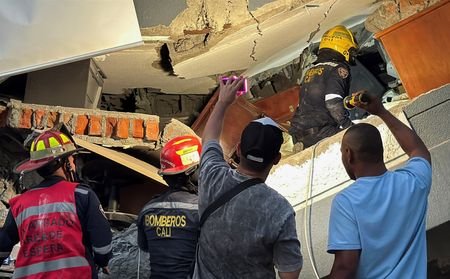
Video from Cali also showed rescue workers rappelling people out from the windows of a local hospital.
BUILDINGS CRUMBLE, AIRPORTS CLOSED
In the hard-hit city of Pereira, rescue workers told local television they were in contact with a young boy trapped under a bakery, and crane operators were working to remove badly damaged parts of buildings.
A four-story building crumbled in Pereira during the quake, according to Reuters-verified video, while footage from Manizales showed one of the side towers of the city's landmark neo-Gothic cathedral collapsing and scattering debris onto nearby streets.
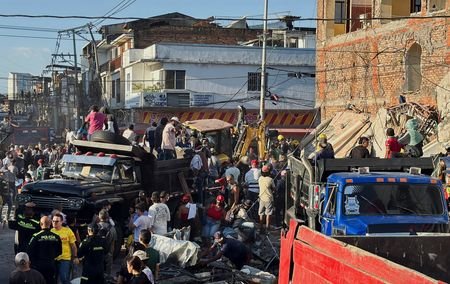
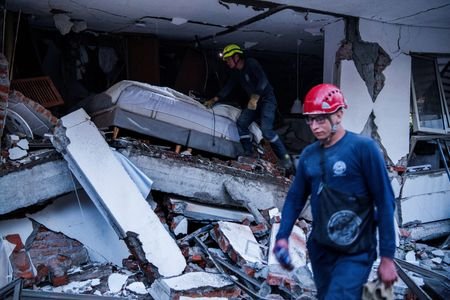
Reuters video showed rescue workers, police and volunteers shoveling debris by hand and loading rubble into trucks as they searched for survivors trapped beneath collapsed buildings. Other footage showed damage to residential towers and emergency-service facilities, with debris crashing onto ambulances parked below.
Mauricio Andrade, a firefighter in Cali, said his team had rescued two adult women and two children from a collapsed building. As he spoke to Reuters, his team was preparing to rescue more people from the rubble.
"They are alive," he said. "We are making space so we can free them and get them out."
Carmen Yasmin Garcia, 43, a Cali resident and rescue volunteer, said her group had helped seven people out of a fallen building but there were still four people and a dog trapped underneath.
"A moment ago there was scratching but now we can't hear anything, we still have faith that the dog is alive and we can get these people out," she said. "The more people lending a hand the better."
Saul Paz, 69, a resident of a Cali residential complex that partially collapsed, told Reuters he had been in the dining room with his son and wife when the shaking began.
"I think if it had lasted five seconds more there would be nothing left," he said. "There are people who went to bed last night with a house and a car and today they won't have anything."
Colombia's civil aviation authority suspended operations at several airports in the region, including Pereira, Manizales, Quibdo, Armenia, Cartago and Buenaventura, while engineers carried out structural inspections.
RING OF FIRE
Colombia sits along the seismically active Pacific Ring of Fire and records thousands of mostly minor earthquakes each month.
Northwestern University seismologist Suzan van der Lee said the quake's powerful magnitude, inland location and strike-slip motion may have amplified damage in populated valleys despite its considerable depth.
"This one was far below the crust, and in theory it shouldn't cause as much shaking. At this magnitude, it did actually cause a lot of shaking," she said, adding Colombia is particularly difficult for seismologists to analyze due to the interaction of several major tectonic plates.
The Colombian Geological Service said it had recorded 21 aftershocks by late Monday and warned that additional tremors were likely.
Colombia's coffee region was devastated by a magnitude 6.2 earthquake in 1999 that killed more than 1,000 people, particularly around Armenia and Pereira.
(Reporting by Nelson Bocanegra, Luis Jaime Acosta, Julia Symmes Cobb and Fabiola Aramburo; Additional reporting by Marco Trujillo in Cali and Sarah Morland in Mexico City, Writing by Kylie Madry and Daina Beth Solomon; Editing by Daniel Wallis, Paul Simao, Matthew Lewis and Lincoln Feast.)