(Corrects May 27 story headline and first paragraph to make clear Norway is to join France's nuclear deterrence initiative and not France's nuclear umbrella; edits paragraphs 9-10 to explain French initiative. The error was initially made in a news alert.)
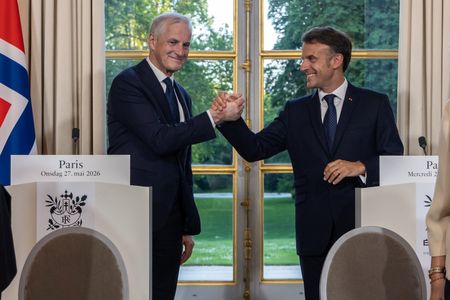
PARIS/OSLO, May 27 (Reuters) - Norway will open talks with France on boosting cooperation around French nuclear deterrence activities, President Emmanuel Macron and Prime Minister Jonas Gahr Stoere said on Wednesday, reflecting growing European concern about reliance on U.S. security guarantees.
The move signals a shift by Norway, long a staunch Atlanticist that has relied heavily on NATO and the U.S. nuclear umbrella, towards closer defence cooperation within Europe.
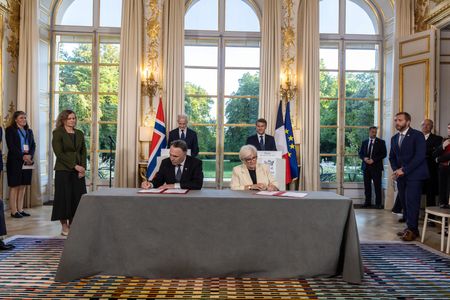
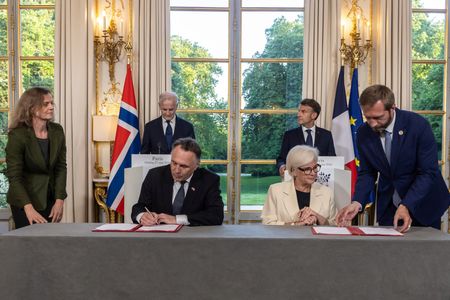
Macron and Stoere announced the plan at a meeting in Paris, where they also signed a broader defence agreement which includes Norway joining a French-led nuclear weapons initiative.
Stoere said Norway's primary deterrence would remain the NATO alliance and the United States, but described France's nuclear capabilities as "an important contribution" to the alliance's overall posture.
"France's capabilities are an important contribution to NATO's deterrence posture, which is important for us," Stoere said.
Under the plan, Norway would take part in what France calls "forward nuclear deterrence", under which European partners are more closely involved in French strategic thinking on nuclear defence.
"This agreement establishes a principle of mutual assistance between our two countries," Macron said, adding that deeper cooperation would support Europe's ambitions for greater strategic autonomy.
The initiative comes as European countries seek to strengthen their own defence capabilities amid doubts about long-term U.S. commitments and heightened tensions with Russia.
In March, France offered more nuclear deterrence cooperation with European allies, seeking to bolster the credibility of France’s nuclear arsenal beyond its borders. It proposes joint exercises, the possible short-term deployment of nuclear-capable assets on allied territory and deeper consultation.
The deterrence initiative stops short of offering a formal nuclear umbrella like the United States. Norway becomes the ninth country to sign up to the initiative, including Poland and Germany, according to French officials.
Stoere told Norwegian news agency NTB earlier on Wednesday that no nuclear weapons will be deployed in Norway in peacetime.
The Nordic nation of 5.6 million inhabitants is a member of NATO, but not of the European Union, and shares a border with Russia in the Arctic.
"This closer cooperation will make European and transatlantic security stronger. Together, we are enabling a burden shift. It was long before Trump that this became necessary, that Europe had to pay more and do ... wiser investments, not only country by country, but coordinated," Stoere said.
Russia and the U.S. are the world's biggest nuclear powers, with over 5,000 nuclear warheads each. China has about 600, France has 290 and Britain 225, according to the Federation of American Scientists.
(Reporting by Gwladys Fouche, Nerijus Adomaitis and Terje Solsvik in Oslo and Makini Brice in Paris; Editing by Aidan Lewis, Emelia Sithole-Matarise and Sanjeev Miglani)