By Trevor Hunnicutt
WASHINGTON, May 15 (Reuters) - U.S. President Donald Trump's two-day state visit to Beijing featured wide-ranging talks on Taiwan, Iran and trade with Chinese President Xi Jinping but yielded few concrete outcomes on the issues dividing the world's two largest economies.
Here are some takeaways from Trump's trip to China, the first by a U.S. president since 2017.
NO BREAKTHROUGH ON IRAN
Trump downplayed the need for China's help with Iran ahead of the trip, even as his aides said Beijing - a major buyer of Iranian oil - could play an influential role in brokering a path to ending a conflict that has created the biggest crisis of Trump's presidency.
The U.S.-Israeli war with Iran has crowded out other policy priorities, raised energy costs and weighed on Republican prospects ahead of November's midterm elections.
Trump ended his trip without any obvious sign of securing China's help, and it remains unclear how hard China is willing to push for Iran to do a deal or what it would want in return for its help.
Trump suggested he could ease sanctions on Chinese refineries that do business with Iran, potentially rolling back one of the few concrete steps the U.S. has taken to punish China for its support of Iran.
“We feel very similar,” Trump said on Friday as he met with Xi in a secretive Chinese Communist Party compound in central Beijing. “We want that to end. We don't want them to have a nuclear weapon. We want the straits open."
Xi said nothing. About the same time, the country’s foreign ministry issued a statement that sounded a different note: “This conflict, which should never have happened, has no reason to continue,” the ministry wrote, adding that it wants to help the parties find peace.
MORE PAGEANTRY THAN POLICY
Trump touted deals with Xi on Chinese purchases of farm goods, beef and Boeing aircraft, but the details were thin.
He departed Beijing without extending a trade truce due to expire later this year. Markets were disappointed that a deal reported by Trump for China to buy 200 Boeing jets wasn't bigger, and traders said U.S. soybean futures fell to their lowest level in more than two weeks on Friday after the summit failed to produce specific deals for American farm goods.
On major issues from expanding trade to artificial intelligence and Taiwan, the leaders appeared to have made little progress beyond agreeing to disagree and, perhaps, to keep talking.
The two countries agreed to set up separate boards to govern bilateral trade and investment, but Chinese Foreign Minister Wang Yi said officials from both sides were still working out details.
Unlike in 2017, the leaders made no joint public statement to the media. They didn’t release mutually agreed summaries of their meetings, nor a fact sheet detailing what came out of the talks. China’s public statements made little specific reference to purchase agreements or other commitments by Xi to the U.S.
A person familiar with the planning for the trip said there was little pressure within the White House to secure a big new deal.
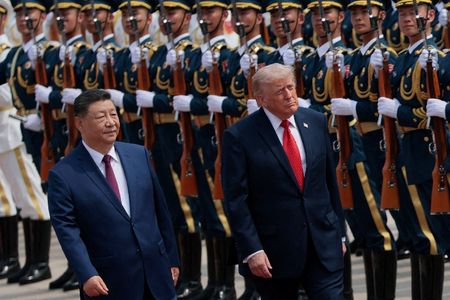
The pageantry outshone the policy. Xi treated Trump to goose-stepping soldiers and succulent preparations of Beijing beef but sent him home with little of substance to show for his journey.
STRATEGIC SILENCE ON TAIWAN
When Trump emerged from his first round of talks with Xi on Thursday, reporters wanted to know one thing. What did they discuss on Taiwan?
Standing at the ancient Chinese Temple of Heaven alongside Xi, a president known for his loquaciousness opted for an almost spiritual silence. Trump said nothing.
By that point, China had already released an extended summary of Xi’s own comments on Taiwan in the private meeting with Trump. The Chinese leader warned that mishandling the countries' disagreements over Taiwan, the democratically governed island claimed by Beijing, could push China-U.S. relations to a "dangerous place."
For much of the trip, Trump appeared inclined to maintain the United States' traditional “strategic ambiguity” on the topic.
As he headed back to Washington on Friday, he finally offered a bit more. In Trump’s telling, Xi wanted more information about where Trump stands on Taiwan, in particular if he would defend the island.
“I said I don’t talk about that," Trump told reporters aboard Air Force One.
Trump also did not commit to selling more arms to Taiwan, telling reporters he would decide later.
DISCIPLINED TRUMP
Trump often deviates from his prepared remarks to spin yarns, give advice, drop insults or tell jokes.
In Beijing, the Republican president stayed on script, including during a prewritten toast he delivered to Xi at a state dinner on Thursday.
A White House official said Trump was eager to pull off a summit that improved ties, and Chinese Communist Party officials are not well known for appreciating surprises during their highly choreographed events.
For his part, Xi paired gestures of friendship with pointed warnings, underscoring both cooperation between the two countries and their sometimes frosty ties.
"We must make it work and never mess it up," he said of the China-U.S. relationship.
HEADWINDS BACK HOME
Trump arrives back in the U.S. facing the same political quagmire that dogged him before the trip.
Gas prices, high. Inflation, high. Voter anger, high.
The U.S. president badly needed a win as his administration struggles to contain the political and economic fallout from the war with Iran. The highly anticipated visit may have offered a short-term distraction, but it likely will do little to shift the narrative.
(Reporting by Trevor Hunnicutt; Additional reporting by Andrea Shalal and David Brunnstrom; Editing by Colleen Jenkins and Deepa Babington)