By Shi Bu and Alessandro Diviggiano
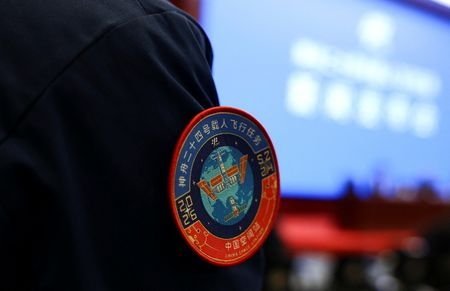
JIUQUAN, China, Nov 24 (Reuters) - When the Shenzhou-24 space flight takes off on Wednesday for China's Tiangong space station, it will be a moment of pride not just for China, but also for Pakistan.
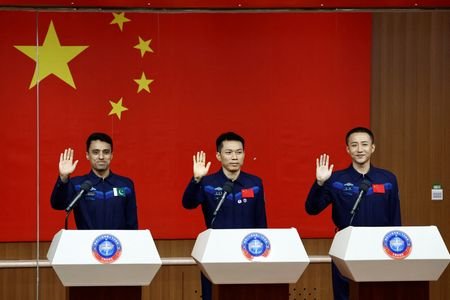
Zeeshan Ali, a 40-year-old pilot, is set to be the first Pakistani in orbit and the first foreign national to board the space station, as China makes new strides in space diplomacy.
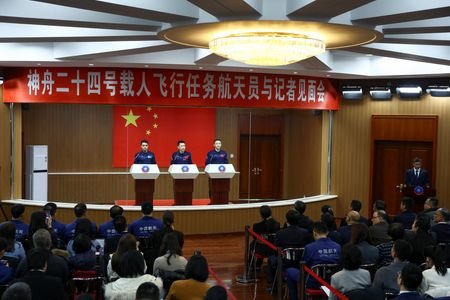
Part of a three-man crew that includes Chinese commander Tang Hongbo and flight engineer Wu Yi, Ali will work as a payload specialist and is set to stay at the station for 5 to 10 days, conducting experiments.
The launch of the spacecraft, which will use a Long March-2F rocket, is scheduled for 8:18 a.m. (0018 GMT) from the Jiuquan Satellite Launch Centre in northwest China.
To prepare for the flight, Ali trained for seven months in Beijing, during which he underwent intensive Chinese-language classes, learning Chinese songs and reading Chinese poetry. He also practised calligraphy and played table tennis.
"I'm not flying for myself. I carry the name of Pakistan on my shoulder," Ali told reporters.
Space cooperation between China and Pakistan dates back to the early 1990s. China has launched Pakistani satellites and a Pakistani-built rover is also set to fly on a Chinese lunar mission around 2028.
"China has always been very good at using space for soft power outreach," said Victoria Samson, chief director of US-based Space Security and Stability at the Secure World Foundation.
"See how many satellites it builds and launches for other countries, and how it builds telescopes and tracking centres in the Global South — so this is just one more action of that same genre," she said.
A LONG STAY FOR ONE CHINESE ASTRONAUT
While Ali's stay is much shorter than the usual six-month rotation for a Chinese astronaut, it is a big deal for Pakistan.
"It brings prestige, important science and technology know-how, and a level of deeper collaboration and diplomatic goodwill with China," said Blaine Curcio, founder of Hong Kong-based Orbital Gateway Consulting.
The mission underscores Beijing's vision to promote its Tiangong space station as a hub for international space cooperation as the NASA-led International Space Station (ISS) faces possible retirement by 2030.
"By having an international astronaut, China is making it clear that they are open for business," Curcio said.
China's self-built station, named Tiangong or Celestial Palace in Chinese, has been fully operational since late 2022. It can host up to six astronauts during handovers when an arriving three-person crew overlaps with the departing crew.
This time, the handover will be different.
Shenzhou-23 commander Zhu Yangzhu will stay on to support Beijing's study of how the human body copes in space — a crucial step towards a planned crewed mission to the moon and a potential journey to Mars. The rest of the Shenzhou-23 crew departs Tiangong alongside Ali.
Zhu, who will stay for a year, will hold the record for the longest single stay in orbit by a Chinese astronaut by the time he leaves, though that will fall short of the 14-1/2-month record set by a Russian cosmonaut in 1995.
China's goal of human presence on the moon by 2030 remains unchanged following the postponement of its Chang'e-7 lunar mission, which was delayed this year after failing to meet launch conditions amid adverse weather linked to a tropical storm.
It compares with the US target of 2028 to return humans to the moon amid a tense race for a moon base buildup, a stepping stone to eventual human exploration of Mars. China plans to establish a research base on the moon by 2035 with Russia.
Washington has warned that Beijing could seek to dominate access to resource-rich areas of the moon. Beijing rejects such allegations, saying it advocates peaceful use of outer space.
Flying to the moon was also on Ali's mind.
"I hope for the next chapter of China-Pakistan space cooperation to grow from one astronaut, one flight to multiple joint flights, to (the) moon, Mars and beyond," he said.
(Reporting by Shi Bu and Alessandro Diviggiano; Additional reporting by Liz Lee; Editing by Edwina Gibbs)