By Idrees Ali, Phil Stewart, Susan Heavey and Doina Chiacu
WASHINGTON, March 4 (Reuters) - U.S. Defense Secretary Pete Hegseth said on Wednesday that President Donald Trump had gotten the "last laugh" after the U.S. military killed an Iranian official who led an effort to assassinate him.
Hegseth used unusually colorful language to describe the four-day-old war on Iran and invoked Trump's name repeatedly as he said the Pentagon could sustain activity as long as necessary.
"They are toast and they know it. Or at least soon enough they will know it," Hegseth said of Iranian leaders. "America is winning - decisively, devastatingly and without mercy."
IRANIAN MAN CHARGED OVER ALLEGED TRUMP PLOT IN 2024
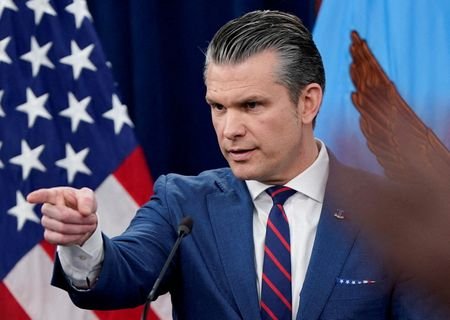
Hegseth, who wore a red-white-and-blue tie and pocket square, described the killing of an unnamed Iranian who headed a unit that attempted to assassinate Trump in personal terms, even as he stressed the official was not the initial focus of the war.
"Iran tried to kill President Trump and President Trump got the last laugh," Hegseth told reporters.
In 2024, the U.S. Justice Department charged an Iranian man in connection with an alleged plot ordered by Iran's Revolutionary Guard Corps to assassinate Trump, then U.S. president-elect.
Tehran has denied accusations that it had targeted Trump and other U.S. officials.
Trump cited the alleged Iranian plot when he spoke on Sunday about a joint U.S.-Israeli operation that killed Iran's Supreme Leader Ayatollah Ali Khamenei, saying to ABC News: "I got him before he got me."
Hegseth, however, said Trump never mentioned the effort to track down the plot leader as a priority for the Pentagon.
"While that was not the focus of the effort by any stretch of the imagination - in fact, never raised by the president or anybody else - I ensured, and others ensured, that those who were responsible for that were eventually part of the target list," Hegseth told reporters.
STRIKES DEEPER INSIDE IRAN
The war widened after a U.S. strike hit an Iranian warship off Sri Lanka, deepening a crisis that has paralyzed shipping through the Strait of Hormuz and choked off vital Middle East oil and gas flows.
Hegseth told reporters that the United States and Israel would have complete control of Iranian skies in a few days.
General Dan Caine, chairman of the Joint Chiefs of Staff, said at the briefing that U.S. strikes were expanding as the country establishes air superiority along the southern Iranian coast.
"We will now begin to expand inland, striking progressively deeper into Iranian territory, and creating additional freedom of maneuver for U.S. forces," Caine said.
He said Iran's launches of theater-wide ballistic missiles were down 86% from the first day of fighting and their one-way attack drone shots were down 73% from the opening days. He said U.S. strikes were expanding as the U.S. established localized air superiority across the southern Iranian coast.
Trump has suggested that the conflict with Iran could go on for four weeks. U.S. lawmakers from both major political parties have criticized the Trump administration for not spelling out a "day-after" strategy, which appears to largely hinge on the hope that the Iranian people will rise up and determine their own future after decades of repression.
"We can sustain this fight easily for as long as we need to," Hegseth said, adding that the only limit was Trump's desire to achieve specific objectives.
Only one in four Americans approves of U.S. strikes on Iran that have plunged the Middle East into chaos, while about half — including one in four Republicans — believe President Donald Trump is too willing to use military force, according to a Reuters/Ipsos poll.
At the White House, White House Press Secretary Karoline Leavitt said on Wednesday that ground U.S. troops were not part of the plan for Iran operations at this time and Trump believed that Americans support the military strikes.
(Reporting by Phil Stewart, Idrees Ali, Susan Heavey and Doina Chiacu, editing by Andy Sullivan, Michelle Nichols, Nick Zieminski and Alex Richardson)