By Marta Fiorin, Christian Levaux, Yves Herman and Kate Abnett
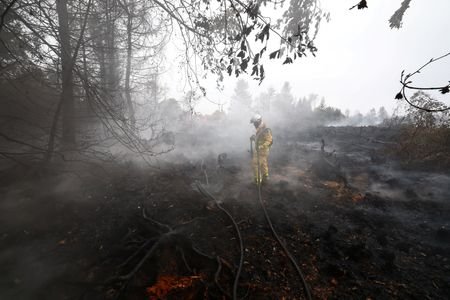
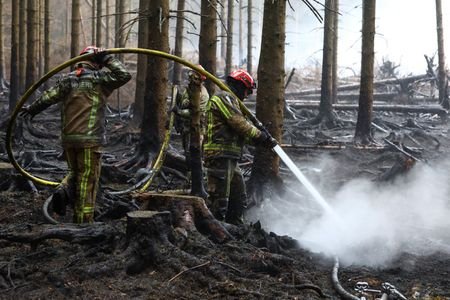
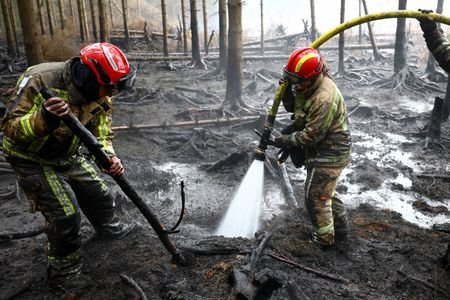
HIGH FENS NATIONAL PARK, Belgium, Aug 17 (Reuters) - Rain over eastern Belgium on Monday brought some relief to firefighters battling to contain the country's biggest wildfire on record, which had threatened to reach the German border.
Wildfires have ripped through Europe this summer, with successive heatwaves fuelled by climate change intensifying drought and leaving vegetation tinder-dry.
From France and Spain to Greece, fires have killed more than 20 people, forced hundreds of thousands to flee their homes and burned 576,000 hectares (2,225 square miles) across Europe this year, data from the European Forest Fire Information System shows - an area twice the size of Luxembourg.
ARMY, FARMERS BATTLE BELGIUM'S BIGGEST FIRE
In Greece, an elderly couple died at the weekend as fires swept through the island of Salamina, where 500 people were evacuated by ferry after wind pushed the flames into residential areas.
Spanish firefighters stabilised a massive wildfire in Andalusia in the south that has burned nearly 40,000 hectares (98,842 acres)since August 6, while a fire in the tourist town of Omis, Croatia, forced 1,000 people to flee.
In Belgium, firefighters aided by rain and lower temperatures early on Monday had contained parts of the blaze in the High Fens, a nature reserve in the east of Belgium which has been burning since Friday - following a heatwave that saw thermometers in parts of Belgium hit 37 degrees Celsius (98.6 degrees Fahrenheit).
"This is the biggest ecological disaster in terms of forest fires, that's clear, for Belgium," said Nicolas Yernaux, a spokesperson for the administration of the Wallonia region.
"We can't say that the fire is contained. It flares up all the time," he told Reuters.
Some 500 firefighters from across Belgium, neighbouring Germany and Luxembourg, as well as farmers, soldiers and reinforcement aircraft from the European Union's emergency reserve, have been battling the blaze.
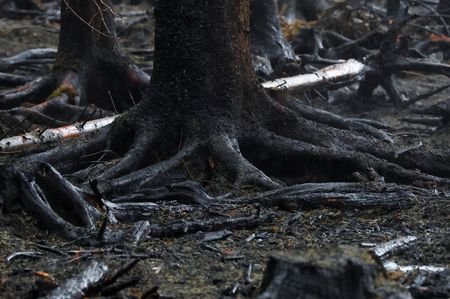
Having burned 3,000 hectares (7,400 acres), the wildfire is Belgium's biggest on record, far surpassing a blaze in 2011 which burned close to 1,400 hectares. Evacuated residents have not yet been allowed to return home.
The fire has penetrated the nature reserve's metres-deep peat bogs - meaning it could take months to fully extinguish. Peat fires can smoulder underground, without flames, for long periods.
EUROPE'S FIRE SEASON FAR FROM OVER
Extreme fire risk has become a regular part of European summers in recent years, as hotter, drier weather caused by climate change has combined with other factors – including rural abandonment, which has left land untended and allowed flammable, dry vegetation to build up in forests – to fuel fast-spreading fires.
Fires were also raging on Monday in northeastern Spain, where a firefighter died on Sunday, and in northern Portugal's Braganca district.
About 90% of wildfires are ignited by human activities, such as campfires or discarded cigarettes. Prosecutors in Belgium have opened an investigation into the cause of the blaze.
German firefighters were also working to contain a fire front 1.5 km (0.9 miles) away from buildings in the evacuated German village of Ruitzhof, close to the Belgian border. A local fire department spokesperson said the situation was "static".
Europe had already suffered its worst fire season on record last year, with more than a million hectares of land burned. Some countries, including France, have smashed through their annual records this year, with the traditional June-September fire season far from over.
Dozens of people in the village Le Porge, in southwestern France, where hundreds of homes were destroyed by a megafire last month, booed French Prime Minister Sebastien Lecornu as he visited on Monday. Residents have criticised the government's response and accused authorities of prioritising richer areas.
(Reporting by Bart Biesemans, Yves Herman, Inti Landauro, Kate Abnett, Andreas Kranz, Petra Wischgoll, Ivana Sekularac, Andrey Khalip; Editing by Toby Chopra, Alex Richardson and Helen Popper)