(Corrects descriptions of sub-indexes of deprivation in 14th and 15th paragraphs)
By Andy Bruce and Sophie Royle
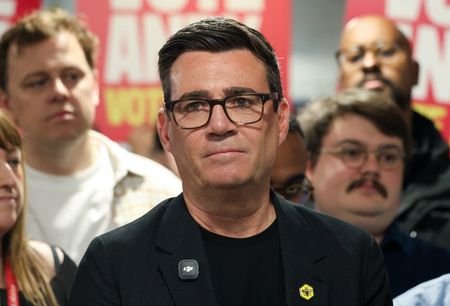
ASHTON-IN-MAKERFIELD, England, June 15 (Reuters) - If Andy Burnham wins Thursday's election in Makerfield, the seat he needs to challenge Prime Minister Keir Starmer for the country's leadership, it may have less to do with his own appeal than the feuding of two populist right-wing parties splitting their vote.
The election is shaping up to be one of the most consequential one-off contests in modern British political history. The 77,000 voters who live in Makerfield, in northern England, could decide the identity of the prime minister governing almost 70 million people.
Opinion polls show Burnham, currently the governing Labour Party's mayor of Greater Manchester, could win because the populist right-wing vote is likely to be divided between two political parties led by two men who used to be colleagues before an acrimonious split last year.
Peter Thompson, who runs a record shop in Ashton-in-Makerfield, said he would vote for Nigel Farage's Reform UK party, but he feared the decision by Restore Britain, led by Rupert Lowe, to stand in the contest could allow Burnham to win.
"All my voting in life there's only been two parties that have run this country, Labour and Conservatives. Look around you, it's a mess," the 78-year-old said, describing how Britain's politics has fractured into more parties and independent representatives than ever before.
"If it was a straightforward fight, I think Reform may well edge it but because there's that many parties that you can vote for now, I think it will swing it to Labour's advantage, unfortunately."
BURNHAM BACKING 'BUSINESS FRIENDLY SOCIALISM'
Opinion polls in the constituency point to a Labour lead of between five and 12 points over Reform, although by their nature these surveys are prone to large degrees of error.
Labour won the seat in the 2024 general election by 13 points over Reform. Lawmaker Josh Simons announced last month that he was stepping down to make way for Burnham to contest the seat and potentially challenge Starmer from within parliament, as Labour rules require.
Reform and its splinter party Restore - born out of the feud between Farage and Lowe - both pitch themselves as anti-establishment parties with hardline immigration policies, Restore's extending to mass deportations.
With opinion polls showing Restore averaging 7%-8% support in Makerfield, it is seriously undermining Reform's hopes for the seat.
Farage said last week it was a two-horse race and that voting for Restore risked letting in "perhaps the most left-wing prime minister of modern times".
Burnham's pitch to voters leans on a narrative of post-industrial neglect following the decline of the area's mining and manufacturing industries.
"It all adds up to 40 years of neoliberalism that have not been kind to the North of England. Forty years of trickle-down economics that did not again trickle down very much at all," Burnham said last month as he kicked off his campaign.
Official figures paint a more nuanced picture. Makerfield sits in the middle of the national deprivation rankings on income, but fares relatively poorly on employment and health.
Where it scores better is access to housing and services, a domain that happens to sit at the heart of Burnham's own "Manchesterism" vision for Britain, which he describes as "business friendly socialism".
PLACARDS SHOWING SUPPORT FOR REFORM
"It is a seat of aspirational middle-class commuters, as much as anything," Rob Ford, professor of politics at the University of Manchester, told Blonde Money, an independent financial and political consultancy firm.
"It is 'Red Wall' in its heritage and identity, it is not Red Wall in terms of the kind of people who live here," said Ford, referring to the traditionally working-class Labour-held northern seats, many of which swung briefly to Boris Johnson's Conservatives in 2019, and are now prime Reform targets.
Reform swept 24 of 25 Wigan Borough Council seats - which includes the Makerfield area - in local elections May 7, leaving Labour's hopes for this campaign resting almost entirely on Burnham's personal appeal.
On the streets, there are generally more placards that show support for Reform than Labour, especially in the more working-class areas such as the Stubshaw Cross estate.
The Labour Party has thrown vast resources at defending the seat from Reform, evidenced by flying visits from cabinet ministers and well-known lawmakers joining leafleting efforts.
While Burnham's mayoral brand was built on local transparency and accessibility to the media, his return to national politics is being managed under strict parameters dictated by London-based party fixers - a sign of the high stakes at play.
For all the Westminster machinations and Burnham's grand designs, the seat will ultimately be decided by voters like Neil Price, 41, a local bricklayer.
"I'm going to be voting for Andy Burnham. I know he does a lot for the community round here. He does well with everything he talks about ... so yeah, he's the one I'm going to be voting for."
(Writing by Andy Bruce;Editing by Alison Williams)